


Methods for Designing Enterprise Architecture in Manufacturing Companies |
EAM as enabler for the design of transferable AI solutions

| Journal | Industrie 4.0 Management |
| Issue | Volume 39, 2023, Edition 1, Pages 37-42 |
| Open Access | https://doi.org/10.30844/I4SE.23.1.106 |
| Bibliography | Share | Cite | Download |
Abstract
Keywords
Article
Enterprise Architecture Management (EAM) can be used to create transparency and alignment between different use cases, processes and IT systems. On the one hand, EAM is an essential prerequisite for creating data consistency in the IT system landscape. On the other hand, EAM helps to gain an overview of a highly complex data and application landscape and thus efficiently plan the use, transferability and reusability of AI solutions. This article will discuss findings from within this area of tension between agility and architecture management.
Avoiding isolated solutions – designing holistically
Complexity in the manufacturing industry is increasing. This is driven by complex products, growing individualization efforts, and a resultant larger variety of product variants. Additional factors that are increasing complexity include heightened requirements for sustainable manufacturing practices and growing uncertainties in the supply chain. These global drivers result in an increased need to make today’s factory planning, production and logistics processes more flexible, robust, and efficient. Targeted use of AI solutions offers considerable potential in this area.
The German industry association BITKOM defines AI as “the ability of an IT system to show ‘human-like’, intelligent behavior” [2]. We understand “human-like” as the capacity to solve complex tasks and be adaptable. Image-based quality control of manufactured goods, predictive maintenance for factory machinery and plant technology or the prediction of delivery dates are examples of ways AI can be used within manufacturing and logistics. Often, though, individual solutions are developed, and these are then viewed in isolation from a factory’s existing IT systems. The reason this occurs is because AI pilot projects often involve rapid and agile development in order to quickly leverage potential in affected processes.
The development of AI solutions in a manufacturing context requires extensive pilot project iteration, which typically starts with the development of a proof of concept (PoC). This proves the basic feasibility of a technical solution in the real application environment. The PoC is iteratively validated and further developed, and this process usually occurs and is implemented within an agile software development and IT context. Possible consequences that may occur are:
- Bypassing interfaces in peripheral IT systems such as MES or ERP,
- Creation of new data pools by collecting necessary data (e.g. via additional sensor systems),
- Redundant programming of basic functions that have long existed elsewhere,
- Lack of clarity regarding who is responsible in the event of an error, as well as for the maintenance and further development of the resulting solutions.
For these reasons, many AI solutions do not make it past the prototype stage.
When taken separately, isolated solutions can indeed make the affected processes more efficient. However, their transferability is extremely limited. In order to develop transferable solutions, clarity regarding existing IT systems and the processes in which they are used is essential. Aligning use cases with processes and the IT system landscape makes it clear when an AI solution can and should later be transferred into additional processes.
Furthermore, clarity regarding the connections between IT systems and processes is useful in the management and maintenance of developed AI applications while these are in use. Without appropriate clarity, the operative efforts for the software can offset any process improvements created by a stand-alone AI solution. In addition to an operating environment for AI models, an additional digital environment that enables E-learning for the AI solutions is often required. This is intended to ensure that the AI continues to adapt in the face of changing data. Embedding the selected E-learning solution into the IT system landscape represents yet another challenge.
Companies must find and implement their own solutions to resolve the outlined area of tension between encouraging agile development of PoCs for data-driven solutions and taking into account all requirements for integrating the solutions into the IT system landscape. The aim is to maintain and further develop a consistent IT system landscape. But consideration of all requirements must not serve to limit the agility of individual projects. The following result must be avoided at all costs: A large project developed over a long period of time using the waterfall method, whose data-driven solutions meet neither the user requirements nor the requirements for integration into the IT system landscape. In order to master the balancing act between speed, agility, transferability and reusability, a holistic approach is necessary. Enterprise architecture management (EAM) can be a suitable approach that meets these needs and supports the development and implementation of transferable AI solutions.
Enterprise Architecture Management – an industry heavyweight
Lankhorst [3] defines enterprise architecture as “… the sum of the principles, methods and models that underlie the design and implementation of the organizational structure, business processes, information systems and infrastructure.” In other words, the goal of EAM is to optimize the alignment between the strategic goals of a company, its business processes, and its IT system landscape. EAM thus supports companies in structuring their strategic goals and the corresponding drivers for these as well as in aligning their business processes accordingly. At the same time, the EAM approach supports the logical conception and technical infrastructure planning of IT systems, insofar as these are linked to the overarching business logic. In this way, consistency and goal orientation can be ensured at all levels, meaning EAM can provide a remedy for the challenges surrounding the development and implementation of transferable solutions.
The EAM management approach is now based on frameworks such as TOGAF, DODAF or UAF. It is in the nature of these frameworks to provide a broad scope for orientation, which is often deliberately kept very abstract. Tailoring is thus required to be able to use EAM well in practice. TOGAF is a widely used framework and often serves as a basis for companies practicing EAM. The fact that there are over 120,000 TOGAF-certified enterprise architects worldwide is proof of the framework’s popularity [4]. The following sections will delve into what a tailoring TOGAF framework can look like and discuss the work done thus far within the German research project “Datenfabrik.NRW – Artificial Intelligence in the Production of Tomorrow”. We will then discuss how EAM is used to ensure the transferability and reusability of AI solutions.
Making EAM manageable
The TOGAF framework states that EAM components must be interpreted and defined in an organization-specific manner [5, 6]. The basis for this is an extensive and highly abstract standard work. This means that transferring and customizing the content to fulfill the specific challenges and problems faced by the project and company is therefore crucial.
Customization for use in corporate practice, especially in SMEs with limited resources, can be developed using the tailored EAM design procedure shown in Figure 1. The procedure consists of three consecutive phases and is explained below using the Datenfabrik.NRW project as an example.

The first phase is a preparatory step, entailing classic project definition wherein the project goals, participants and structure are defined. The result of this phase is a project plan with detailed Statement of Architecture Work as well as a schedule and project description. This shows the contents of the project plan in a concise, abbreviated format and serves as orientation for the project manager, steering committees and project employees during the course of the project.
Using the example of Datenfabrik.NRW, this phase saw the definition of 14 work packages across three so-called Transformation Areas, each corresponding to a factory area of the same name: Production Engineering, Manufacturing, and Logistics. The project aims to create data-driven or AI solutions in all three areas. The challenges mentioned earlier with regard to the risk of isolated solutions are to be addressed in a fourth Transformation Area, titled Data-driven Enterprise Architecture. This is where the manufacturing and digitalization strategies of the project stakeholders are aligned with the process landscape and information architecture.
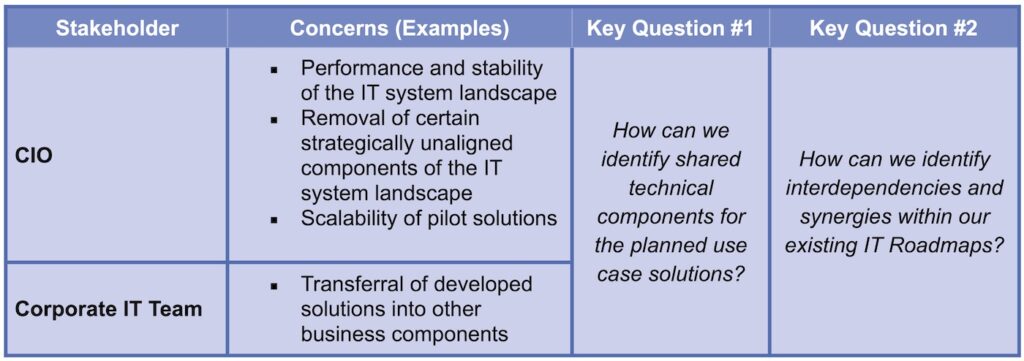
In the second phase of the procedure (Fig. 1), it is important to identify the stakeholders of the project with the aim of understanding their concerns [7] and deriving key questions from them that are to be answered through the use of EAM. Stakeholder concerns relate to the AI system set to be developed, the influence of the AI system on the system environment (consisting of technological, business, operational as well as organizational aspects) and on the prevailing corporate political conditions [8]. This phase results in a catalog of questions that serves as the basis for the development of a tailored system for the EAM project. An excerpt of the stakeholders identified, their concerns and the corresponding key questions that were developed in the Datenfabrik.NRW project is shown in Figure 2.
Based on the questionnaire, the third phase of the phase milestone diagram (Fig. 1) is to identify which elements and components of various common EAM metamodels should be used to answer the key questions for the project. The resulting tailored system is presented in the next section.
Agile for individual solutions – consistent for the IT landscape
The system consists of four main components: a metamodel, a fit gap analysis, appropriate tool support, and a concept for collaborative work. The first and most central component of the system is an adapted metamodel (Figure 3) based on the Archimate metamodel [9]. The metamodel developed contains the relevant modeling elements and causal relationships that are needed to answer the key questions (Figure 2). This keeps the effort required for training project members to a minimum and maintains the readability of the formal modeling language. The elements, which are initially restricted to processes, business events, business roles, business objects, data objects, and IT components, limit the complexity of the resulting models. This makes it easier to communicate both the model and the underlying concepts to project stakeholders at different hierarchical levels.
Communication regarding the model should also be simplified by implementing a hierarchical structure for the process landscape. Core processes are at the top level, as these show the company’s relevant end-to-end processes. Below this, the end-to-end processes are broken down into their sub-process steps. The use-case specific target processes are at the lowest level. In this way, a key question like “How can the affected processes and the effects this will have on them be identified?” is addressed. Key questions like this one can result from the concerns of stakeholders, especially factory management, business process owners or application owners.
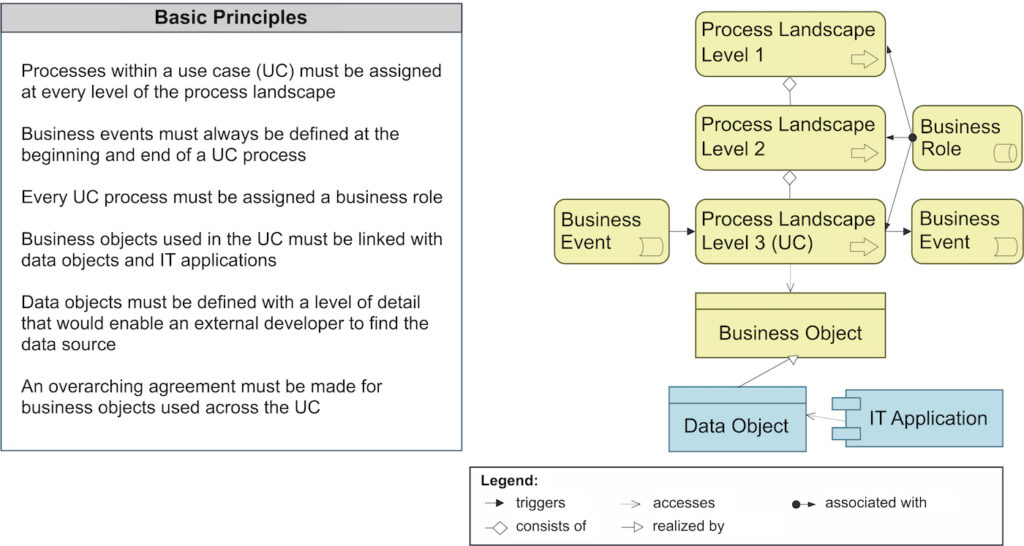
The streamlined metamodel is also accompanied by so-called Basic Principles (Figure 3). Each use case process must be assigned to the two levels above it in the process landscape. In addition, the business objects used in a use case must be linked to the necessary data objects. The level of abstraction or detail used for the modeled elements must be chosen so that a developer who is unfamiliar with the specific concept can still identify the data sources and understand the target functions.
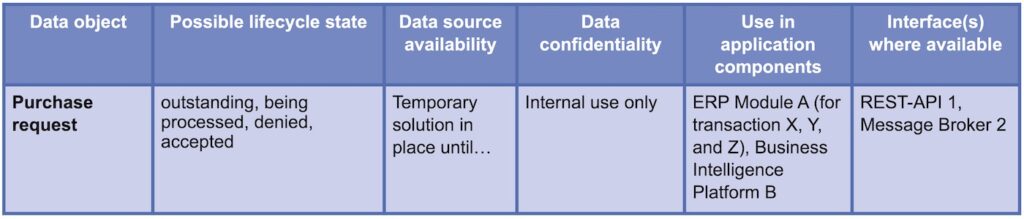
If these and other basic principles are followed and an appropriate modeling tool is used, a data catalog can be automatically generated to identify synergies between the use cases (Figure 4). This catalog presents information about the data and business objects, their possible life cycle states, data source availability, confidentiality or data protection needs, use in application components, and the employed interface.
Based on the data catalog, clusters are then formed by combining data objects with similar properties. For each cluster formed, analysis must be conducted to determine whether a common technical solution can be found.
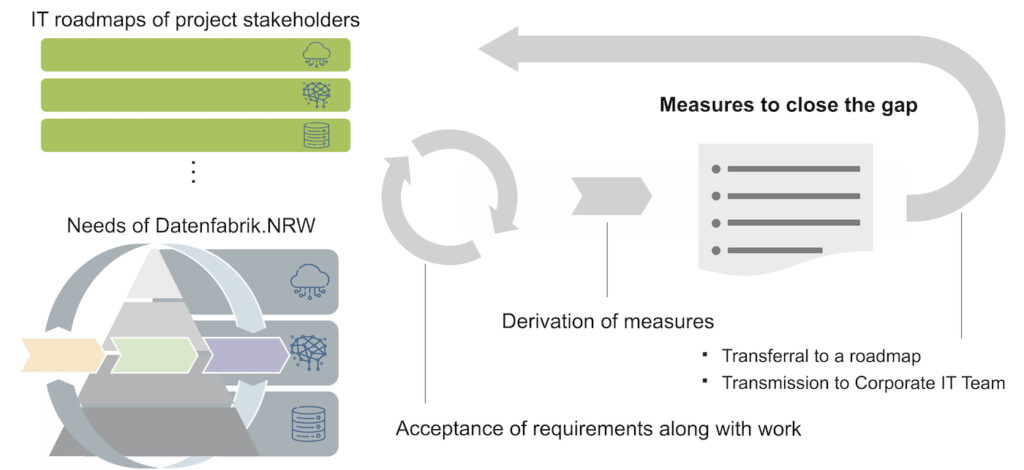
The clusters formed here become the basis for the following fit gap analysis (Figure 5). This represents the third component of the system based on Kreikebaum [10]. As part of the analysis, the corporate IT roadmaps are first mapped onto end-to-end processes. This clarifies how they will influence the use cases undergoing implementation. The roadmaps can then be compared with the “Use in Application Components” and “Interface(s) where available” columns of the data catalog. This then allows digitalization measures missing from the corporate IT roadmaps to be identified and specified below. Finally, the intersection of the strategic roadmaps, the project plan, and the derived measures creates a roadmap for the further development and enrichment of the IT system landscape.
In the case of Datenfabrik.NRW, one result of this analysis was the introduction of a central data storage for image data from quality assurance (work package: Smart Quality and Approval) as well as for goods receipt (work package: AI for Inbound Logistics) and load carrier tracking (work package: Internal Transport). Establishment of a centralized data storage area to simplify the handling of image data from various data-driven applications is also underway. Furthermore, the development process of any future AI solutions is streamlined because the data storage and the interfaces here can be reused. This makes it easier to transfer an AI solution, e.g. for quality inspection at one workplace, to other workplaces in a plant.
In addition to the image database, an infrastructure for the usage of and E-learning opportunities for the image processing models completes the IT roadmap. As a result, the corporate IT teams of the project stakeholders can create the right conditions to enable transferability of future AI solutions, while the project teams in agile development can ensure that the needs of the end users (e.g. workers or warehouse employees) are fully met.
Tool support is required to assure that the synchronization between the activities in solution development and the fit gap analysis takes place with as little effort as possible. Since several AI projects usually run in parallel and all need to be embedded in the company model, a concept for collaboration and versioning of the resulting models is also required. The right combination of both components offers the possibility of decentralized and asynchronous modeling and the automatic fit gap analysis derivation, which then only needs to be accompanied by synchronization workshops at certain points. In the Datenfabrik.NRW project, the Archi open source tool was used with a collaboration plugin for this purpose. The storage and versioning of models is being organized in a Gitlab repository.
Designing efficient, transferable AI solutions with EAM tailoring
In summary, the Enterprise Architecture Management approach provides a good foundation for the development, implementation, and transfer of AI solutions. To this end, activities for solution development and implementation must run in parallel and be regularly synchronized with activities for planning and controlling the IT system landscape. This ensures the efficient transferability of the resulting data-based solutions. In order to use the very comprehensive EAM framework TOGAF in practice, an individualized tailoring to the company and project context is necessary.
This article explained the tailoring process employed by the Datenfabrik.NRW project. The combination of methodological tools (data catalog and fit gap analysis) along with a collaboration concept and corresponding tool support were also explained. This approach will be used and further developed over the next three years with a project team of around 50 people in 14 work packages.
This article was created as part of the project “Datenfabrik.NRW – Artificial Intelligence for the Production of Tomorrow”, an AI flagship project funded by the Ministry of Economics, Industry, Climate Protection and Energy of the State of North Rhine-Westphalia.
Bibliography
[1] BITKOM-Verband: Leitfaden – Künstliche Intelligenz verstehen als Automation des Entscheidens. URL: www.bitkom.org/sites/default/files/file/import/Bitkom-Leitfaden-KI-verstehen-als-Automation-des-Entscheidens-2-Mai-2017.pdf, Abrufdatum 20.10.2022.[2] acatech – Deutsche Akademie der Technikwissenschaften; Plattform Lernende Systeme: Leitfaden – Führung im Wandel: Herausforderungen und Chancen durch KI. URL: www.plattform-lernende-systeme.de/files/Downloads/Publikationen/AG2_WP_Fuehrung_im_Wandel.pdf, accessed Oct 20, 2022.
[3] Lankhorst, M.: Enterprise Architecture at Work – Modelling, Communication and Analysis, 4th edition. Enschede Berlin 2017.
[4] The Open Group: Directory of Certified People. URL: togaf9-cert.opengroup.org/certified-individuals, accessed Oct 20, 2022.
[5] The Open Group: TOGAF Standard 10, Chapter 1: Architecture Development Method (ADM). URL: pubs.opengroup.org/togaf-standard/adm/chap01.html, accessed Oct 20, 2022.
[6] The Open Group: TOGAF Standard 10, A Practitioners’ Approach to Developing Enterprise Architecture Following the TOGAF® ADM. URL: pubs.opengroup.org/togaf-standard/adm-practitioners/adm-practitioners_5.html#_Toc95288825, accessed Oct 20, 2022.
[7] The Open Group: TOGAF Standard 10, Chapter 2: Architecture Content. URL: pubs.opengroup.org/togaf-standard/architecture-content/chap02.html#tag_02, accessed Oct 20, 2022.
[8] The Open Group: TOGAF Standard 10, Chapter 3: Introduction and Core Concepts. URL: pubs.opengroup.org/togaf-standard/introduction/chap03.html#tag_03, accessed Oct 20, 2022.
[9] The Open Group: ArchiMate 3.1 Specification, Kapitel: Generic Metamodel. URL: pubs.opengroup.org/architecture/archimate3-doc/chap04.html, accessed Oct 20, 2022.
[10] Farwick, M.; Hauder, M.; Roth, S.; Matthes, F.; Breu, R.: Enterprise Architecture Documentation: Empirical Analysis of Information Sources for Automation. In: Hawaii International Conference on System Sciences (HICSS 46). Maui, Hawaii 2013.
[11] Kreikebaum, H.; Gilbert, D. U.; Behnam, M.: Strategisches Management. Stuttgart 2011. [12] Innovator: ArchiMate®-Spezifikation der The Open Group. URL: help.innovator.de/Enterprise/de-de/Content/InoConf/ArchiMate_TOGAF_Specification.htm, accessed Oct 20, 2022.
Your downloads
