How to Change Cost-Effectively

A method for the appropriate design of transformability

JournalIndustrie Management
Issue Volume 20, 2004, Edition 2, Pages 12-16
Share Cite Download

Abstract

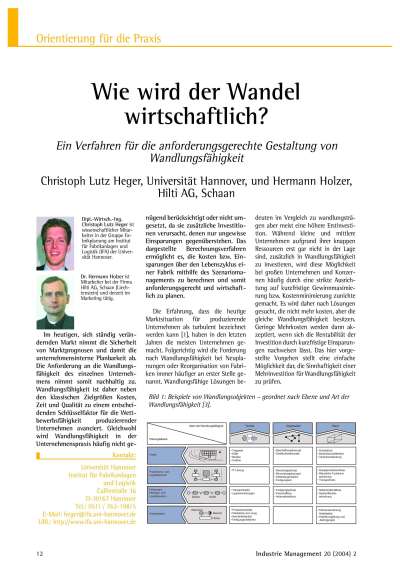
In today’s changing market forecasts have become much less certain, thus seriously affecting in-house planning. The need to be able to adapt, on the other hand, is increasing. Transformability has therefore become a decisive key factor in the competitiveness of manufacturing companies in addition to the classical target factors of costs, time and quality. Nevertheless, transformability is seldom taken into sufficient consideration or implemented in practice, for it requires additional investments and the returns are not always clear. This paper describes a method that makes it possible for companies to calculate the relevant costs of changeability using the technique of scenario planning.

Keywords

Your downloads


You might also be interested in

MAKI—A Digital Assistant for Practice-Based Learning

MAKI—A Digital Assistant for Practice-Based Learning

Why every factory is a learning factory
Olaf Resch ORCID Icon
With the help of digital assistants, academic teaching is possible in any factory. In order to achieve the best learning effects, however, the interests of all stakeholders must be taken into account. The factory wishes to deploy its employees quickly and productively, the learners desire a positive learning experience, and the educators want to illustrate abstract concepts in a meaningful and practical way. The only way to combine all of these perspectives is via a well-thought-out educational concept and highly functioning technology.
Industry 4.0 Science | Volume 42 | 2026 | Edition 2 | Pages 70-77
Conducting Experiments in Hybrid Learning Factories

Conducting Experiments in Hybrid Learning Factories

The example of the InTraLab Potsdam
Industrial production is undergoing rapid transformation through digitalization, automation and cyber-physical systems, creating new competence requirements for employees. Learning factories provide experiential environments for developing these competences. This article presents the Industrial Transformation Lab (InTraLab) as a hybrid learning factory combining physical demonstrators and digital simulations.
Learning Factories for the Future of Manufacturing in Brazil

Learning Factories for the Future of Manufacturing in Brazil

Advancing manufacturing through technology and skills development
Manufacturing firms in developing countries face challenges in closing productivity gaps while adopting Industry 4.0 technologies. Learning factories are one helpful approach to countering these challenges. One such example is the learning factory Fábrica do Futuroin São Paulo, Brazil, which has engaged students, supported competence development, and collaborated with industry in applied research, functioning as a hub for advanced manufacturing initiatives.
Serious Gaming and the Energy Transition

Serious Gaming and the Energy Transition

Collaborative knowledge generation and interactive understanding of complex interrelationships
Janine Gondolf ORCID Icon, Gert Mehlmann, Jörn Hartung, Bernd Schweinshaut, Anne Bauer
Conveying the complexity and multifaceted nature of the energy transition to a broad audience is a challenge. This article demonstrates how interactive serious games on a multitouch table can help make connections tangible and comprehensible. The games and the table were used in various conversational contexts. These are presented here in three case vignettes based on participant observation of the different applications, as well as situated and shared reflection. The vignettes demonstrate how interaction can trigger epistemic processes, enable shifts in perspective, and foster collective thinking, all of which are necessary for shaping the future of society as a whole.
Industry 4.0 Science | Volume 42 | 2026 | Edition 2 | Pages 62-69
Industrial Transformation via a Machining Learning Factory

Industrial Transformation via a Machining Learning Factory

A learning module to foster competencies for a sustainability-driven transformation
Oskay Ozen ORCID Icon, Victoria Breidling ORCID Icon, Stefan Seyfried ORCID Icon, Matthias Weigold
Sustainability-enhancing transformation processes are necessary in all sectors if we are to remain within planetary boundaries. This also applies to the industrial sector as a significant emitter of greenhouse gases. Employees need new competencies to master this complex task of industrial transformation. These range from CO2 equivalents accounting to the development and evaluation of transformation scenarios, including technical measures. The learning module developed here addresses these competency requirements and uses the example of the ETA factory to show how a competency-oriented learning module for industrial transformation can be structured. It essentially comprises four phases: data collection and CO2 equivalents accounting, cause analysis, development of measures and evaluation of measures.
Industry 4.0 Science | Volume 42 | Edition 2 | Pages 38-47 | DOI 10.30844/I4SE.26.2.38
Data Quality and Domain Expertise for Resilient AI Deployment

Data Quality and Domain Expertise for Resilient AI Deployment

Integrating anomaly and label error detection in industry
Pavlos Rath-Manakidis, Henry Huick, Erdi Ünal, Björn Krämer ORCID Icon, Laurenz Wiskott ORCID Icon
AI implementation transforms work and worker-technology relationships in industrial quality control. This paper explores how approaches to data quality and model transparency support ethical AI deployment, fostering worker agency, trust, and sustainable work design in automatic surface inspection systems (ASIS). Recurring problems like data inefficiency, variable model confidence, and limited AI expertise point to key challenges of human-centered AI: user trust, agency and responsible data management. A solution co-developed with an ASIS supplier demonstrates that the challenges extend beyond the purely technical, underscoring the value of AI design that augments human capabilities. Technical solutions such as anomaly, label error, and domain drift detection are proposed to enhance data quality and model reliability. The insights emphasize the following generalizable strategies for resilient AI integration: understanding user-reported problems through a human-AI interaction lens, ...
Industry 4.0 Science | Volume 42 | Edition 1 | Pages 128-135 | DOI 10.30844/I4SE.26.1.120