Serious Gaming and the Energy Transition |
Collaborative knowledge generation and interactive understanding of complex interrelationships

| Journal | Industry 4.0 Science |
| Issue | Volume 42, 2026, Edition 2, Pages 62-69 |
| Bibliography | Share | Cite | Download |
Abstract
Keywords
Article
The energy transition is a challenging technical undertaking, a social learning process, a political strategy, and a societal question of shaping a resource-just, sustainable future [1]. It is therefore described as a socio-technical transformation in which technical, societal, individual, and collective decision-making and implementation issues are intertwined [2]. Sustainable implementation requires the cooperation of many stakeholders [1, 2, 3]. But how can this complexity be discussed without oversimplifying it? This question arises whenever different stakeholders engage in dialogue about energy systems, policy governance, and individual options for action [1, 4, 5].
This article reports on the application of a game concept for the energy transition, based on the concept of serious games, on mobile multi-touch tables. The games and the accompanying table were further developed and promoted as part of the Kopernikus project ENSURE, funded by the BMFTR. ENSURE is an interdisciplinary consortium dedicated to researching issues related to power grids in the energy transition [6]. Over the past eighteen months, the tables and games have been used in various contexts to visualize system interrelationships and stimulate discussion.
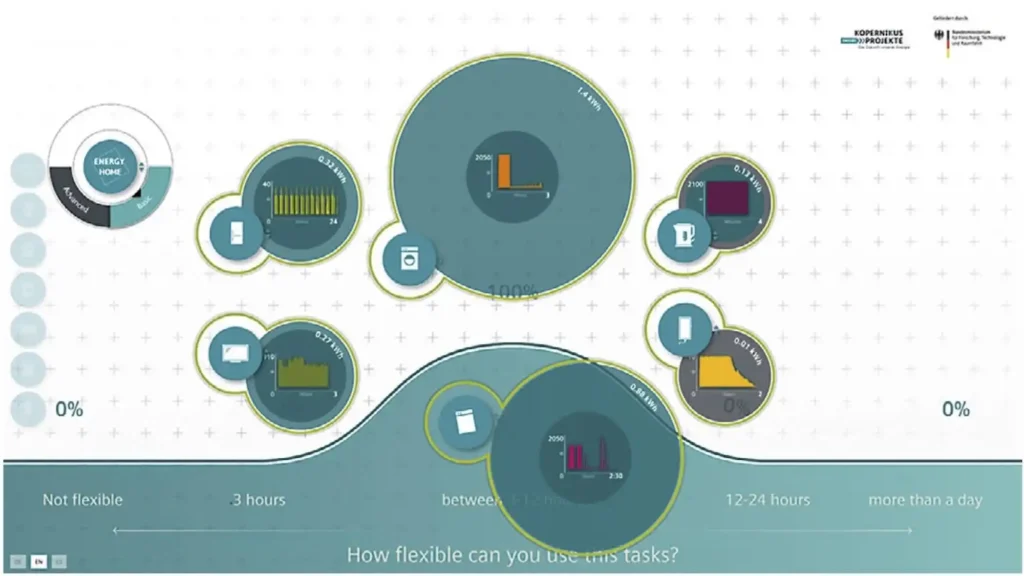
In 21 smaller sessions with 5 to 15 participants, the games were played for 1.5–2 hours at varying levels of depth. At eleven events lasting several hours, the table and games were used for interaction with all attendees who wished to participate—that is, with very heterogeneous, dynamic, and large groups. The game concept was developed as part of the BMWE project WindNODE (2017–2020), expanded in ENSURE, and supplemented with the game Energy Flow.
The further development benefited in particular from sessions with grid operators, energy managers, and scientists. Over the course of one and a half years, one major and three minor updates were implemented, focusing primarily on additional scaling options, weather maps, and expanded flexibility options in the Energy Flex game. This paper reflects on these experiences using illustrative case vignettes [7] and discusses the potential and limitations of such interactive formats based on these experiences.
Making complexity comprehensible
Communicating complex, action-relevant energy transition topics presents particular challenges: beyond conveying facts (e.g.; via one-way information channels), it also requires the ability to reflect on interconnections, interactions, and conflicting goals (e.g.; through dialogue-based knowledge transfer) [1, 5]. Serious gaming aims to integrate both approaches by linking individual expectations and experiences with the foundational and systemic knowledge embedded in the games by scientists [8].
The games developed in ENSURE are designed to facilitate engagement with the energy transition by allowing players to interactively explore fundamental technical relationships and complex systemic dependencies, clarify options for action, and experience the consequences of decisions firsthand [9]. Joint reflection around the table can reveal conflicting goals and potential courses of action, helping participants grasp the malleability of a shared energy future [2, 5].
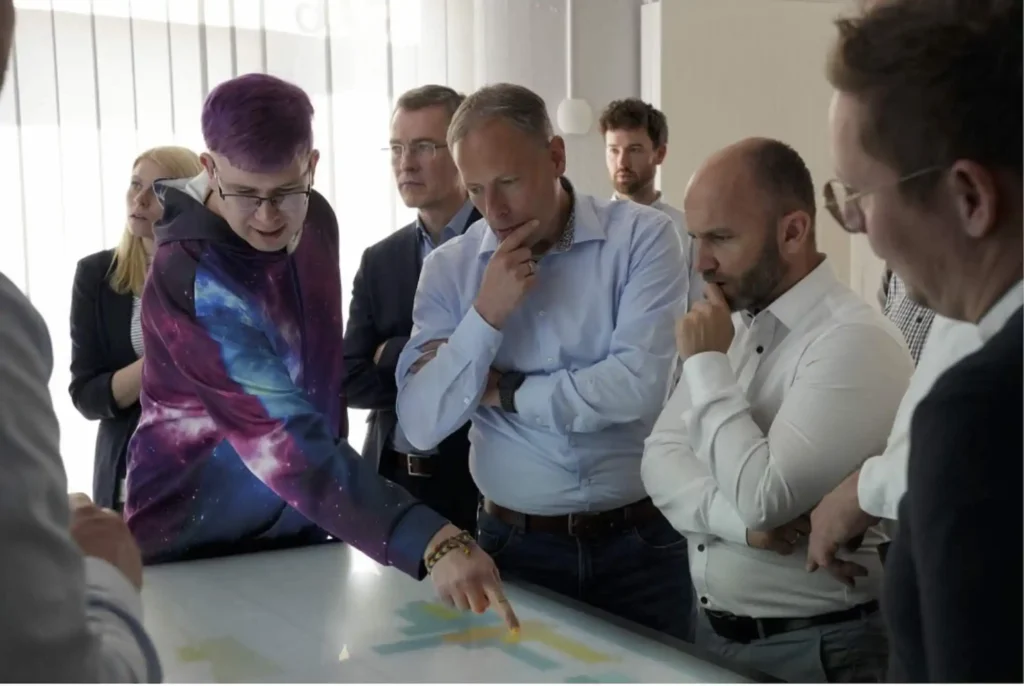
The multi-touch table as a play surface creates a hybrid experiential space in which human-machine interaction can be understood as an epistemic practice [10]. Central to this is the principle of collaborative and experiential learning [9]: participants, together with the facilitator—who may act as host, initiator, or game leader as needed—interact with the content on the table, make decisions, observe the direct consequences, and reflect on their assumptions [11]. The game thus becomes a medium for collective learning —not through linear instruction, but through situated interaction [3, 4].
Physical co-presence at the table, collaboration, and interaction with the materials reinforce this effect: learning becomes social, visible, and tactile [8, 10]. This form of interactivity creates new possibilities for dialogue on equal footing and collaborative thinking about alternatives, precisely where traditional formats for complex topics reach their limits [9, 10, 11].
Experience-based reflection with narrative case vignettes
The following case vignettes are drawn from the use of the described serious games on mobile multitouch tables in various contexts within the ENSURE project: as a focal point during a project partner’s celebration, as a central element of a co-creative event bringing together different stakeholders for the energy transition, and as an opportunity for exchange with experts. The primary goal of these activities was interaction, alongside communicating the project’s content and fostering networking.
The authors were involved in the design, implementation, and facilitation of the game scenarios; they collaborated with colleagues to draft proposals and justifications for the purchase of hardware and software; and here they jointly reflect on their experiences. The vignettes were subsequently developed based on participant observation, situational documentation, and dialogic feedback. They distill typical dynamics, reactions, and moments of insight that emerged in the respective application settings—not as an empirical evaluation, but as an insight-oriented reflection on experience.
Interaction with the game and its associated infrastructure is viewed as part of a social and communicative framework [2, 3, 9]. The reflection focuses on how interactive formats can trigger epistemic processes, foster collective thinking, and make complex topics accessible in all their complexity.
Case Study 1: Interactive energy transition at an event
Whether at an open house, as part of an anniversary celebration, or at the start of the semester, the glowing horizontal surface of the multitouch table with its transparent, puck-shaped game pieces draws the attention of visitors of all ages—from children to adults. A complex energy system unfolds on the screen, which they build together by placing game pieces and drawing cables with their fingers.
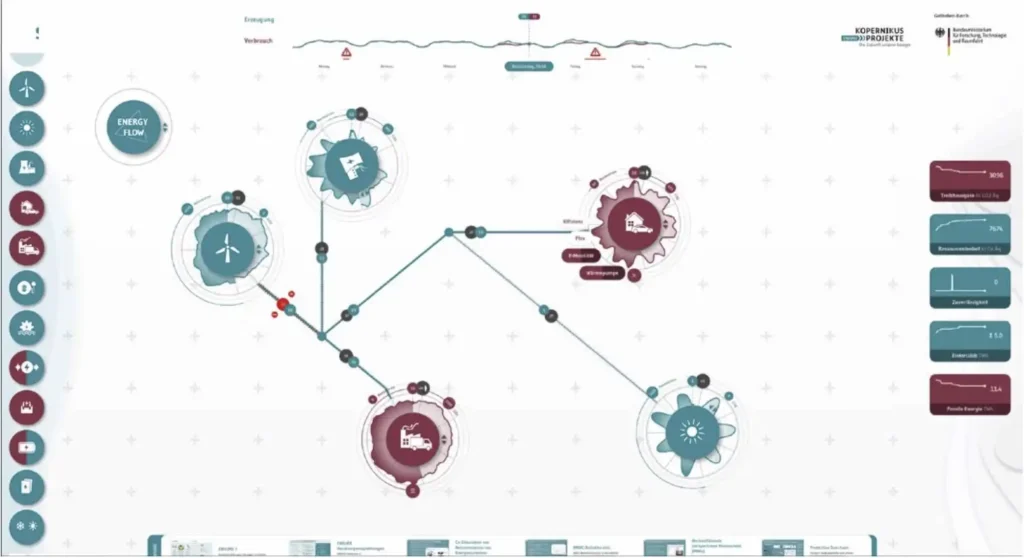
A child removes a token with a storage symbol, and simultaneously, activates a wind turbine. The power flows shift, CO₂ levels and resource requirements increase, and eventually a warning symbol appears because the grid is overloaded. The scene comes alive; players experiment, ask questions, and discuss. The complexity of the interrelationships becomes tangible as the energy transition unfolds schematically and in fast motion on the table.
The multitouch table functions as a social and epistemic resonance space where open, curious exchange can take place [4, 8]. It activates prior knowledge and provokes questions. Particularly striking is the cross-generational participation—from elementary school children to emeritus professors, everyone can join in.
Case Study 2: Collaboratively shaping the energy transition in a workshop
Interested parties are invited to a workshop to discuss the local implementation of the energy transition, with a multi-touch table at the center. In the game, interactions between energy generation, consumption, grid infrastructure, and emissions are represented schematically. The group begins moving game pieces or removing them from the surface while discussing the resulting consequences, which are immediately visible.
In this context, the games act as a sandbox: they provide a safe environment that allows for experimentation within schematically defined contexts, while simultaneously illustrating real-world decision-making situations. These scenarios can then be contextualized or expanded upon by other participants as well as through facilitation. The atmosphere during gameplay is cooperative, curious, and sometimes controversial. Playing fosters interest and understanding of conflicting goals and the consequences of decisions by bringing together knowledge and experience in the interpretation of game feedback.
Case Study 3: Interactive understanding in the expert panel
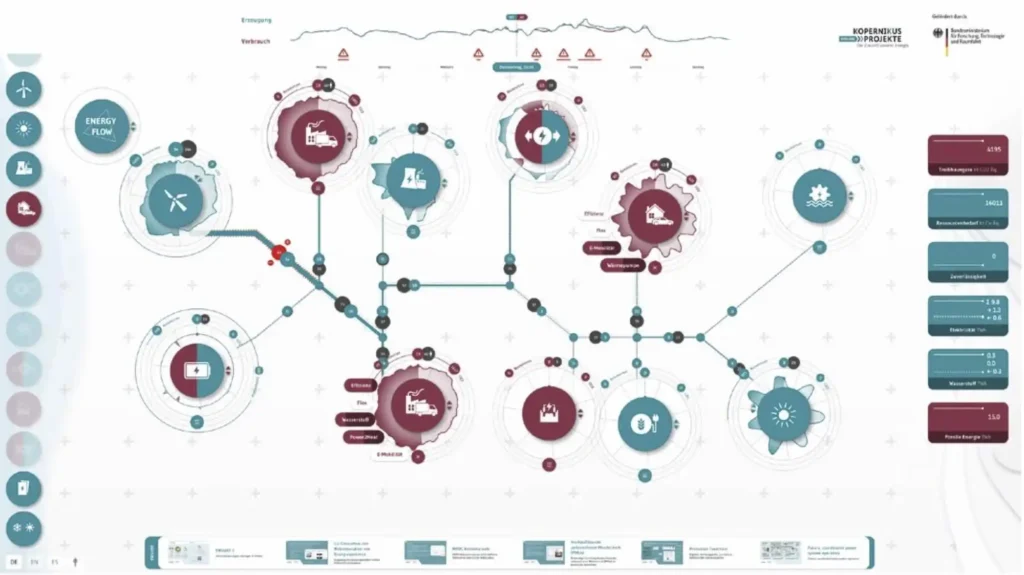
As part of an interdisciplinary workshop on energy transition, experts from industrial companies, research institutes, and innovation networks come together. The goal is to learn from one another, jointly analyze systemic challenges, and develop new approaches to solutions. Instead of traditional presentations, everyone gathers around a multitouch table to discuss the expansion of renewable energy, the integration of storage technologies, regulatory interventions, and demand behavior. Discussions are particularly intense because the disciplinary backgrounds and organizational logics of participants’ home institutions sometimes come into conflict .
Interaction at the table thus becomes a medium for understanding that extends beyond the immediate technological setting. Different technical languages, priorities, and mental models collide and must be made explicit and verbalized through the shared game. New questions arise, hypotheses are formulated, and existing assumptions are questioned. The game thus functions as an epistemic space for co-creation, where interdisciplinary knowledge develops and benefits all participants.
Playful exchange on equal terms
The three vignettes illustrate how interactive formats can contribute to understanding complex interrelationships.
The epistemic aspect of playing together is evident in the action: during the game, the process of discovery is situational and varies for all participants [8, 10]. This is particularly evident at the beginning, when participants, the facilitator, the table, and the games come together for the first time—and when reactions range from joyful anticipation to direct experimentation to cautious skepticism. The table and the games serve as a framework that fosters participation in the game as an exchange among equals. This does not lead to concrete solutions, but instead fosters shared insights into the energy transition that can serve as a starting point for further discussion [1].
A gradual or continuous increase in complexity and level of detail is crucial for enabling a wide range of applications. Initially, simple relationships, such as the relationship between load and generation, can be physically constructed as the simplest power grid (placing game pieces, drawing connections with fingers, visual feedback from the table) and then explored (pushing, turning, and swapping game pieces).
In the next step, renewable generators such as wind power and photovoltaics can be added to simulate the so-called first phase of the energy transition through the integration of renewable energies [12]. In a further step, flexibilities such as storage and sector coupling facilities can then be introduced (second phase of the energy transition) [13]. This game structure generates high interest in in-depth experimentation and discussion. The intensity of the games can lead to sessions lasting two to three hours.
Scenarios with constraints
Interactive formats can make a valuable contribution to explaining complex relationships. At the same time, however, there are limitations: without additional information or at least some minimal integration into the broader context of the energy transition, the games and their interactivity remain unfocused stimuli—the table and games alone spark curiosity but playing them requires facilitation or game instructions. The depth of engagement then depends heavily on the setting, group dynamics, and willingness to reflect.
Furthermore, there is a risk that the visualization of functional relationships will be misunderstood as a representation of reality—especially when conflicting goals, interdependencies, or systemic uncertainties are not equally visible and understandable to everyone during gameplay.
Even the development of such games requires technical and pedagogical expertise and involves a significant investment of human resources; their implementation is also demanding.
The “multitouch table” hardware setup further limits the possibilities. This is because the infrastructure is expensive to acquire and operate, yet necessary for the interaction dynamics described here. Even using the games as an interactive presentation on a vertical monitor without game pieces produces the described phenomena only weakly, and depending on the group constellation, not at all.
Its use requires technical support, suitable facilities, and logistical planning, which limits its transferability to everyday educational or participatory settings. Despite the “mobile” designation, the devices are bulky and difficult to transport. They are therefore only partially suitable for spontaneous, low-threshold, or inclusive formats. The potential for interaction also depends heavily on the functionality of the hardware and software. Even the lighting conditions at the location of use have a direct impact.
This does not diminish the value of the format, but rather highlights the need to understand interactive formats as part of a well-thought-out overall setting.
Human-machine interaction as an epistemological practice
Experiences with serious games on the energy transition show that interactive formats on multi-touch tables can function as spaces for collaborative knowledge production. The combination of visualization, interactivity, and social co-presence can trigger epistemic processes by promoting shifts in perspective, systems thinking, and collaborative learning.
Human-machine interaction thus becomes an epistemological practice: it makes complexity tangible, enables shifts in perspective, and creates spaces of social resonance for collective thinking. At the same time, the technical, didactic, and social limitations of such formats must be taken seriously and addressed appropriately.
This publication was produced as part of the Kopernikus research project ENSURE—“New Energy Network Structures for the Energy Transition,” funded by the Federal Ministry of Research, Technology, and Space (BMFTR).
The original German version of this article can be accessed via DOI: 10.30844/I4SD.26.2.62
Bibliography
[1] Stockholm Resilience Centre: Planetary boundaries. URL: https://www.stockholmresilience.org/research/planetary-boundaries.html.[2] United Nations: Paris Agreement. Paris 2015. URL: https://unfccc.int/process-and-meetings/the-paris-agreement.
[3] dena-Leitstudie Aufbruch Klimaneutralität. Berlin 2021.
[4] Seyfried, S.: Reifegradorientierte Gestaltung von Klimastrategien für kleine und mittlere Unternehmen der Fertigungsindustrie. Düren 2025.
[5] Abele, E.; Metternich, J.; Tisch, M.; Kreß, A.: Learning Factories. Featuring New Concepts, Guidelines, Worldwide Best-Practice Examples, Second edition. Cham 2024.
[6] Abele, E.; Bauerdick, C. J.; Strobel, N.; Panten, N.: ETA Learning Factory: A Holistic Concept for Teaching Energy Efficiency in Production. In: Procedia CIRP 54 (2016), pp. 83-88.
[7] Seyfried, S.; Nagel, L.; Weyand, A.; Weigold, M.: A Learning Factory as a Competence Centre for Climate-Neutral Production. In: Thiede, S.; Lutters, E. (eds.): Learning Factories of the Future. Cham 2024.
[8] Seyfried, S.; Weyand, A.; Webersinn, J.; Weigold, M.: Development of a competence-oriented training on climateneutral production for learning factories. In: SSRN Electronic Journal (2023).
[9] Kosow, H.; Gaßner, R.: Methods of future and scenario analysis. Overview, assessment, and selection criteria. Bonn 2008.
[10] Seyfried, S.; Weyand, A.; Kohne, T.; Weigold, M.: Process for Climate Strategy Development in Industrial Companies. In: Herberger, D.; Hübner, M.; Stich, V. (eds.): Proceedings of the Conference on Production Systems and Logistics: CPSL 2023 – 1. Hannover 2023.
[11] Tisch, M.; Hertle, C.; Abele, E.; Metternich, J.; Tenberg, R.: Learning factory design: a competency-oriented approach integrating three design levels. In: International Journal of Computer Integrated Manufacturing 29 (2016) 12, pp. 1355-75.
[12] Bloom, B. S.: Taxonomy of Educational Objectives. The Classification of Educational Goals. New York 1956.
[13] Anderson, L. W.; Kratwohl, D. R.: A taxonomy for learning, teaching, and assessing. A revision of Bloom’s taxonomy of educational objectives. New York 2001.
[14] Projektträger VDI/VDE Innovation + Technik GmbH: Bundesförderung für Energie- und Ressourceneffizienz in der Wirtschaft (EEW) – Transformationsplan – Anlage „Modul 5 – Transformationsplan“. Berlin 2025.
[15] Büttner, S. M.: How can climate neutrality be achieved for industry? A multi-perspective analysis 2023.
[16] Rahnama Mobarakeh, M.; Kienberger, T.: Climate neutrality strategies for energy-intensive industries: An Austrian case study. In: Cleaner Engineering and Technology 10 (2022), p. 100545.
[17] World Resources Institute; World Business Council for Sustainable Development: Technical Guidance for Calculating Scope 3 Emissions 2013.
[18] Science Based Targets Initiative: SBTi Corporate Net-Zero Standard 2024.
Your downloads
Potentials: Innovation Training
You might also be interested in