Bridging Knowledge Gaps with GenAI in Industrial Maintenance |
Specific needs and contextualized solutions

| Journal | Industry 4.0 Science |
| Issue | Volume 41, 2025, Edition 5, Pages 50-57 |
| Open Access | https://doi.org/10.30844/I4SE.25.5.50 |
| Bibliography | Share | Cite | Download |
Abstract
Keywords
Article
GenAI tools for writing, designing, composing, programming, and other functionalities are distributed among users at higher speed and with a more global scope than any prior technology [1]. Due to high user acceptance, the implementation of genAI at the workplace exhibited typical characteristics of a grassroots movement. Employees started to bring their own devices and free software for performing tasks.
As a first reaction and gradually also as a strategic action, companies provided GPT@Firm applications, hosted on company-owned server landscapes, for protecting firm-specific knowledge and interfaces while at the same time benefitting from the knowledge assistance provided by large language models (LLMs). Efficiency gains are especially reported for tasks where the required knowledge is so far not available in a structured synthesis or in explicit standards [2], which is often the case in clerical tasks [3]. In knowledge-intensive white-collar work, the use of genAI fosters hybrid systems of task performance [4].
One acatech report from 2020 [5] highlighted the potential benefit of AI applications along the value chain in German manufacturing and specified how AI functionalities could support in many sub-processes. So far, however, investment in genAI applications remains lower than expected [6]. The following analysis reflects on this implementation gap and discusses the requirements for genAI assistance in manufacturing companies. Elaborating on a sociotechnical systems perspective on genAI usage in manufacturing, maintenance demands are identified, with a focus on accessing implicit domain knowledge and coping with internal and external regulation of sub-processes. To facilitate these processes, context-sensitive maintenance assistance systems based on genAI are outlined.
Requirements for genAI support in manufacturing from a sociotechnical systems perspective
Generative artificial intelligence (genAI) is based on LLMs trained on natural language data sources from all kinds of media and generates context-related answers from stochastics about the sequence of words and syllables [4, 7]. It performs “tasks that would conventionally require human cognition and decision-making” [8]. In principle, this means that decision-making in both types, causation and effectuation, can be supported by AI [9].
Considering the continuous interaction of decision-makers with genAI tools, where they share their questions and knowledge deficits with the machine, the users become entities in the emergent reinforcement learning process of LLMs [10]. This is why Bender et al. [7] characterize LLMs as “stochastic parrots,” which direct all inquiries towards dominant patterns of structured knowledge presentation. Thus, from a long-term perspective, genAI always fosters causation [9] and exploits efficiency gains from standardization [2, 3].
GenAI is not a technical tool that can be considered in an isolated manner. It incorporates human agency in terms of human-generated thoughts and paperwork generated in a specific context and further develops on the basis of other humans’ interaction. It is a sociotechnical system by itself. Moreover, with the continuous use of LLMs, the social, in terms of users’ support needs, knowledge gaps, etc. materializes in the digital [11] through frequently asked questions. Domains with standardization needs as well as the standardization potential become evident through user behavior.
Thus, genAI is considered especially helpful in contexts with a high demand for synthesizing information that is distributed across multiple platforms and not available in a structured manner.
The support is appreciated as it enables the exchange of operators with domain experts who are not always reachable in person via operator-genAI-interaction. Moreover, it is useful for finding an appropriate starting point for an unstructured task while supporting individual problem-solving styles [2]. In principle, there is both automation potential for efficiency gains and augmentation potential for enhancing the quality of outcomes [3].
In the manufacturing context, the specific entanglement of technology, organization, and user demands brings about certain issues that are different from other industries and fields of knowledge work (for theoretical foundation, see [12]). We refer to four core characteristics.
High level of standardization and explicit task description
Manufacturing systems are characterized by a high level of standardization and job routines based on explicit job descriptions. This is a result of more than a hundred years of applying methods for standardization [13] and automation, also in fields of flexible production systems [14]. Productivity gains through process standardization and automation have been systematically exploited. Deploying single-purpose AI trained for one specific task [15], for example quality control, has contributed to optimization through standardization. Thus, additional productivity effects from LLMs can be assumed in principle but not primarily via standardization, unlike in other industries [3].
High consciousness for participatory job design and labor processes
Due to the institutionalization of codetermination practices in manufacturing firms [16], work councils have a high awareness of how to mutually benefit from technology-based efficiency gains whilst also preventing job loss and avoiding digital control systems [17]. Consequently, genAI applications are considered through the lens of skill development, job protection, and managerial control systems, as outlined in the labor process debate [18]. From a union’s or work council’s perspective, a new technology that tends to downgrade individual qualifications must be treated with caution [19].
Another critical point is the hidden control function of genAI tools. Continuous interaction with an LLM regarding knowledge gaps and open questions could become an indirect way of making performance practices and deficits assessable for others. The EU AI Act [20] evaluates genAI as a low-risk technology but classifies biometric approaches as an unacceptable risk. GenAI incorporates hidden components that could be used for scoring employee performance practices.
This is an ethical challenge that may not just face reservations from an employee perspective but also poses challenges for managerial accountability, since the beneficiary of the exposed social data (for example knowledge deficits) is the software company and not the manufacturer. Thus, the probability of quick, unreflected genAI adoption in manufacturing is rather low.
Norm-based and regulatory organizational design with implicit coping knowledge
Manufacturing firms have a high need for safety regulations and other guidelines to meet industry standards throughout the production flow and potentially also the supply chain (depending on the regulatory framework). Manufacturing work requires clear rule-based behavior corresponding with legal issues such as SDGs, privacy, health protection, etc. The number of regulations to be considered in parallel has increased considerably over time [21]. Supervisors and operators need to ensure system characteristics of a technocratic bureaucracy.
Assistance is therefore not needed for generating more standards but for evaluating, ordering and prioritizing existing regulations within a workflow. In other words, in manufacturing, it is procedural knowledge for coping with such a highly regulated context that is required. This knowledge is at least partly implicit and developed via experience [22]. This is why recent initiatives for developing LLMs for manufacturing aim at new approaches in knowledge management [23].
Process-specific differences and knowledge-support needs
The knowledge needs of employees differ considerably depending on sub-processes. Plant operators are confronted with the ever-increasing complexity of machine tools, which require in-depth expertise for efficient operation and maintenance. This is a big challenge, particularly for German SMEs, which have limited access to qualified specialists due to demographic change. More than half of vacancies cannot be filled within an acceptable time period with qualified staff [24].
As a result, SMEs increasingly commission cost-intensive external maintenance services. The surrounding activities are often redundant and error-prone, while the internal organizational exchange of maintenance knowledge and experience decreases. LLMs offer potential for supporting failure detection, communication, and the search for information through human-AI-interaction.
Considering the potential of genAI against the background of a sociotechnical systems perspective on support needs in manufacturing, it becomes obvious that there is an especially high demand for: 1) strategies to cope with the sub-process-specific challenges posed by technocratic bureaucracy and its multi-faceted regulation and 2) ways to bridge knowledge gaps where and when human expertise and human implicit knowledge are not available. At the same time, there are still reservations as long as ethical issues related to indirect control mechanisms and unclear consequences for employee skill development remain unresolved.
Bridging knowledge gaps in highly contextualized industrial maintenance
Facilitating sub-process-specific access to two types of knowledge, implicit operator knowledge and complex regulatory knowledge, for bridging knowledge gaps in near-real time requires a context-sensitive maintenance assistance system (MAS) based on GenAI. Such a system has to integrate different layers of knowledge representation, as shown in Figure 1 [25, 26]:
- Documentation level: Documents are often unstructured and difficult to analyze due to their linguistic diversity. A context-sensitive MAS must be able to extract structured information from heterogenous data.
- Expert level: Maintenance processes are largely determined by the implicit knowledge of employees. A context-sensitive MAS must be able to capture implicit knowledge, supplement it with technical knowledge about the plant structure, analyze machine data and service reports, and translate it into formal, standardized knowledge.
- Planning level: Efficient deployment and maintenance planning requires machine, process, and personnel data to be linked and analyzed. A context-sensitive MAS must therefore be able to integrate relevant planning information and automated decision-making aids.
- Process level: Data-driven algorithms for natural language processing are required to convert unstructured data into analyzable formats. The systematic and data protection-compliant storage of knowledge also requires flexible data structures that can map and semantically describe relationships between entities.
- Interaction level: A user-friendly human-machine interface is crucial to facilitate access to empirical knowledge and thus democratize it. Asking questions should be possible in natural user language, and answers should be provided in a dialogue-based chat.
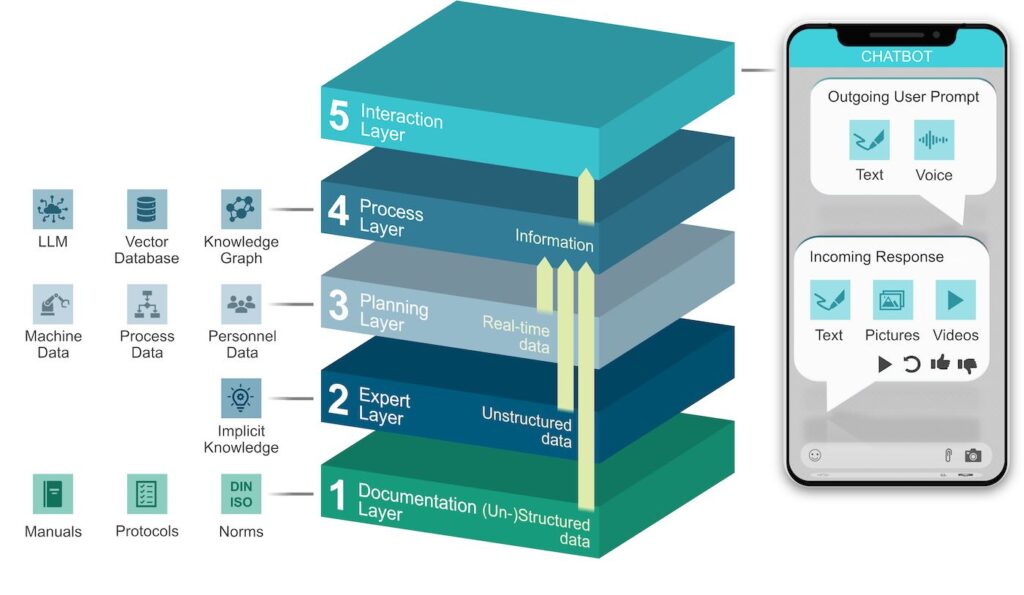
The technical components behind this layer architecture are Retrieval-Augmented Generation (RAG) and intelligent AI agents. RAG enriches user queries with relevant contextual data from internal and external sources, enabling decision-making based on the most recent information without the need for manual data aggregation [27].
In parallel, AI agents powered by LLMs can interpret complex tasks expressed in natural language, decompose them into logical steps, and autonomously execute actions. Acting as digital shopfloor assistants, they streamline workflows, reduce non-value-adding tasks, and improve information flow across fragmented IT landscapes [28]. RAG and AI agents reduce programming effort and enhance flexible, adaptive, and user-friendly maintenance support.
To give an example, the HSC600 from the company Exeron in Oberndorf, Germany, is a high-precision milling machine tool that encounters multiple maintenance challenges due to its complexity. A context-sensitive MAS (for illustration, see Fig. 2) offers inclusive access for diverse user groups and customers in global SMEs through its multilingual interaction in both speech and text form. The system integrates structured and unstructured data from machine documentation, user manuals, and historical service logs to provide accurate, context-rich responses.
At its core, the system leverages intelligent AI agents to dynamically detect user needs and autonomously initiate relevant actions. The knowledge base integrates real-time sensor data from the HSC600, software requests (for example retrieving job schedules), targeted internet research, and operator questions via email when external support is necessary. The MAS responds in the user’s chosen language and modality, thereby streamlining complex diagnostics and support tasks into intuitive, dialogue-based workflows, including learning units on-the-fly. This integration of multimodal interaction, intelligent reasoning, and flexible data retrieval exemplifies a scalable solution for sustainable maintenance in digitally transforming production environments.
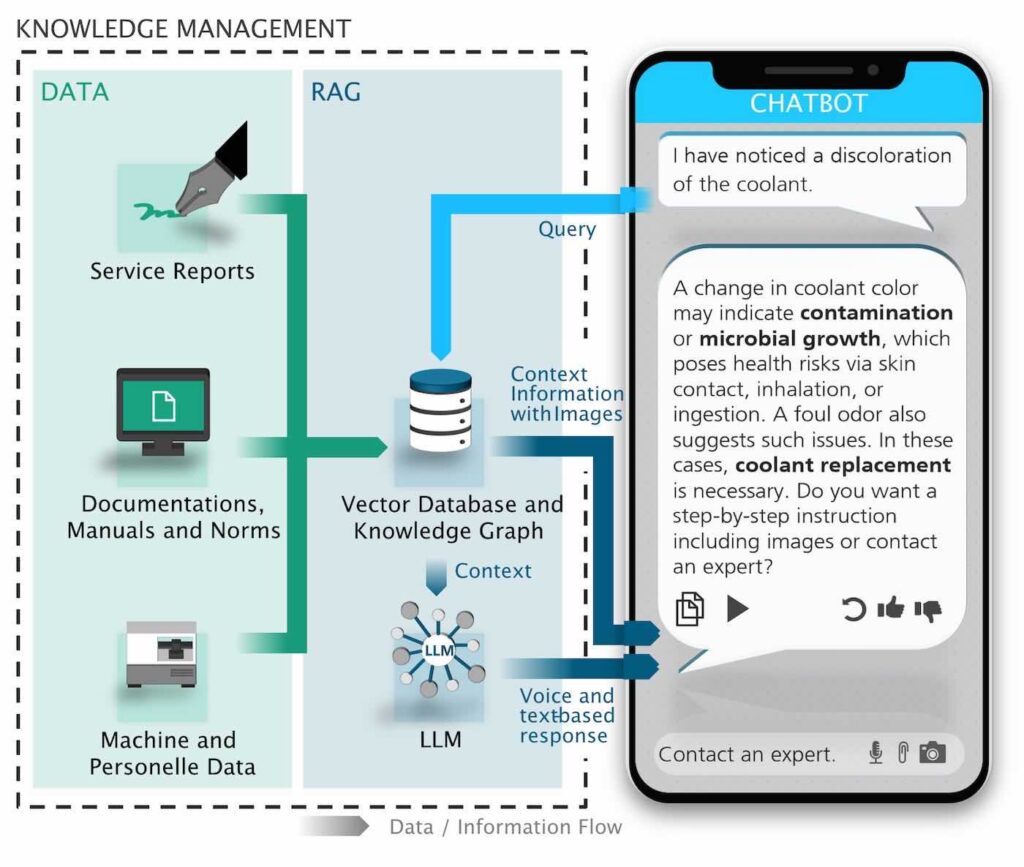
This streamlined MAS is a proof-of-concept, which, as a next step, must be validated in a real application environment with cooperating customers. The expected benefits are a standardized maintenance process for the HSC600 and customized on-demand maintenance assistance, reducing downtime and costs while improving access to expertise.
Outlook on further validation
There is a need for genAI support for two specific types of knowledge required in industrial maintenance: implicit operator knowledge and complex regulatory knowledge. Especially SMEs suffer weaknesses and knowledge gaps in this regard.
This article introduced a multi-layer architecture for an AI-based maintenance assistant system that could bridge such knowledge gaps. Any further validation of the concept should integrate both aspects discussed at the beginning of the article, the need arguments and the no-need arguments. When there is a need, the contribution of the knowledge management system can be operationalized with reduced downtime and improved access to expertise to measure improvement. A validation should also integrate the consequences for employment, job design, skill level, and possible indirect control of work behavior and expert status due to continuous data processing.
Moreover, it should reflect the effects regarding changing expert roles of supervisors and consequences for leader-member exchange. Such extended validation reflects the criteria that typically lead to employees’ and/or managers’ reservations against genAI. The advancement towards increasing resilience on individual and organizational levels depends on supporting the knowledge needs and treating the reasonable arguments for no needs with respect in participatory implementation processes.
This is an original article. The German translation can be accessed via DOI: 10.30844/I4SD.25.5.50
Bibliography
[1] Adrados Herrero, A.: In-depth Study of the AI Industry by Writerbuddy. URL: https://www.silicon.eu/in-depth-study-of-the-ai-industry-by-writerbuddy-12477.html, 2024, accessed 16.04.2025.[2] Yun, B.; Feng, D.; Chen, A. S.; Nikzad, A.; Salehi, N.: Generative AI in Knowledge Work: Design Implications for Data Navigation and Decision-Making. In: CHI Conference on Human Factors in Computing Systems (CHI ’25), Yokohama, Japan, 2025. ACM, New York, NY, USA, pp. 1-19.
[3] Gmyrek, P.; Berg, J.; Bescond, D.: Generative AI and Jobs: A Global Analysis of Potential Effects on Job Quantity and Quality. ILO Working Paper 96 (2023).
[4] Schönberger, M.; Beinke, J. H.: Hybride Intelligenz als Konvergenz menschlicher und künstlicher Intelligenz – wie verändert ChatGPT die Wissensarbeit? In: HMD Praxis der Wirtschaftsinformatik 60 (2023) 6, pp. 1174-1193.
[5] acatech Horizonte: Künstliche Intelligenz in der Industrie. URL: https://www.acatech.de/wp-content/uploads/2020/07/200619_acatech_horizonte_KI_Screen.pdf, 2020, accessed 16.04.2025.
[6] Kagermann, H.; Süssenguth, F.; Weber, T.: Souveräne Antworten – Anwendung und Entwicklung generativer Künstlicher Intelligenz in Deutschland. URL: https://www.acatech.de/publikation/generative-kuenstliche-intelligenz/, 2024, accessed 16.04.2025.
[7] Bender, E. M.; Gebru, T.; McMillan-Major, A.; Shmitchell, S.: On the dangers of stochastic parrots: Can language models be too big? In: Proceedings of the 2021 ACM conference on fairness, accountability, and transparency, 2021, pp. 610-623.
[8] Prikshat, V.; Islam, M.; Patel, P.; Malik, A.; Budhwar, P.; et al.: AI-Augmented HRM: Literature review and a proposed multilevel framework for future research. In: Technological Forecasting and Social Change 193 (2023).
[9] Lupp, D.: Effectuation, causation, and machine learning in co-creating entrepreneurial opportunities. In: Journal of Business Venturing Insights 19 (2023).
[10] Kaplan, J.; McCandlish, S.; Henighan, T.; Brown, T. B.; Chess, B.; et al.: Scaling laws for neural language models. arXiv preprint arXiv:2001.08361 (2020).
[11] Leonardi, P. M.; Treem, J. W.: Behavioral visibility: A new paradigm for organization studies in the age of digitization, digitalization, and datafication. In: Organization studies 41 (2020) 12, pp. 1601-1625.
[12] Orlikowski, W. J.; Scott, S. V.: 10 sociomateriality: challenging the separation of technology, work and organization. In: The Academy of Management Annals 2 (2008) 1, pp. 433-474.
[13] Taylor, F. W.: Die Grundsätze wissenschaftlicher Betriebsführung. Munich, Berlin, 1913.
[14] Jovane, F.; Koren, Y.; Boer, C. R.: Present and Future of Flexible Automation: Towards New Paradigms. In: CIRP Annals 52 (2003) 2, pp. 543-560.
[15] Fischer, G.: A research framework focused on AI and humans instead of AI versus humans. In: Barricelli, B.R.; et al. (2022) (eds.), Proceedings of CoPDA2022 – Sixth International Workshop on Cultures of Participation in the Digital Age: AI for Humans or Humans for AI? URL: https://ceur-ws.org/Vol-3136/paper-1.pdf
[16] Funder, M.: Quo vadis Betriebsrat? Entwicklungstrends der betrieblichen Mitbestimmung. In: WSI-Mitteilungen 71 (2018) 6, pp. 497-504.
[17] Leesakul, N.; Oostveen, A.-M.; Eimontaite, I.; Wilson, M. L.; Hyde, R.: Workplace 4.0: Exploring the Implications of Technology Adoption in Digital Manufacturing on a Sustainable Workforce. In: Sustainability 14 (2022) 6.
[18] Braverman, H.: Labor and Monopoly Capital: The Degradation of Work in the Twentieth Century. New York: Monthly Review Press, 1974.
[19] Lühr, T.; Kämpf, T.: Bots im Büro. Künstliche Intelligenz und der Wandel von Angestelltenarbeit in der digitalen Transformation. Düsseldorf: Hans-Böckler-Stiftung, 2025.
[20] European Parliament: EU AI Act: first regulation on artificial intelligence. URL: https://www.europarl.europa.eu/topics/en/article/20230601STO93804/eu-ai-act-first-regulation-on-artificial-intelligence, 2025, accessed 16.04.2025.
[21] Deloitte: Regulatory Cost Barometer – Regulatory compliance costs for companies in the insurance industry and in mechanical engineering. Munich: Deloitte, 2021.
[22] Ottersböck, N.; Prange, C.; Dander, H.; Rusch, T.: Babyboomer weg, Wissen weg – Partizipative Entwicklung eines KI-basierten Assistenzsystems zur Erfassung und Sicherung erfahrungsbasierten Wissens in der Produktion. In: Nachhaltig Arbeiten und Lernen – Analyse und Gestaltung lernförderlicher und nachhaltiger Arbeitssysteme und Arbeits- und Lernprozesse, Hannover, 2023.
[23] Freire, S. K.; Wang, C.; Foosherian, M.; Wellsandt, S.; Ruiz-Arenas, S.; et al.: Knowledge sharing in manufacturing using large language models: User evaluation and model benchmarking. arXiv preprint arXiv:2401.05200 (2024).
[24] Finkel, P.; Wurster, P.; Radler, R.: Large Language Models in Production – An analysis of the potential for transforming production processes in modern factories. I40S (2024) 6, pp. 50-55.
[25] McCauley, D. (ed.): Laying the foundation for data- and AI-led growth. Cambridge: MIT Technology Review, 2023.
[26] VDI Verein Deutscher Ingenieure e.V., Technik und Gesellschaft (publ.): Künstliche Intelligenz – Erwartungen und Realität. Düsseldorf: VDI, 2022.
[27] Uhlmann, E.; Polte, J.; Lelidis, P.: Generative KI zur No-/Low-Code-Wissensverarbeitung. Zeitschrift für wirtschaftlichen Fabrikbetrieb 119 (2024) 11, pp. 840-844.
[28] Uhlmann, E.; Polte, J.; Mühlich, C.; Elsir, Y.: Intelligente Shopfloor-Assistenten – Produktivitätssteigerung durch den Einsatz generativer KI. Industry 4.0 Science 40 (2024) 6, pp. 64-71.
Your downloads
Potentials: Services
Solutions: Maintenance
You might also be interested in