AI-Supported Personnel Planning in Industrial Maintenance |
User-centered development and implementation in a pilot project

| Journal | Industry 4.0 Science |
| Issue | Volume 41, 2025, Edition 5, Pages 14-20 |
| Open Access | https://doi.org/10.30844/I4SE.25.5.14 |
| Bibliography | Share | Cite | Download |
Abstract
Keywords
Article
Maintenance plays a crucial role in ensuring the availability, reliability, and cost-effectiveness of technical systems and equipment in almost all branches of industry. The complexity of modern production facilities has a direct impact on their maintenance, increasing the demands on personnel [1]. Maintenance tasks are often performed by specialized service providers who also offer related services such as the installation of machines and systems, commissioning, or machine relocation under the term “industrial services”. These services sometimes merge with maintenance or are performed by the same personnel.
The selection of the best possible personnel for deployment is an essential part of the service provision of these companies. Dispatchers carry out flexible, competence-based assignments of often highly specialized employees to the sometimes singular, sometimes recurring maintenance requests of different customers. The planning process requires a high level of experience regarding customer requests and the company’s own workforce and demands a high level of cognitive performance in order to take into account the manifold dependencies and restrictions.
Due to the dynamic nature of personnel planning, which involves a high degree of freedom and short deadlines, dispatchers are under a great mental strain. That is why supporting them with digital tools is a promising approach, especially for small and medium-sized enterprises (SMEs) with limited human resources. Assistance systems based on artificial intelligence (AI) can provide optimized suggestions for personnel planning by processing request data and linking it to employee data, thereby reducing the dispatchers’ workload [2].
It is of central importance that the focus is placed on the users [3]. Complex personnel planning requires not only the consideration of hard facts but also experiential knowledge and sensitivity, for example when assessing customer-employee relationships or unforeseen events. Therefore, AI must be designed as an intelligent tool that takes into account the implicit knowledge of dispatchers and thus enhances human capabilities. In addition to dispatchers, company employees must also be considered as stakeholders from the outset of planning such a tool, as their data serves as the basis for the AI’s predictions.
As part of the project “Künstlich und menschlich intelligent – Kompetenzzentrum für transformierte Arbeit in Westsachsen“ (KMI) (engl. „Artificial and Human Intelligence – Competence Center for Transformed Work in Western Saxony”), such an AI assistant for personnel planning is in development. It was implemented as a prototype at WIN Wartung und Instandhaltung GmbH Zwickau. This article shows how user-centered principles are implemented in this pilot project.
AI-supported personnel planning based on employee skills
WIN GmbH is a service provider in the field of maintenance, repair, and installation of machines and systems and maintains a large number of branch offices and locations. With over 140 employees and partners in the fields of project planning, design, toolmaking, switch cabinet construction, and control systems, complex tasks in the fields of mechanical and metal engineering as well as electrical engineering are planned and implemented.
Accordingly, personnel dispatchers at WIN GmbH are faced with the complex task of assigning highly specialized personnel to changing and recurring customer orders in a flexible and skill-based manner. Numerous aspects must be taken into account: occupational groups, additional qualifications, specific industry experience, and the social and personal skills of the employees. Although ERP and other IT systems are available in the company, this allocation has so far been carried out largely without specific technical support, relying on the implicit knowledge of experienced dispatchers.
In the current personnel planning process (Fig. 1), the experience and implicit knowledge of the dispatchers is particularly important in two areas. First, when deriving skills from customer requests: customer orders are often incomplete, unspecific, or imprecisely worded. As a result, they are not sufficient for identifying the necessary skills and qualifications, which must instead be derived from the context and previous experience with the customer. Errors that occur in this process occasionally lead to the need to call in specialists at a later stage during order processing.
The consequences are increased costs, declining customer satisfaction, and frustration among employees due to delayed support or inappropriate assignments. The second experience-based step is to identify employees with the appropriate skill profile. Here, dispatchers must take into account both the actual skills of the employees and additional factors such as the relevance of additional qualifications or soft skills.
Against this backdrop, the goal was set to develop an AI-based assistance system that analyzes job descriptions and provides suggestions for the optimal selection of personnel. Such a system could automatically record and process the aforementioned aspects. This would relieve the burden on dispatchers, allowing them to focus more on the human aspects of personnel planning (for example customer preference for certain employees or elements related to teamwork).
Specifically, the assistance system would predict the employees likely to be needed based on structured job descriptions, historical data, and skill profiles. These AI predictions would serve as a sound basis for decisions made by project managers and personnel planners, enabling them to deploy the “right employee at the right time in the right place”.
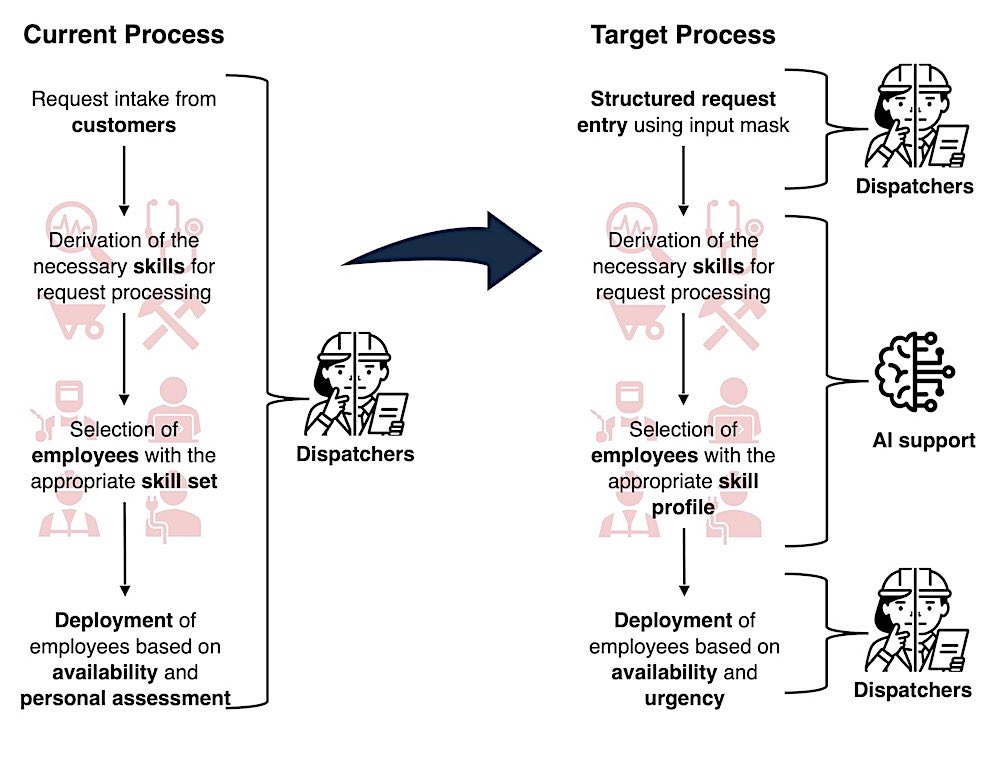
Figure 1 shows the current and the target process for personnel planning. Although WIN GmbH already had comprehensive data on past orders, deployment times, and material usage, this data was not suitable for training an AI-based solution. A major problem was the inconsistent and incomplete recording of relevant order and skill data, as this data was not originally collected with the aim of using AI. Different spellings, abbreviations, and a lack of detail in order entry also make automated evaluation difficult.
User-centered introduction and development of an AI assistant in the pilot project
As in all KMI pilot projects, the development process took a human-centric perspective based on ergonomic principles. The user-centered development process (see Fig. 2) serves as the framework for AI introduction, incorporating human-centered core objectives [4, 5, 6]. To this end, the first step in the user-centered development process is to analyze the context of use.
For AI system development, it is necessary to broaden the concept of users [7]. In addition to the dispatchers who interact directly with the AI assistant, the employees whose data is processed by the AI system and who are affected by the system’s decision proposals are also important stakeholders in the development process. Other stakeholders include the decision-makers and process moderators within the company, who are driving the operational implementation of AI. They are important key figures for incorporating human-centered principles into the AI development process, as they make decisions that affect the entire process.
In order to identify the AI users and stakeholders in the pilot company and analyze the context of use, semi-structured interviews were conducted with the managing director, project manager, dispatchers, and operational employees. The customers, who could profit from faster and higher-quality order processing, are also indirectly affected.
The semi-structured interviews were conducted on-site or online, depending on availability. At the beginning of the interviews, the project’s objectives and the specific implementation at WIN GmbH were presented to employees who had not yet been informed. The content of the interviews was then structured and categorized based on the topics discussed, in accordance with [8]. The following topics and categories were explored: dispatcher tasks, work organization/tools/software, cooperation/teamwork, solution strategies, and process description.
As direct participants, the dispatchers were also asked about their expectations and requirements for working with the AI assistance system, and their answers were categorized accordingly. They expressed positive expectations, such as relief from routine tasks and more focus on interpersonal factors in personnel planning, but at the same time also fears, in particular of “being patronized by AI”. So, whilst dispatchers welcomed support, they also wanted to ensure that their autonomy was maintained.
![Figure 2: User-centered development process (illustration based on [4]).](https://industry-science.com/wp-content/uploads/2025/09/Hein_I4S-25-5_Figure-2-1.jpeg)
Operational employees, who would be assigned new orders by the AI-supported system in the future, expected a reduced workload and more accurate allocation in line with individual skill profiles. This could reduce overwork or idle time; waiting times caused by incorrect assignments could be reduced. At the same time, there were concerns about being deployed by a “machine” instead of a human being, and there was uncertainty about how this would affect their working reality.
In the second step of the user-centered development process, requirements for the AI system were derived from interviews with employees and dispatchers. To create a structured database, order entry, which previously involved a combination of phone calls and emails, was expanded to include a standardized input mask. This is filled out by employees when orders are received. Due to the company’s profile as a service provider, a conscious decision was made not to outsource the structured order entry to the customer.
The second pillar of the database, employee skills, was created with the help of the IHK training occupation profiles. Manual additions were made by the dispatchers and project managers of WIN GmbH, because the occupation profiles alone led to the duplication of skills and insufficient selectivity.
When using social data about employees in the form of their skills and qualifications, the influence of possible data biases in the AI system must be considered. Data biases are systematic distortions or imbalances in the training data. These distortions can cause the AI to produce incorrect, unfair, or discriminatory results [9]. In the pilot project, these distortions could occur through the use of historical data.
If, in the past, individual employees were assigned to certain jobs particularly frequently by dispatchers based on subjective assessments, or if the skills for automatic matching are not entirely accurate, certain employees could be suggested particularly frequently by the AI system. It is thus important to check the data basis of past assignments, as well as the weighting of these by the algorithm, for biases as the project progresses.
On the part of the direct users, the dispatchers, maintaining autonomy is an important requirement for the AI system. The system should provide suggestions for personnel planning but leave the final decision to the dispatchers—also because their experiential knowledge cannot be fully incorporated and rare use cases occur for which the AI has no training data. The AI system must therefore be designed as a tool and not as an independently acting agent [10]. Further requirements for the AI system are interfaces to existing WIN GmbH systems (for example ERP) and the ability to operate on existing hardware.
In the further course of the pilot project, the system will be implemented as an initial executable prototype. The input and output of the AI system will be integrated directly into the existing planning tool of WIN GmbH. Dispatchers can either accept the AI agent’s suggestions directly or override and modify them at any time based on their experience and process knowledge. The prototype’s alignment with requirements will be tested iteratively.
To this end, user tests will be designed in which dispatchers perform real work tasks using the AI prototype. Since this is a small group of directly interacting users, the evaluations will also be carried out using qualitative methods such as semi-structured interviews. An important focus of the iterative testing is dispatcher autonomy. It is necessary to work with the dispatchers to find a balance between algorithmic support for process improvement and the preservation of autonomy.
User-centered design in collaboration with SMEs and AI experts
When introducing AI—and when processing personal data—it is important to involve employees in order to overcome obstacles in the change process [11]. However, implementing a user-centered approach is often difficult for SMEs, as it requires specific resources, qualified personnel, and sufficient awareness, which are not always available. AI projects are also often supported by developers whose focus is on technical implementation rather than employee involvement. Increased collaboration between developers and human factors researchers thus holds great potential for supporting the introduction of AI.
In the pilot project, collaboration was not limited to the implementation of the AI system but began in the early stages. At the start of the project, it became apparent that SMEs often do not have a sufficiently advanced level of digitalization to use existing data for AI applications. In many cases, data was not originally collected with AI use in mind, meaning that it is incomplete or not optimally structured.
At WIN GmbH, too, a suitable database first had to be created. Based on the data structure requirements specified by the developers, a database for skills was created in collaboration with the employees. The early involvement of employees in the development process plays a key role in helping them develop a deeper understanding of the AI system and its data basis, while at the same time recognizing the resulting benefits for their own work—a process that contributes significantly to acceptance.
The KMI research and development project is funded as part of the funding measure „Zukunft der Arbeit: Regionale Kompetenzzentren der Arbeitsforschung – Künstliche Intelligenz” (engl. “Future of Work: Regional Competence Centers for Labor Research – Artificial Intelligence”) in the program „Innovationen für die Produktion, Dienstleistung und Arbeit von morgen“ (engl. “Innovations for Tomorrow’s Production, Services, and Work”) of the Bundesministeriums für Forschung, Technologie und Raumfahrt (BMFTR) (engl. Federal Ministry of Research, Technology, and Space) and is supervised by the Project Management Agency Karlsruhe (PTKA).
The original German version of this article can be accessed via DOI: 10.30844/I4SD.25.5.14
Bibliography
[1] Obermaier, R.: Handbuch Industrie 4.0 und Digitale Transformation. Betriebswirtschaftliche, technische und rechtliche Herausforderungen. Wiesbaden 2019.[2] Ansari, F.; Kohl, L.; Sihn, W.: A competence-based planning methodology for optimizing human resource allocation in industrial maintenance. In: CIRP Annals 72 (2023) 1, pp. 389-392.
[3] Huchler, N.; Adolph, L.; André, E.; Bauer, W.; Bender, N.; et al.: Kriterien für die Mensch-Maschine-Interaktion bei KI. Ansätze für die menschengerechte Gestaltung in der Arbeitswelt. Plattform Lernende Systeme (2020). Munich.
[4] DIN – Deutsches Institut für Normung e. V.: DIN EN ISO 9241-210: 2011-01: Ergonomie der Mensch-System-Interaktion-Teil 210: Prozess zur Gestaltung gebrauchstauglicher interaktiver Systeme (ISO 9241-210:2010). Deutsche Fassung EN ISO, 9241-210. Beuth Verlag, Berlin 2010.
[5] Ozmen Garibay, O.; Winslow, B.; Andolina, S.; Antona, M.; Bodenschatz, A.; et al.: Six Human-Centered Artificial Intelligence Grand Challenges. In: International Journal of Human-Computer Interaction 39 (2023) 3, pp. 391-437.
[6] Hein, P.; Simon, K.; Kögel, A.; Löffler, T.; Bullinger-Hoffmann, A. C.: Menschzentrierte Einführung von Künstlicher Intelligenz in Produktion und Engineering: Erfahrungen aus Pilotprojekten in KMU. In: Zeitschrift für wirtschaftlichen Fabrikbetrieb 120 (2025) s1, pp. 12-16.
[7] Simon, K.; Hein, P.; Kögel, A.; Löffler, T.; Bullinger-Hoffmann, A. C.: Framework zur Untersuchung von Auswirkungen der KI-Einführung in kleinen und mittleren Unternehmen. In: Arbeitswissenschaft in-the-loop : Mensch-Technologie-Integration und ihre Auswirkung auf Mensch, Arbeit und Arbeitsgestaltung; 70. Kongress der Gesellschaft für Arbeitswissenschaft e.V.; Artikel-Nr.: H.3.4. Stuttgart 2024.
[8] Kuckartz, U.: Qualitative Inhaltsanalyse. Methoden, Praxis, Computerunterstützung; Weinheim 2018.
[9] Kellogg, K. C.; Valentine, M.; Christin, A.: Algorithms at Work: The New Contested Terrain of Control. In: Academy of Management Annals 14 (2020) 1, pp. 366-410.
[10] Shneiderman, B.: Human-Centered Artificial Intelligence: Three Fresh Ideas. In: AIS Transactions on Human-Computer Interaction 12 (2020) 3, pp. 109-124.
[11] Langholf, V.; Wilkens, U.; Lupp, D.; Obermann, N.: Wege zum verantwortungsvollen Einsatz von KI am Arbeitsplatz. In: Industry 4.0 Science 40 (2024) 5, pp. 58-66.
Your downloads
Potentials: Training
Solutions: Maintenance
You might also be interested in