Software

Economic Evaluation of Information in Industrial Logistics

Economic Evaluation of Information in Industrial Logistics

Challenges and first thoughts about value orientation in information logistics
Michael Eßig, Michael Rüdiger
Up to now there are few approaches to an evaluation of information in logistics. However, with the increasing establishment of logistics as a corporate leadership function and a visible increase of the focus on company spanning control of supplier-buyer relationships as part of Supply Chain Management, we also see an increase in the need for an evaluation of information. This article attempts to give first thoughts about an economic evaluation of information in logistics and also attempts to substantiate the need for continued research in this subject area. The presented approach is the Total Logistics Information Value which consist of the company specific contributions of information logistics to the Economic Value Added on the one hand, and the information logistically relevant value added by the suppliers on the other hand.
Industrie Management | Volume 23 | 2007 | Edition 4 | Pages 45-48
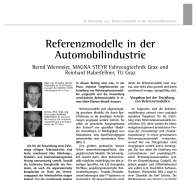
Reference Models in the Automotive Industry

Reference Models in the Automotive Industry

Bernd Wiermeier, Reinhard Haberfellner
The necessary work steps for the development of an automotive are distributed more and more across boarders of divisions, locations and enterprises. Both the technical complexity of products and the organizational complexity regarding the degree of integration are increasing. In order to understand, plan, logically map, and successfully manage the very complex product structure and the highly networked product development-process, commonly accepted structure or process models are used. The creation of these models can be supported by reference-models. In this article a field tested approach for modelling reference-process-models and application of different reference models in a multi-level-model will be shown.
Industrie Management | Volume 23 | 2007 | Edition 3 | Pages 47-50
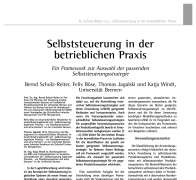
Autonomous Control in Practice

Autonomous Control in Practice

Ein Framework zur Auswahl der passenden Selbststeuerungsstrategie
Bernd Scholz-Reiter ORCID Icon, Felix Böse, Thomas Jagalski, Katja Windt
Production logistics has seen the introduction of autonomous control strategies, which had been implemented with different modelling methods. Additionally a standardising body of tools for the evaluation of autonomous control strategies has been set up. This article presents a framework, which helps to identify the appropriate autonomous control strategy together with the corresponding modelling approach for given production logistics scenarios.
Industrie Management | Volume 23 | 2007 | Edition 3 | Pages 7-11
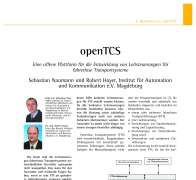
openTCS

openTCS

Eine offene Plattform für die Entwicklung von Leitsteuerungen für fahrerlose Transportsysteme
Sebastian Naumann, Robert Hoyer
To this day, automated guided vehicle system (AGVS) controllers of different suppliers are not compatible with each other. If the customer wishes to extend his AGVS, this may have unpleasant consequences as the supplier may no longer provide an according service. That is why a consortium of seven companies from the material flow business and three institutes of scientific research developed a platform for the implementation of concrete AGVS controllers. All such applications have the same architecture, therefore maintenance and future changes may be done by other suppliers. Consequently the customer is no longer dependent on a single supplier.
Industrie Management | Volume 22 | 2006 | Edition 2 | Pages 41-44
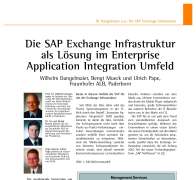
The SAP Exchange Infrastructure

The SAP Exchange Infrastructure

A solution for the integration of enterprise applications (EAI)
Wilhelm Dangelmaier, Bengt Mueck, Ulrich Pape
The increasing coupling of software applications leads to complex integration scenarios in many companies. Doing this successfully requires well-harmonized concepts and tools. One promising approach is the product “Exchange Infrastructure” of the SAP AG, which is discussed in this article.
Industrie Management | Volume 21 | 2005 | Edition 4 | Pages 19-22
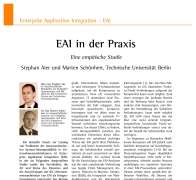
EAI in Practice – An Empiric Survey

EAI in Practice - An Empiric Survey

Stephan Aier, Marten Schönherr
Enterprise Application Integration (EAI) is an approach to improve system interoperability in a business process oriented fashion. The described empirical research study examines the impact of the general organizational understanding, the manner of implementation and deployment of EAI projects on the enterprise architecture. The article illustrates the results and introduces some advice how to improve the recognized issues of the EAI situation in real life context.
Industrie Management | Volume 21 | 2005 | Edition 4 | Pages 60-62
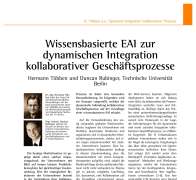
Knowledge-Based EAI for the Dynamic Integration of Collaborative Business Processes

Knowledge-Based EAI for the Dynamic Integration of Collaborative Business Processes

Hermann Többen, Duncan Rubinger
Today’s economic situation can be characterized by increasingly changing demands from the markets to the companies leading to shorter product life-cycles in conjunction with cost-reductions. One of the strategical reactions of the companies is to enforce mutual collaboration. Hence collaborative business processes are the basis to establish such a collaboration on the process layer. The integraton of theses processes nearly in real-time is one today’s peculiar challenges. In the following a concept is described, that enables the dynamic interconnection of collaborative business-processes based upon a knowledge-based EAI.
Industrie Management | Volume 21 | 2005 | Edition 4 | Pages 41-44
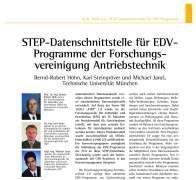
The Realization of a STEP Data Interface

The Realization of a STEP Data Interface

Calculation programs of the German Research Association for Gears and Transmissions
Bernd-Robert Höhn, Karl Steingröver, Michael Jaroš
The calculation programs of the German Research Association for Gears and Transmissions were developed at the leading German instituts and are able to calculate nearly all aspects of a gear unit. For the automatic data exchange between these programs a standardized interface was created. Based on the standard ISO 10303 ‘STEP’ [1] a product model for gear units was developed at the Gear Research Centre (FZG) of the Technical University of Munich to realize a central data base. Meanwhile this product model is published as VDMA guideline 23900 [2]. A converter program enables the connection to the FVA programs. Additionally this converter program includes a data interface to CAD systems.
Industrie Management | Volume 21 | 2005 | Edition 2 | Pages 23-26
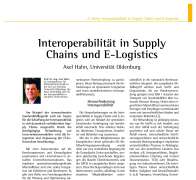
Interoperability in Supply Chains and E-Logistics

Interoperability in Supply Chains and E-Logistics

Axel Hahn
An approach to the creation of interoperability in dynamically changing supply chains is presented applying the example of transnational hazardous waste logistics. By an integral consideration of business models the integration and adaptation of the IT infrastructure is advanced.
Industrie Management | Volume 20 | 2004 | Edition 3 | Pages 67-70
Modularization of Complex Enterprise Architectures

Modularization of Complex Enterprise Architectures

An instrument for sustainable flexibilization
Stephan Aier, Marten Schönherr
The target of complex IT-projects is the improvement of flexibility and sustainability of organisational architectures. The main topic of the article is the definition and implementation of modules of organisational and IT-structures to increase flexibility. Approaches found in the area of Enterprise Application Integration (EAI) and Service Oriented Architectures (SOA) fit the described paradigm and support the technical implementation.
Industrie Management | Volume 20 | 2004 | Edition 2 | Pages 39-42
1 5 6 7