Autor: Thomas Jagalski

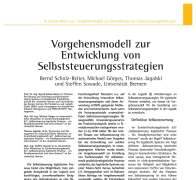
A Procedure Model for Autonomous Control Strategies

A Procedure Model for Autonomous Control Strategies

Bernd Scholz-Reiter ORCID Icon, Michael Görges, Thomas Jagalski, Steffen Sowade
Logistics has seen the introduction of autonomous control strategies and their abilities - as far as performance and robustness are concerned - have been proven. This article presents a procedure model, which helps to guide the design process for autonomous control strategies in logistics.
Industrie Management | Volume 27 | 2011 | Edition 1 | Pages 55-58
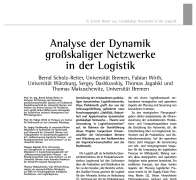
Analysis of Dynamics of Large-Scale Logistics Networks

Analysis of Dynamics of Large-Scale Logistics Networks

Bernd Scholz-Reiter ORCID Icon, Fabian Wirth, Sergey Dashkovskiy, Thomas Jagalski, Thomas Makuschewitz
Planning and control of logistics processes is more and more determined by an increasing complexity of structure of logistics networks and dynamics. However, in many aspects methods and tools for a comprehensive analysis of large-scale logistics networks are missing. This set of problems is the object of investigation in the new research project ‘Stability, Robustness and Approximation of Dynamic Large-Scale Networks - Theory and Applications in Logistics Networks’ founded by Volkswagen Foundation. The project will be run in a dual way: Mathematicians from the university of Bremen und the university of Würzburg cooperate with researchers from the field of engineering of the university of Bremen.
Industrie Management | Volume 24 | 2008 | Edition 3 | Pages 37-40
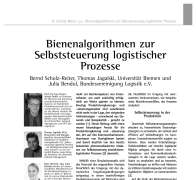
Autonomous Control of Production Systems using Honey-Bee-Algorithms

Autonomous Control of Production Systems using Honey-Bee-Algorithms

Bernd Scholz-Reiter ORCID Icon, Thomas Jagalski, Julia Bendul
This paper focuses on the application of a bee-like autonomous control method to a matrix-like shop floor model with setup times.Apparently present planning and control systems are unable to cope with the new needs for flexiblity and process reliability resulting from dynamics and complexity in the environment. Autonomous control means de-centralized coordination of intelligent logistic objects in a dynamically changing environment. By the aid of a continuous flow simulation the system’s performance will be analyzed in regard to the application effect on throughput times and inventory levels.
Industrie Management | Volume 23 | 2007 | Edition 5 | Pages 7-10
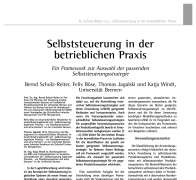
Autonomous Control in Practice

Autonomous Control in Practice

Ein Framework zur Auswahl der passenden Selbststeuerungsstrategie
Bernd Scholz-Reiter ORCID Icon, Felix Böse, Thomas Jagalski, Katja Windt
Production logistics has seen the introduction of autonomous control strategies, which had been implemented with different modelling methods. Additionally a standardising body of tools for the evaluation of autonomous control strategies has been set up. This article presents a framework, which helps to identify the appropriate autonomous control strategy together with the corresponding modelling approach for given production logistics scenarios.
Industrie Management | Volume 23 | 2007 | Edition 3 | Pages 7-11
Autonomous Control of Logistic Processes in Production Networks

Autonomous Control of Logistic Processes in Production Networks

Bernd Scholz-Reiter ORCID Icon, Thomas Jagalski, Christoph de Beer
Autonomous control strategies for production logistic processes have already demonstrated their effectiveness on the shop-floor level. This article can be understood as a proof of concept: It is exemplarily shown that a pheromone-based autonomous control strategy can lead to better performance than a central control system when applied to a production network regarding production and transport logistic processes in a holistic way.
Industrie Management | Volume 23 | 2007 | Edition 1 | Pages 19-22