Software

Digital Document Management – Methodical Support for the Introduction of Document Management Software in Production Environment

Digital Document Management - Methodical Support for the Introduction of Document Management Software in Production Environment

Methodische Unterstützung zur Einführung von Dokumenten-managementsystemen in produktionsnahen Unternehmensbereichen
Stefan Treber, Emanuel Moser, Jonas Schneider, Gisela Lanza ORCID Icon
Industrial companies face the challenge to manage an increasing number of documents digitally and reliably. Document Management Software (DMS) enables the efficient generation, retrieval and filing of documents. However, the range of software solutions is vast. Furthermore, many introduction projects fail due to inherent organizational challenges. This article introduces a methodology for preparing the successful implementation of a DMS in both theory and practice.
Industrie 4.0 Management | Volume 33 | 2017 | Edition 4 | Pages 17-20
Industrial Big Data: Data-Driven Process Understanding

Industrial Big Data: Data-Driven Process Understanding

Modern Information Management in Production
Thomas Thiele, Max Hoffmann, Tobias Meisen
The digital transformation led to disruptive changes in business models of leading companies. Big Data serves as one of the key enables in this area. The transfer of this concept in the production domain towards an Industrial Big Data is key challenge for producing companies. Although exemplary key projects exist, no available characterization of structural elements in Industrial Big Data Processes exists. Therefore, this article aims at presenting initial structural elements of Industrial Big Data projects based on exemplary use cases.
Industrie 4.0 Management | Volume 33 | 2017 | Edition 4 | Pages 57-60
Lean Information Economy as Challenge of Modern Industry

Lean Information Economy as Challenge of Modern Industry

Einsatz der Lean-Philosophie zur Identifizierung wertschöpfender Informationen
Susanne Altendorfer-Kaiser, Johannes Kapeller, Georg Judmaier
The information economy is characterized by an excessive supply of data and information, which makes it difficult to establish an optimal information management. Therefore, this paper deals with the challenge of how an efficient information logistics can be established. An approach using the lean philosophy for identification and categorization of information is presented. The paper concludes with a practical use case example outlining the feasibilty of this approach.
Industrie Management | Volume 31 | 2015 | Edition 2 | Pages 19-22
Agile Engineering in Mechatronic Machinery and Plant Construction

Agile Engineering in Mechatronic Machinery and Plant Construction

Effiziente Arbeitsgestaltung und -organisation in der Entwicklung von mechatronischen Maschinen und Anlagen
Thorsten Klein, Gunther Reinhart
Experts shape theses about the trends of Industrie 4.0 in the fields of human, technology and organisation. Whereas Industrie 4.0 often focuses on the intelligent networking of technical objects, this contribution considers human and organizational aspects of mechatronic engineering of manufacturing systems. Thereto, the theses of Industrie 4.0 are compared with the Agile Manifesto and agile principles using the example of the agile framework Scrum, showing that agile engineering can provide an innovative approach to the efficient job design and organisation in the age of Industrie 4.0.
Industrie Management | Volume 30 | 2014 | Edition 6 | Pages 59-63
Cloud-based Tool Management

Cloud-based Tool Management

Potenziale einer unternehmensübergreifenden Cloud-Lösung für ein digitales und automatisiertes Werkzeugmanagement
Marcus Röschinger, Dominik Stockenberger, Willibald A. Günthner
The networking between companies in a supply chain becomes tighter. This applies for manufacturing plants and the supply with manufacturing equipment as well. Hence, the complexity of the flow of information, in particular for tool management, increases. Currently the exchange of information is mostly paper-based and tool data is not available continuously along the supply chain. By using a digital and cloud-based tool management system, breaks in the flow of information along the supply chain for machining tools can be overcome. Herewith tool data can be called and updated ongoing and location-independent. Furthermore, after clearly identifying a tool, required tool data can automatically be transferred into the control system of the machine.
Industrie Management | Volume 30 | 2014 | Edition 3 | Pages 52-56
Formal Verification of UML-based Specifications

Formal Verification of UML-based Specifications

Prüfung der Korrektheit von Systementwürfen vor deren Implementierung
Mathias Soeken, Robert Wille, Rolf Drechsler
The design of complex systems usually starts with a natural language specification which serves as the basis for the ongoing implementation. To deal with the increasing complexity, these informal specifications are extended by means of formal modeling languages such as the Unified Modeling Language (UML) and the Object Constraint Language (OCL). They enable to check the specification for conceptual errors and inconsistencies before a precise implementation is available. This paper presents methods which make use of these possibilities. It is illustrated which errors can already exist in specifications and how they can be detected automatically.
Industrie Management | Volume 29 | 2013 | Edition 1 | Pages 44-48
Ecology in Contract Logistics

Ecology in Contract Logistics

Ein praxistaugliches Instrument zur Überwachung und Optimierung von Ressourcenverbräuchen
Jan Heitkötter, Ann-Kathrin Pallasch, Thomas Beck, Silke Kröger, Anna Podrygala
Logistics is one of the biggest trade volume industry sectors in Germany. External factors of influence are pushing the logistics sector to redesign its processes and operating activities environmentally. In the practical experience methodical tools are missing which help to identify environmental potential for optimization, to evaluate it and to document quantitatively the realized improvement. One possibility to combine the environmental and the financial point of view in intralogistics is demonstrating a novel reference model. With this model weaknesses can be identified and appropriate goals and activities can be defined to improve them. The combination of the reference model with a data base system affords to simulate and to review the effects of the activities just before their operational realization. The application of the reference model and its benefits for the contract logistics enterprises will be characterized in this article.
Industrie Management | Volume 27 | 2011 | Edition 6 | Pages 29-32
Choosing the Right Open Source Standard Software

Choosing the Right Open Source Standard Software

a Structured Approach
Carsten Brockmann, Dominik Henn
Standard software should be chosen based on the value created through it’s introduction within the firm. Business process improvements that are achieved after the software has been introduced create value for the company. Due to the vast amount of software companies and their products it is recommend to follow a structured approach when selecting standard software, assuring that a high degree of functional coverage and profitability surging through the introduction of the software are present. This approach is briefly introduced in this article.
Industrie Management | Volume 26 | 2010 | Edition 3 | Pages 9-12
Reference Model for Optimizing the IT Organization in the Order Fulfillment Process of SMEs

Reference Model for Optimizing the IT Organization in the Order Fulfillment Process of SMEs

Peter Dürr, Tobias Fröhlich
In building their IT environment, manufacturing companies usually confine themselves to the selection of isolated systems, for example an ERP system, neglecting the fact that the interaction of multiple IT systems is required to achieve an optimal IT organization. Especially small- and medium-sized enterprises (SME) often lack up-to-date knowledge in designing an IT environment aligned with the needs of the order fulfillment process. The European research project „SIMCET-TailorICT“, managed by the Fraunhofer IPA, has developed a reference model aimed at supporting SMEs in the design of a tailored system landscape in a systematic and standardized way. The objective is to strengthen the SMEs’ competitiveness.
Industrie Management | Volume 25 | 2009 | Edition 3 | Pages 61-64
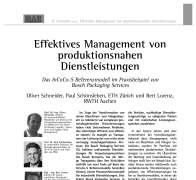
Effective Management of Business Related Services

Effective Management of Business Related Services

Using the InCoCo-S reference model
Oliver Schneider, Paul Schönsleben, Bert Lorenz
In recent years machine and plant manufacturers transformed to providers of complex after-sales services. After that transformation, many companies have problems in managing their activities effectively and efficiently. There is a lack of transparency on the not longer material driven processes. Bosch Packaging Services AG, as a provider of extensive after-sales services for the packaging machines sold by Bosch, realized the needed transparency through the development of two software tools on the basis of the InCoCo-S Reference Model, a process reference model for industrial services. Now Bosch Packaging Services is in the position to offer sustainable service contracts with adequate prices and realistic performance levels.
Industrie Management | Volume 24 | 2008 | Edition 2 | Pages 71-74
1 4 5 6 7