Simulation

Demand Planning Falcon

Demand Planning Falcon

Precise stochastic demand calculation with a newly developed digital planning method
Alexander Schmid, Thomas Sobottka, Samuel Luthe, Wilfried Sihn
Precise stochastic demand calculation is the key to successful material planning, i. e. to always have exactly the right quantity on hand. However, decision-makers are faced with the dilemma of which of the many forecasting methods they should use, adapted to the item properties as much as possible. This paper examines the optimization potential of a self-developed automatically optimizing forecasting approach based on ten common forecasting methods, which are evaluated using two case studies from the capital goods industry.
Industrie 4.0 Management | Volume 38 | 2022 | Edition 6 | Pages 47-50 | DOI 10.30844/IM_22-6_47-50
“Data Generated by Cyber-Physical Systems Will Play a Decisive Role”

"Data Generated by Cyber-Physical Systems Will Play a Decisive Role"

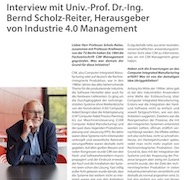
Interview with Prof. Bernd Scholz-Reiter, former editor of Industrie 4.0 Management
Bernd Scholz-Reiter ORCID Icon, Bernd Scholz-Reiter ORCID Icon
Professor Bernd Scholz-Reiter studied industrial engineering at the Technical University of Berlin. After several positions in Germany and abroad, he accepted the call to the University of Bremen in 2000, where he initially held the professorship of Planning and Control of Production Systems in the Department of Production Engineering. From 2002 to 2012, he also headed the Bremen Institute for Production and Logistics (BIBA). From 2012 to 2022, Bernd Scholz-Reiter was rector of the University of Bremen.
Industrie 4.0 Management | Volume 38 | Edition 6 | Pages 6-8
Digital Product Optimisation for the Use of Additive Manufacturing

Digital Product Optimisation for the Use of Additive Manufacturing

Michael Wahl, Martin Bonenberger, Julian Morbach, Adrian Huwer ORCID Icon, Lauri Hoffmann
Additive manufacturing, i.e. the printing of three- dimensional workpieces from different materials, offers the possibility of quickly producing functional prototypes. Digital optimisation is an important building block for the rapid implementation of functional product ideas. Based on digital models, the product is virtually optimised and continuously improved. Once the product has been digitally optimised in terms of its properties, it is checked and, if necessary, adapted for additive manufacturing. The product is then manufactured, reworked and finally tested. The article shows the optimisation possibilities using the example of a dispenser from the food industry. An existing component is digitised, a flow optimisation is carried out on the digital model and the improved product is additively manufactured.
Industrie 4.0 Management | Volume 38 | 2022 | Edition 5 | Pages 25-29 | DOI 10.30844/IM_22-5_25-29
Container Terminal Automation − Success Factors for the Management of Straddle Carrier Automation

Container Terminal Automation − Success Factors for the Management of Straddle Carrier Automation

Erfolgsfaktoren für das Management der Automatisierung von Straddle Carriern
Sebastian Eberlein, Stephan Oelker, Serge Jacovis, Vanessa Beckmann, Michael Freitag ORCID Icon
Efficiency in container terminal operations is key for competitiveness. Many large German terminals use the flexible but relatively risk-laden manned straddle carriers (SCs). The research project STRADegy evaluated the reliability and profitability of automated SCs in northern-German container terminals via a combination of a pilot installation and an emulation at the container terminal in Wilhelmshaven. Parallel to that, rollout-guidelines were developed. This paper introduces central results regarding a successful rollout of auto-SC-systems.
Industrie 4.0 Management | Volume 37 | 2021 | Edition 6 | Pages 6-10
Energy-Efficient Planning of Value-Added Networks

Energy-Efficient Planning of Value-Added Networks

Integration von Energieeffizienz in die strategische Gestaltung von Produktions- und Logistiknetzwerken
Lucas Schreiber, Lea Vliegen, Jan-Philipp Jarmer, Andreas Günter, Christian Hohaus, David Grimm, Andrea Vennemann, Christian Fischer
When selecting a new refrigerator, energy efficiency is a decisive selection criterion. However, in the strategic and tactical planning of value-added networks, this is not yet the case. The E²-Design-toolbox enables energy efficiency to be considered in the planning process of production and logistics networks, in addition to the classic performance and cost variables. The early integration allows to draw on the overall potential. This paper presents the underlying energy data, the optimization modules, and the user’s perspective.
Industrie 4.0 Management | Volume 37 | 2021 | Edition 4 | Pages 51-54 | DOI 10.30844/I40M_21-4_S51-54
Project LoTuS – Energetic Optimization of Parts Drying

Project LoTuS - Energetic Optimization of Parts Drying

Projekt LoTuS: Ansätze zur energetischen Optimierung von Reinigungsanlagen mit integrierter Trocknung
Ghada Elserafi, Adrian von Hayn, Matthias Weigold
Due to rising quality requirements in the metalworking industry, parts drying has been gaining significance, leading to the increasing importance of reducing the energy consumption of drying processes. Therefore, the LoTuS project investigates different approaches to increase drying efficiency. Along with alternative drying technologies, process digitization is employed to provide sufficient transparency for part-specific drying. Using sensor data, artificial intelligence is utilized for process monitoring. Peak demand is further reduced by implementing load management techniques.
Industrie 4.0 Management | Volume 37 | 2021 | Edition 4 | Pages 8-11 | DOI 10.30844/I40M_21-4_S8-11
High Performance Technology for SMEs

High Performance Technology for SMEs

Wie auch kleine und mittlere Unternehmen Simulationstechnologien nutzen können
Andreas Wierse
Efficient product development can be a decisive factor in a company’s competition - it quickly falls behind who has to cope without simulation technologies. For large companies, these have long since become part of everyday life. But for small and medium-sized companies, they often remain wishful thinking for reasons of capacity and know-how. But: They, too, can benefit from the advantages of simulation with the right support and appropriate training programs.
Industrie 4.0 Management | Volume 36 | 2020 | Edition 3 | Pages 61-64
Modeling and Simulation of Complex Systems with Annotated JavaScript

Modeling and Simulation of Complex Systems with Annotated JavaScript

Stefan Bosse
Designing and simulating complex mechatronic and distributed intelligent systems requires a unified system modeling and programming language. This paper presents JavaScript as a unified modeling and programming language by extending JavaScript with a semantic type system JST to bridge the gap between models and implementations. The result is the JS+ Superset language, which combines typing, modeling and programming. Different model domains and their relation to the JS+ programming model including some generic transformation rules are shown using the example of a sensory material. Finally, the multidomain simulation tool SEJAM is introduced, which combines physical and data processing simulation with agents.
Industrie 4.0 Management | Volume 35 | 2019 | Edition 1 | Pages 47-52
Automation of Container Terminals

Automation of Container Terminals

Concept for the Design of a Pilot Installation and Emulation-Based Evaluation of Scalability
Sebastian Eberlein, Stephan Oelker, Joy Schumacher, Michael Freitag ORCID Icon
German sea and inland ports are of outstanding importance for Germany as a base for manufacturing and logistics. In the last decades, the port sector underwent several structural changes. Currently, the expected autonomation and digitalization of the entire supply chain create entirely new challenges for the port industry. In this context, the present article describes a planning approach for the development of an automated straddle carrier in northern German seaports. To evaluate both the reliability and the profitability of such an automated system, a planning approach, consisting of two fundamental steps, was chosen: (1) At first, in order to perform prototypical experiments, a pilot installation will be established in the area of the container terminal in Wilhelmshaven (CTW). (2) Based on this, the system’s suitability for the operative conditions in a mega container terminal is evaluated using a simulation and emulationbased planning approach.
Industrie 4.0 Management | Volume 34 | 2018 | Edition 6 | Pages 25-29
The Appropriate Degree of Autonomy in Cyber-Physical Production Systems

The Appropriate Degree of Autonomy in Cyber-Physical Production Systems

Norbert Gronau ORCID Icon
Existing factories face multiple problems due to their hierarchical structure of decision making and control. Cyber-physical systems principally allow to increase the degree of autonomy to new heights. But which degree of autonomy is really useful and beneficiary? This paper differentiates diverse definitions of autonomy and approaches to determine them. Some experimental findings in a lab environment help to answer the question raised in this paper.
Industrie 4.0 Management | Volume 34 | 2018 | Edition 6 | Pages 7-12 | DOI 10.30844/I40M_18-6_7-12
1 2 3 6