knowledge management

Technology-related Innovation Management with Innovation-Database

Technology-related Innovation Management with Innovation-Database

Jürgen Gausemeier, Volker Brink, Stephan Ihmels
Product innovations are mainly based on a future-oriented alignment of technology push and market pull. The alignment of both aspects with regard to conformity to the corporate strategy is carried out in the context of the strategic product and technology planning, which is the initial point within the product design process. The integral element of this paper is a data base-system which allows performing the tasks of strategic product and technology planning. In particular, information about technologies, product ideas and market segments are represented and related with each other. Typical applications are the design of morphologic boxes an innovation roadmaps.
Industrie Management | Volume 25 | 2009 | Edition 1 | Pages 40-44
Open Innovation Processes in the Life Science Industry

Open Innovation Processes in the Life Science Industry

How SMEs should plan and manage them
Norbert Gronau ORCID Icon, Guido Reger, Silvia Adelhelm, Julian Bahrs, Gergana Vladova
The research project “Open Innovation in Life Sciences” (project duration May 2008-April 2011) aims at the development and implementation of new innovation strategies and concepts for SMEs in the life sciences segment. In particular inside-out and outside-in processes in joint innovation projects beyond firm boundaries are analyzed. The life sciences segment is known as being highly research intense and interdisciplinary. As a result of the growing complexity of innovation processes, the development of cooperative, i.e. open innovation strategies for SMEs has become more important. SMEs can gain the capability to tap crucial innovation potentials by bundling distributed complementary knowledge. The article describes the development of a method which might help to evaluate opportunities and risks of different innovation concepts. This may serve as basis for decision-making regarding the implementation of a predefined innovation process. Project outcomes are expected to be an ...
Industrie Management | Volume 25 | 2009 | Edition 1 | Pages 9-12
Knowledge Management in Design of Micro Production Manufacturing Process Chains

Knowledge Management in Design of Micro Production Manufacturing Process Chains

Nutzung von Wiki in Forschungsnetzwerken
Bernd Scholz-Reiter ORCID Icon, Michael Lütjen ORCID Icon, Nele Brenner
The shortening of both time to market und product life cycle in combination with an increase of cost pressure, demand a fast and flexible product development process. The idea of simultaneous engineering is to gain time by treating product, process and resources in parallel and thus discovering discrepancies faster and adjusting the necessary factors. In order to establish an efficient knowledge management a wiki platform, here acting as a social software, is introduced. It serves as a centre of navigation within the process chain and supports the communication between the subprojects. Content can be edited by any member of the research project and may be discussed and changed by others. Its fast and free implementation qualifies the wiki tool and offers a secure and easy to handle platform.
Industrie Management | Volume 24 | 2008 | Edition 3 | Pages 53-56
To Decide Correctly, Designing Learning Effects

To Decide Correctly, Designing Learning Effects

Günther Schuh ORCID Icon, Sebastian Gottschalk, Bastian Franzkoch, Axel Hoeschen
Due to shortening product life cycles, complex supplier networks and an increasing number of parties involved, the decision making process has become both more critical and more difficult. The complexity and dynamics of the ramp-up phase make it necessary to not try to concentrate the decisions in on hand, but rather distribute decisions among decentralized yet competent decision makers on-site. It is, however, necessary to provide the decentralized decision makers with the basis and the capability of decision making, and a joint target system to ensure optimal outcome. The paper presents a heuristic approach to design and operate production ramp-up appropriate to stable and efficient ramp-up processes.
Industrie Management | Volume 23 | 2007 | Edition 3 | Pages 71-74
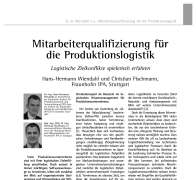
Employee Training in Production Logistics

Employee Training in Production Logistics

Learning about Conflicting Logistic Objectives with a Simulation Game
Hans-Hermann Wiendahl, Christian Fischmann
Many manufacturing firms are dissatisfied with the fulfilment of their logistic objectives. Instead of investing in ever powerful software tools, it is worthwhile to start out by identifying organizational stumbling blocks and knowledge gaps among employees. For this reason, the Fraunhofer IPA analyzed the training activities in manufacturing businesses when introducing ERP or MES systems. Knowledge gaps point to the need for training the logistics skills of the production operators. This paper describes a simulation game developed for this purpose, which can be used as a building block of the logistics knowledge management of manufacturing firms.
Industrie Management | Volume 23 | 2007 | Edition 2 | Pages 25-28
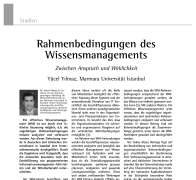
Prevailing Circumstances for Knowledge Management

Prevailing Circumstances for Knowledge Management

Between Requirement and Reality
Yücel Yılmaz
An effective knowledge management is only possible through an indirect management, i.e. associated circumstances have to be analyzed and improved. From this objective in German and Turkish enterprises in Istanbul an enterprise study was performed. It has been noticed from the findings of the research that the answers differentiate significantly according to execution of programmed information management activities and the number of employees.
Industrie Management | Volume 23 | 2007 | Edition 1 | Pages 72-75
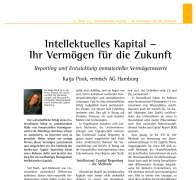
Intellectual Capital: Your Future Assets

Intellectual Capital: Your Future Assets

Reporting and Development of Intangible Assets
Katja Pook
Corporate success depends increasingly on immaterial assets. These are hard to assess, evaluate and shape. Only a few companies manage them systematically. Intellectual Capital Reporting provides a framework and opens the way for sustainable management of intangible assets.
Industrie Management | Volume 22 | 2006 | Edition 6 | Pages 45-46
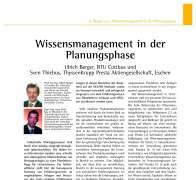
Knowledge Management in the Automotive Industry

Knowledge Management in the Automotive Industry

A research approach for complex sub-assemblies
Ulrich Berger, Sven Thiebus
Assembly processes are characterized by increasing complexity. Fast ramp-up is a question of vital importance due to the high invests for production lines. A key factor to success is the integrated reuse of experience concerning similar machines and processes. In many cases experiences from shop floor level remain unused in new projects. A main obstacle on production level is to identify and record experience rapidly and precisely. This concept was developed on the base of the Delphi-Method to process experiences of employees effectively and efficiently.
Industrie Management | Volume 22 | 2006 | Edition 6 | Pages 39-41
Requirement and Knowledge Oriented Team Formations

Requirement and Knowledge Oriented Team Formations

Jane Fröming, Simone Schmid, Uwe Rüßbüldt, Norbert Gronau ORCID Icon
The allocation of available knowledge, the creation of new knowledge as well as the preparation of knowledge as a foundation for a companywide use are main tasks in the area of knowledge management. Even if the euphoria was declining during the last years, knowledge management instruments can contribute decisively to the creation of value in many divisions. In this article it will be shown how a staffing module, which is based on knowledge management, can make an important contribution for the composition of project teams.
Industrie Management | Volume 22 | 2006 | Edition 5 | Pages 12-14
Process-Based Knowledge Management in Product Development

Process-Based Knowledge Management in Product Development

Phasenübergreifender Wissenstransfer unterstützt den Produktentwicklungsprozess
Sigrid Wenzel ORCID Icon, Christian Willmann
Preserving and re-using experience and knowledge from employees is a decisive task in industrial engineering. In this context the usage of tools for knowledge management is highly up-to-date, however a concrete implementation starts very unassertively in practise. The article discusses advisability and feasibility of a process-based knowledge management. A method of resolution in form of a knowledge infrastructure is worked out exemplary for the two phases “product planning” and “product design” linking the tools of knowledge management with knowledge-related tasks of the product development process.
Industrie Management | Volume 22 | 2006 | Edition 5 | Pages 43-46
1 3 4 5 6