knowledge management

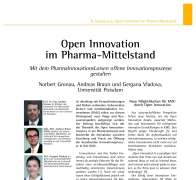
Open Innovation in the Pharmaceutical Small Firm Sector

Open Innovation in the Pharmaceutical Small Firm Sector

Mit dem PharmaInnovationsLotsen offene Innovationsprozesse gestalten
Norbert Gronau ORCID Icon, Andreas Braun, Gergana Vladova
Innovation is a central determinant of the competitiveness of a company. The discovery, development and realization of innovative ideas are, however, bound up with challenges and risks. Against this backdrop, new paths and resources must be demonstrated, particularly for small and mid-sized enterprises (SME). This article is concerned with the open-innovation approach in the pharmaceutical industry and describes the interaction between research and practice to open the existing innovation processes in three SME.
Industrie Management | Volume 27 | 2011 | Edition 5 | Pages 9-12
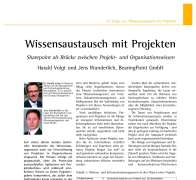
Knowledge Transfer with Projects

Knowledge Transfer with Projects

SharePoint as a Bridge to the Organisation
Harald Voigt, Jens Wunderlich
Knowledge management around projects has been supported for a long time by a host of software applications. But still the knowledge exchange between organisation and projects is weak throughout the project cycle: from project inception where company knowledge is ignored to transfer of results to the dump of collective company data. Social media bring about a sense of communication which may help to solve some of these problems - if it can be successfully implemented. We explore how SharePoint can be employed to enhance the knowledge transfer between organisations and their projects.
Industrie Management | Volume 27 | 2011 | Edition 4 | Pages 23-26
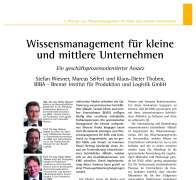
Knowledge Management for Small and Medium Sized Enterprises

Knowledge Management for Small and Medium Sized Enterprises

A Business Process Oriented Approach
Stefan Wiesner, Marcus Seifert, Klaus-Dieter Thoben ORCID Icon
The handling of customer-individual requirements, product variants and a worldwide market requires the professionalization of knowledge-intense processes. Small and Medium sized Enterprises (SME) often have excellent individual competencies, but lack a systematic management of the associated knowledge. IT-solutions for Knowledge Management in SMEs provide limited functionalities and are thus rarely used. Therefore, a need exists for the business process oriented approach for Knowledge Management in SMEs, featured in this article. Implemented in a portal for information management, it supports optimization of knowledge-intense processes.
Industrie Management | Volume 27 | 2011 | Edition 4 | Pages 31-34
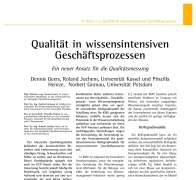
Quality in Knowledge Intensive Business Processes

Quality in Knowledge Intensive Business Processes

A New Approach for Measure Process Quality
Dennis Geers, Roland Jochem, Priscilla Heinze, Norbert Gronau ORCID Icon
Continuous attempt for improvement as well as the permanent impulse to explore and eliminate failures and flaws belong to the classical quality mindset, which is also reflected in CIP approaches. However, it is often difficult to systematically identify improvement potentials with minimal expenses, especially in knowledge intensive business processes. A purposefully combined disciplines and instruments of quality management, process management and knowledge management enables the development of a maturity model adjusted to the needs of SME. This maturity model, based on the methods of CIP, serves to uncover the potentials in the knowledge process. The following contribution demonstrates the development, application as well as the value of employing the quality-oriented maturity model for knowledge intensive business processes.
Industrie Management | Volume 26 | 2010 | Edition 4 | Pages 9-12
Blended Enterprise – a Realistic and Attractive Concept for Knowledge Management

Blended Enterprise - a Realistic and Attractive Concept for Knowledge Management

Michael Reiss, Dirk Steffens
The concept enterprise 2.0 stands for the enabling of new forms of know-ledge management by utilizing internet technology. While web 2.0 focuses on tools for communication, relationship management and learning, i.e. weblogs, wikis, and social networking platforms, enterprise 2.0 also covers the strategy, structure, and culture of knowledge management, and thus encompasses the entire enterprise. The authors argue that the vision of a blended enterprise is superior to existing non-hybrid enterprise 2.0-visions in terms of both feasibility and performance.
Industrie Management | Volume 26 | 2010 | Edition 1 | Pages 21-24
Making Tangible the Benefit of Knowledge Management

Making Tangible the Benefit of Knowledge Management

Harald Voigt, Bearing Point
For many years now, it is a widespread goal of knowledge management to employ knowledge as a resource: Projects aim - but often fail - at optimising processes of generating, distributing, and applying knowledge. This can be attributed in many cases to (one of) three causes: - The basic difference between “knowledge” and “data” is misunderstood - The benefit of knowledge management seems to be regarded as inevitable, while it is not defined as a tangible goal - Projects focus on ideal concepts and processes, losing contact with organisational realities We show how to avoid those pitfalls, how to identify the potential of knowledge management and how to realise it.
Industrie Management | Volume 26 | 2010 | Edition 1 | Pages 17-20
Business Process Analysis and Knowledge Management using Social Networks

Business Process Analysis and Knowledge Management using Social Networks

Edzard Weber, Christian Scharff
This article describes an opportunity to model actors and systems in various business processes into an overall model by using the technique of networking. To achieve this goal, an algorithm is introduced. Next, different metrics based on social network analysis, are described. These metrics are able to expose parts of the network which have a huge utilization and therefore the underlying process itself. With this technique it is possible for project leaders, managers and decision makers to analyze the processes for flaws, finding out capacities and to build new project teams together (staffing).
Industrie Management | Volume 26 | 2010 | Edition 1 | Pages 13-16
Control Panel for Unpredictable Organizational Processes

Control Panel for Unpredictable Organizational Processes

Ein Modell für globales Kollaborations- und Wissensmanagement
Eldar Sultanow, Edzard Weber
Particularily in local processes the search for and dispersion of information as well as the recognition of experts, resources and their availability all takes place by direct social interaction. In distributed time-constrained processes or decentralisable, formal processes employees have to question this information , especially if problems arise. The adequate visualisation and navigation of this information is a reason for the fact that persons responsible for processes can quickly orientate themselves to be able to react adequately in an altered situation. This contribution develops a model for the simulation and visualisation of the collaboration in such situations by means of semantic nets and Web3D.
Industrie Management | Volume 26 | 2010 | Edition 1 | Pages 41-44
Logistics Systems Planning

Logistics Systems Planning

Procedure models and formalization of planning knowledge
Tobias Sommer, Dirk Marrenbach ORCID Icon, Karl-Heinz Wehking
Current changes in market situations may compel companies to adapt their products, manufacturing systems, as well as logistics systems. Required planning procedures are characterized by their complexity and their interdisciplinary nature: A system that has to fulfil future requirements is designed using models, methods, and the knowledge of all involved participants. Therefore, this article aims to discuss procedure models applied in different disciplines in order to assess their usability in logistics planning projects. Furthermore, certain aspects of planning procedures are identified that require formalization of applied knowledge. Thus, an approach to apply knowledge formalization is presented.
Industrie Management | Volume 25 | 2009 | Edition 5 | Pages 57-60
Providing Workspace Knowledge to Support Individual Learning Processes

Providing Workspace Knowledge to Support Individual Learning Processes

Veränderung der Qualifikation durch die Digitale Fabrik
Christian Willmann, Sigrid Wenzel ORCID Icon
In the manufacturing industry, the digital factory plays a decisive role for modern engineering. By linking all information and data from the various stages of factory planning, an efficient and holistic planning and continuous improvement of products, processes and resources is possible. The use of changed processes and new tools needs other and advanced competencies respectively as well as a continuous learning of involved employees. IT-based and stronger parallelized planning processes require also a change in organization and working culture. This article analyzes how the qualification of employees looks on the face of the digital factory utilizing the management of knowledge and learning.
Industrie Management | Volume 25 | 2009 | Edition 2 | Pages 51-54
1 2 3 4 6