knowledge management

Authentic Knowledge Management (KM) Applying KM to KM

Authentic Knowledge Management (KM) Applying KM to KM

Ingrid Scheele, Bernd Bredehorst
Knowledge Management is for many projects a future target whereby the potential of using KM during the project is unfortunately neglected. This starts with the project teams who know nothing about each other and continues with the way in which knowledge management concepts are designed: “in private”. The article describes connections between process optimisation, enterprise culture and knowledge management as well as the “KM²” procedure in the joint project WISMA, where the acceptance for changes and authentic handling during the project is the focal point right from the beginning.
Industrie Management | Volume 21 | 2005 | Edition 1 | Pages 41-44
Applications and Systems for Knowledge Management a Market Survey

Applications and Systems for Knowledge Management a Market Survey

Norbert Gronau ORCID Icon, Stefan Dilz, André Kalisch
This market survey gives an overview on software for the support of knowledge management. The survey overlooks the span from specialized search engines to integrated knowledge management systems with a broad range of functions. The investigated software supports community-oriented approaches as well as information retrieval. Usage possibilities are as different as the heterogenous requirements of enterprises and organizations for knowledge management. Therefore a direct comparison between the investigated tools is not useful.
Industrie Management | Volume 21 | 2005 | Edition 1 | Pages 53-59
Multi-medial Information Systems for Manual Workstations

Multi-medial Information Systems for Manual Workstations

Process Stability and Efficiency Increase by Providing and Feed-Backing of Correct and Current Information
Klaus Feldmann, Stefan Lang
To an increasing degree process stability and documentation gain in importance on manual workstations because of the demand to lot size 1 and the duty of flexibility. To ensure efficiency increase regarding to harder quality guidelines, the flow of information to the worker and back have to be optimised and realised resistant against failures and information loss. The use of multi-medial, IT-based worker information systems to assist workers conducting their tasks and to enable a backflow of relevant information like quality data, waste quantities etc. with current technical methods offers a possible solution.
Industrie Management | Volume 21 | 2005 | Edition 1 | Pages 25-28
Process Optimization Using Knowledge Management

Process Optimization Using Knowledge Management

Strategic Employment of Methods for Medium-Sized Enterprises
Eberhard Abele, Sven Kuhn, Tobias Liebeck
Although medium sized enterprises ascribe high importance to knowledge management and its impact on company’s success, they have rarely undertaken steps to introduce respective methods. Only a small share of companies applies selected methods, usually rather sporadic and without connection to corporate strategy or other management techniques. The reason lies in the lack of a tool for choosing the most suitable methods. Out of the multitude of instruments available for knowledge management, it is difficult to decide about a method mix fitting best to respective business processes, initial situation and specific demands of the company. This paper presents a concept to manage these shortcomings.
Industrie Management | Volume 21 | 2005 | Edition 1 | Pages 13-16
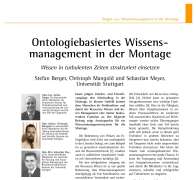
Ontology Based Knowledge Management for Assembly

Ontology Based Knowledge Management for Assembly

Effectively utilizing knowledge in turbulent times
Stefan Berger, Christoph Mangold, Sebastian Meyer
Turbulent business environments force enterprises to ever faster answers and adaptions in order to secure their competitive ability. Mutability and responseability as crucial success factors are based finally on knowledge, which must be continuously improved and renewed. The article shows starting points and how ontology based knowledge management can be used purposefully for the increase of the mutability in and by enterprises and in particular in the assembly.
Industrie Management | Volume 21 | 2005 | Edition 1 | Pages 49-52
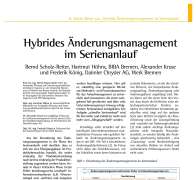
Hybrid Product Change Management in the Ramp-up Phase of the Automotive Industry

Hybrid Product Change Management in the Ramp-up Phase of the Automotive Industry

Bernd Scholz-Reiter ORCID Icon, Hartmut Höhns, Alexander Kruse, Frederik König
The fact that the ramp-up phase is a highly critical and economically important stadium within the product lifecycle for both suppliers and OEMs implies that an efficient product change management is applied to meet the goals of cost, quality, and time. This article introduces a combined management concept called hybrid product change management. By recombining existing management solutions, such as the standard processes matching certain product change types and the product change processes based on process elements, enterprise networks are enabled to coordinate all product change projects. This aspect is described further by giving an idea of how this hybrid product change management can be supported in terms of information and communication technology and knowledge management.
Industrie Management | Volume 20 | 2004 | Edition 4 | Pages 21-24
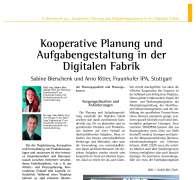
Co-operative planning in the context of Digital Factory

Co-operative planning in the context of Digital Factory

Sabine Bierschenk, Arno Ritter
An intensive co-operation and data exchange between members of different disciplines are necessary in planning, conception and development of production plants and processes. Planning failures that are identified too late or different understanding of contents can lead to significant effects, e.g. during starting or ramp-up. In the context of the Digital Factory the Fraunhofer IPA develops organizational and technological solutions for co-operative planning on the base of workflow and knowledge management as well as solutions for interaction, data and tool integration. The aim is the optimisation of planning quality and planning costs.
Industrie Management | Volume 20 | 2004 | Edition 3 | Pages 71-73
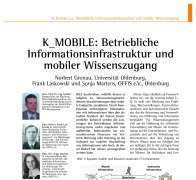
K_MOBILE—Enabling Mobile Access to Information and Knowledge

K_MOBILE—Enabling Mobile Access to Information and Knowledge

An approach for extending enterprise information infrastructures
Norbert Gronau ORCID Icon, Frank Laskowski, Sonja Martens
Software supporting knowledge management and knowledge intensive business processes is mainly planned and deployed for stationary use. The average time needed to process information can effectively be reduced by adding a mobile channel to existing knowledge management software, e.g. when negotiating with business partners or maintaining individual technical installations. In this paper the authors describe K_MOBILE, a concept enabling access to knowledge management services through the mobile channel in a situation aware manner. Access to information systems can be truly adopted to mobile use, with help of a user specific context built by combining available information with respect to time and location. This is a benefit especially when carrying out intensive tasks in sale, consulting, technical services, because it is difficult to estimate the actual need for information and hence the costs of access to this information is potentially very high.
Industrie Management | Volume 19 | 2003 | Edition 6 | Pages 21-24
Optimisation of Knowledge Transfer in R&D Projects

Optimisation of Knowledge Transfer in R&D Projects

Peter Müller-Baum
Knowledge transfer is critical for the success of R&D projects in terms of supply, usage and multiplication of knowledge within and between projects. However, possibilities to opti-mise knowledge transfer do hardly exist since the application of structured methods appears to be hard to realise because of criteria specific for R&D projects like creativity, incertitude and little structuring. In the following, a concept is introduced that establishes transparency according to knowledge transfer in R&D projects and creates a basis to use potentials for optimising knowledge transfer by specific application of knowledge management methods.
Industrie Management | Volume 19 | 2003 | Edition 5 | Pages 54-57
Communities of Practice in Industrial Enterprises

Communities of Practice in Industrial Enterprises

Dieter Spath, Martin Müller, Marc Rüger
Knowledge Management has become one of the most recognized management concepts in the last decade. Knowledge is the critical success factor to sustain the competitive ability in companies but changes rapidly in today’s dynamic business environment. Therefore, companies are obliged to foster the knowledge transfer and development. “Community of Practice” is a team-building method to support the efficient use, communication and creation of knowledge in industrial and manufacturing enterprises.
Industrie Management | Volume 19 | 2003 | Edition 3 | Pages 14-17
1 4 5 6