Industry 4.0

Effort and Benefits of IIoT Platforms

Effort and Benefits of IIoT Platforms

A systematic approach to identifying when to implement common use cases in SME
Rainer Eber, Steffen Schwarzer, Yannik Müller, Dennis Kollmann
SME often encounter risks and obstacles when implementing IIoT solutions, but these challenges can be mitigated with the use of an IIoT platform. To select the appropriate platform, a decision- making approach has been developed. By choosing the right use cases, companies can directly benefit from IIoT implementation and gain a competitive edge in the market. Our research indicates that at least three applications have a favorable balance between benefits and effort. Once successfully implemented, these applications can be expanded and scaled as the company becomes more digitally proficient.
Industrie 4.0 Management | Volume 39 | 2023 | Edition 5 | Pages 22-26
Digital Transformation for SMEs

Digital Transformation for SMEs

Developing a roadmap for Industry 4.0 visions in small and medium-sized enterprises
Robin Sutherland ORCID Icon, Nicolas Wittine ORCID Icon, Deike Gliem ORCID Icon, Sigrid Wenzel ORCID Icon
Small and medium-sized enterprises still face the challenge of shaping their digital transformation. Maturity models offer a way to capture the situation within a company and support the formation of an Industry 4.0 vision. This paper presents a methodology that companies can use to develop a roadmap for shaping digital transformation by enabling the transfer of this vision into concrete decision-making steps.
Industrie 4.0 Management | Volume 39 | 2023 | Edition 4 | Pages 59-62 | DOI 10.30844/IM_23-4_59-62
Regulatory Framework for Artificial Intelligence Applications in the Industry 4.0 Context

Regulatory Framework for Artificial Intelligence Applications in the Industry 4.0 Context

Dirk Schmalzried, Marco Hurst, Jonas Zander, Marcel Wentzien
Artificial Intelligence methods can be structured according to different aspects. Applications within Industrie 4.0 can also be classified into levels and process groups using the RAMI framework or the ISA95 standard. However, a taxonomy is lacking that relates the classification of the application areas to the processes improved by machine learning methods while at the same time locating and evaluating them. Such a framework helps to classify new processes and solutions and supports finding suitable machine learning methods for concrete problems in the Industry 4.0 context.
Industrie 4.0 Management | Volume 39 | 2023 | Edition 3 | Pages 28-33 | DOI 10.30844/IM_23-3_28-33
I4S 1/2023: Digital Transformation (Special Issue)

I4S 1/2023: Digital Transformation (Special Issue)

Paving the way to the 4th Industrial Revolution
Industry 4.0 and Smart Factory have become a real source of hope and are the technological answer to some of the biggest challenges of our time: sustainable production, global interconnections, intelligent exchange of knowledge. This special issue discusses research questions relating to process improvement, artificial intelligence and factory software.
Comparing Industry 4.0 Maturity Models

Comparing Industry 4.0 Maturity Models

Jochen Schumacher, Norbert Gronau ORCID Icon
In recent years, numerous maturity models have been developed with the aim of providing a clear indication of the progress each company has made in terms of Industry 4.0 development. However, not all models include all aspects of Industry 4.0. The models are also not equally practical. This article offers an in-depth comparison and assessment of the comprehensiveness of the ten most important Industry 4.0 maturity models.
Industry 4.0 Science | Volume 39 | 2023 | Edition 1 | Pages 16-33 | DOI 10.30844/I4SE.23.1.16
Trends and Challenges in Factory Software

Trends and Challenges in Factory Software

Norbert Gronau ORCID Icon
Any networked information system that is used in the context of manufacturing and logistics in a factory can be referred to as factory software. This article describes six trends that will significantly influence the way software is used in factories in the near future. The trends are described in ascending order in terms of significance of impact.
Industry 4.0 Science | Volume 39 | 2023 | Edition 1 | Pages 114-119 | DOI 10.30844/I4SE.23.1.114
Industrial Subscription Business Models

Industrial Subscription Business Models

How Several Players Benefit in a Subscription Ecosystem
Markus Burger, Julia Arlinghaus ORCID Icon
Following the success of subscription models such as Netflix or Spotify in the IT and multimedia sector, the implementation of Industry 4.0 is increasingly creating the conditions for offering comparable models in the industrial context. Accordingly, pioneers are offering subscription models for printing machines, compressors or locomotives, for example. Providers do not act alone, but are supported in the design and implementation of the subscription offer by various players such as financiers, insurance companies or digitization service providers. This creates what is known as a subscription ecosystem. This article sheds light on these ecosystems and shows to what extent which players can participate in industrial subscription models. Depending on customer acceptance of these models, a wide variety of companies have the opportunity to benefit from the subscription trend and to tap into new markets and customer groups
Industrie 4.0 Management | Volume 38 | 2022 | Edition 6 | Pages 63-66
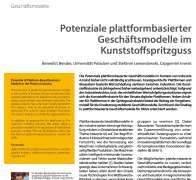
Potential of Platform-Based Business Models in the Plastics Industry

Potential of Platform-Based Business Models in the Plastics Industry

Benedict Bender, Stefanie Lewandowski
The potential of platform-based business models in the context of Industry 4.0 has not yet been fully realized. Approaches for platforms and ecosystem- based value creation vary between industries. The plastics industry has so far been widely ignored in this respect. Due to its industrial structure, in particular the uniform value creation structures, the plastics industry is suitable for digital platforms. In addition to approaches for platforms in the injection molding industry, the article offers a procedure model for the expansion of established business models. This can facilitate the entry into the field of platform-based business models for SMEs.
Industrie 4.0 Management | Volume 38 | 2022 | Edition 6 | Pages 14-18 | DOI 10.30844/IM_22-6_14-18
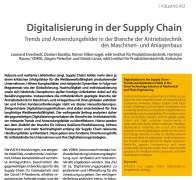
Digitalization in the Supply Chain

Digitalization in the Supply Chain

Trends and fields of application in the drive technology sector of the mechanical and plant engineering industry
Leonard Overbeck, Dardan Baralija, Rainer Silbernagel, Hartmut Rauen, Jürgen Fleischer, Gisela Lanza ORCID Icon
A robust and resilient supply chain is a critical success factor for the competitiveness of manufacturing companies. However, today’s supply chain faces various challenges, such as higher complexities and increasing dynamics coming from megatrends (i. e. globalization and sustainability). The medium-sized drive technology industry, with its global supply chains and high customer requirements, is particularly affected by these challenges. Therefore, digitalization initiatives are crucial. This article analyzes current digitalization projects in the drive technology industry in order to identify relevant trends and fields of application. Synthesized from the industry's target picture for higher resilience/ flexibility, greater transparency and more sustainability along the supply chain, these provide guidance for medium-sized companies and their digitalization strategies. (Only in German)
Industrie 4.0 Management | Volume 38 | 2022 | Edition 4 | Pages 23-27
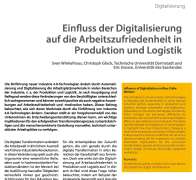
Influence of Digitalization on Blue-Collar Workers

Influence of Digitalization on Blue-Collar Workers

Christoph Glock, Eric Grosse ORCID Icon, Sven Winkelhaus
The introduction of new Industry 4.0 technologies is changing job characteristics in many manual industrial sectors, especially in production and logistics, through automation and digitization. Depending on the extent and degree of maturity, these changes are perceived differently by employees and can have both positive and negative effects on job satisfaction and motivation. This article uses the example of workplaces in in-house logistics to highlight how their characteristics change as a result of the introduction of Industry 4.0 technologies. It also presents a process model that can serve as a decision-making aid for companies to consider important implications for the successful transformation process and to pursue the human-centric design of manual, technically supported workplaces.
Industrie 4.0 Management | Volume 38 | 2022 | Edition 4 | Pages 53-56
1 3 4 5 17