factory planning

Lean Factory Design

Lean Factory Design

Das Landshuter Produktionssystem (LPS): CLean Production - Teil 3
Markus Schneider, Michael Ettl, Stefan Kaspar, Nicolas von Stülpnagel
An actual study about potentials and needs of action in the range of factory planning projects shows clearly that the used process models can’t handle the dynamic and the complexity in these projects. For this reason, the University of Applied Science Landshut has been developing within the Landshuter Produktionssystem (LPS): CLean Production - Lean & Clean a new factory planning methodology. This allows for the first time to design the factory structures from beginning based on lean criteria in connection with the planning and control. The method will also satisfy the requirements referred because of an agile process model.
Industrie Management | Volume 30 | 2014 | Edition 2 | Pages 15-21
Participative Layout Planning with Augmented Reality

Participative Layout Planning with Augmented Reality

Ein Ansatz zur Erweiterung der Layoutgestaltung in der Fabrikplanung mit AR-Techniken
Alexander Schlegel, Frank Börner, Egon Müller, Antonio Lavorgna
The layout planning represents a prime example of the interdisciplinary nature of factory planning. A comprehensive cooperation provides opportunities to involve ideas and experiences of as many people as possible, to exploit synergies, to realize a faster coordination of the planning status between the departments and thus improve the effectiveness and efficiency of the planning process. The development of more powerful computer technology and the increasing popularity of mobile devices (e.g. smartphones, tablet computers) provide new potentials and possibilities for the use of Augmented Reality (AR) in the application field of factory planning. This paper describes an approach for the application of AR in participative layout planning.
Industrie Management | Volume 30 | 2014 | Edition 2 | Pages 35-39
Hybrid Adaption Planning for Configuration of Network Factories

Hybrid Adaption Planning for Configuration of Network Factories

Ein Ausgangspunkt zur methodischen Gestaltung der operativen Produktionsplanung und -steuerung
Enrico Teich, Thorsten Claus
The increasing turbulence in enterprises environment becomes apparent by rising variant diversity and continuously reducing product life cycles. These results cause immense and not resolvable adaption necessities for producing companies. The approach of network factories combines system immanent and network bounded potentials to increase adaption alternatives, reduce adaption risks, and optimize agility.
Industrie Management | Volume 29 | 2013 | Edition 4 | Pages 45-48
Reference Production System for a Systematic Implementation of Lean Production

Reference Production System for a Systematic Implementation of Lean Production

Das Landshuter Produktionssystem (LPS): CLean Production Teil 1
Markus Schneider, Michael Ettl
Due to an increasing cost pressure especially big companies decided in recent years to implement a lean production system. However, the majority does not meet their expectations regarding the overall performance. An actual study confirms the companies´ dissatisfaction. There is a lack of structured and systematic approaches for lean production. Especially small and midsized companies ask for a systematic description for the concept in order to understand the context and to get a guideline for the implementation.
Industrie Management | Volume 29 | 2013 | Edition 1 | Pages 33-38
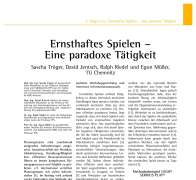
Serious Play – a Paradox Practice

Serious Play - a Paradox Practice

Sascha Tröger, David Jentsch, Ralph Riedel ORCID Icon, Egon Müller
Planning teams are faced with increasing demands concerning their work. The variety of products, globalization, agility or sustainable manufacturing leads to increasingly complex planning processes. Furthermore, planning teams are distributed around the globe and are affected by a growing number of communication interfaces. Building upon this, this paper introduces a particular serious play method. The method intends to improve communication in planning teams and to support knowledge work in general. Furthermore, it tries to foster close collaboration among the planning team members using an interdisciplinary workshop setting and intense communication. Two case studies are utilized to validate the method’s supporting functions. The findings indicate that the method supports communication and knowledge work. Nonetheless, furthermore research is necessary to determine quantitative effects and additional application scenarios.
Industrie Management | Volume 28 | 2012 | Edition 3 | Pages 35-38
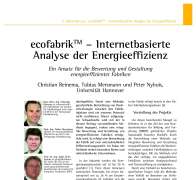
ecofabrikTM—A Web Based Energy Efficiency Analysis

ecofabrikTM—A Web Based Energy Efficiency Analysis

An approach for valuating and designing of energy efficient factories
Christian Reinema, Tobias Mersmann, Peter Nyhuis ORCID Icon
Today there is a big challenge for producing companies to improve their energy efficiency. Generally, a lot of separate measures are performed to optimize energy efficiency of objects in a factory. Because of a missing holistic consideration of interdependencies between the objects in a factory, a huge potential to save energy is completely ignored. To encounter this obvious weak point, the developed method, which is descripted in this article, enables to valuate and design energy efficient factories considering the interdependencies. The factory is observed on two different levels of detail. The method is focused on small and medium-sized factories.
Industrie Management | Volume 27 | 2011 | Edition 6 | Pages 9-12
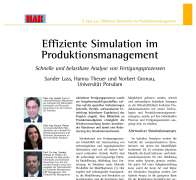
Efficient Simulation in Production Management

Efficient Simulation in Production Management

Schnelle und belastbare Analyse von Fertigungsprozessen
Sander Lass, Hanna Theuer ORCID Icon, Norbert Gronau ORCID Icon
In the research project LUPO a hybrid simulation laboratory is build up. This combines the advantages of the computer simulation with those of a model factory. For the systematic recording, mapping and analysis of various production processes a procedure model has been created that responds to the special requirements (quick, flexible, effortless determination of informative results) of the project. A library of production objects facilitates the reutilisa tion of existing machines and hereby a reduction of simulation effort.
Industrie Management | Volume 27 | 2011 | Edition 3 | Pages 13-15
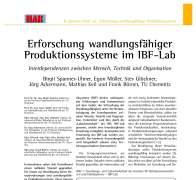
Reconfigurable Production Systems in the IBF-Lab

Reconfigurable Production Systems in the IBF-Lab

Considering interdependencies between human beings, technology and organization
Birgit Spanner-Ulmer, Egon Müller, Stev Glöckner, Jörg Ackermann, Mathias Keil, Frank Börner
Companies are constantly exposed to radical change. One approach to addressing these challenges is changeable production systems. Changeable production systems can only be as adaptable as the human being who is working in them. An integrated view of the dimensions of human beings, technology and organization is essential in this context. The Institute of Industrial Management and Factory Systems has wide experience and competences in the field of research of adaptable production. This is supported by the lab area of the IBF, called IBF-Lab, which allows interdisciplinary research. Practical application is demonstrated using an example of a research project.
Industrie Management | Volume 27 | 2011 | Edition 3 | Pages 69-72
Design of Production Systems Supported by Operations Research

Design of Production Systems Supported by Operations Research

Enhanced Planning Approaches on the Factory Level in the Automotive Sector
Philipp Hertz, Katharina Bunse, Marcel Helmdach, Thomas Sommer-Dittrich
Due to a difficult market situation represented by the world economic and related market crisis and a steady growth of model-variety the automotive industry is facing major challenges: short innovation cycles, increased complexity of production and cost pressures. To respond to these challenges advanced approaches for long-term planning of production systems have to be implemented. This paper presents approaches of plant design utilizing digital factory and shows applications of operations research (OR) for the planning of production systems. The application of OR methods holds significant potential not only for the network planning level but also for supporting strategic decisions on the production system level.
Industrie Management | Volume 27 | 2011 | Edition 3 | Pages 21-24
Federative Factory Data Management

Federative Factory Data Management

Reiner Anderl, Christian Mosch, Klaus Schützer, Antonio Álvaro de Assis Moura
Due to shorter product life cycle and increasing variants of products manufacturing companies have to be flexible in factory structures. Flexibility of factory structures is based on defined factory planning processes considering product, process and resource data resulting from various disciplines and isolated IT tools. Thus factory planning processes can be characterized as iterative, interdisciplinary and participative pro-cesses. To enforce the interdisciplinary and participative character, a federative factory data management (FFDM) as an integrative solution will be described. Product, process and resource data will be provided by web services resulting in acceleration of factory planning pro-cesses due to reduced redundancy, inhomogeneity and inconsistence in data holding.
Industrie Management | Volume 27 | 2011 | Edition 2 | Pages 69-72
1 2 3 4