factory planning

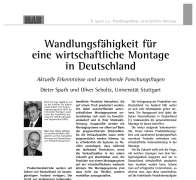
Mutability for a Profitable Assembly in Germany

Mutability for a Profitable Assembly in Germany

Aktuelle Erkenntnisse und anstehende Forschungsfragen
Dieter Spath, Oliver Scholtz
The trend of shifting abroad personnel-intensive mounting from Germany to foreign countries continues. The assembly systems widely differ in investment demand and in output. Since the sales figures can hardly be reliably forecasted any more, it is a necessity to construct extreme flexible systems which can be exchanged by more economical solutions, even when the production has already started and we know reliable sales figures and more reliable prognoses.
Industrie Management | Volume 23 | 2007 | Edition 2 | Pages 61-64
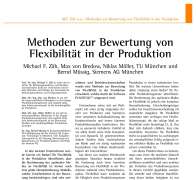
Methods for Flexibility Evaluation in Production

Methods for Flexibility Evaluation in Production

Michael F. Zäh, Max von Bredow, Niklas Möller, Bernd Müssig
Most enterprises have identified the need for flexibility, but the selection of the right degree of flexibility is a complex task. Sophisticated methods, which consider uncertainties in the valuation model, are time consuming and require a supporting software tool. The existing ones are applicable for very specific planning tasks only. In this paper, a methodology to support the valuation of manufacturing flexibility and PLANTCALC™, a supporting software tool, are presented. Both have been developed in a joint research project of the Institute for Machine Tools and Industrial Management and the Siemens AG.
Industrie Management | Volume 22 | 2006 | Edition 4 | Pages 29-32
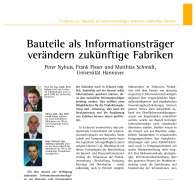
Components as an Information Carrier Change Future Factories

Components as an Information Carrier Change Future Factories

Peter Nyhuis ORCID Icon, Frank Fisser, Matthias Schmidt
Current information technologies like bar codes or transponders offer an enormous potential to logistics of producing companies. But with these technologies the provision of information on processes or components along the value-adding chain is neither possible in real-time nor consistently. Future components should be able to store information on themselves, so that additional transponders are no longer required. This opens up new possibilities for a real-time production planning and control as well as for the segmentation and planning of factories.
Industrie Management | Volume 22 | 2006 | Edition 1 | Pages 19-22
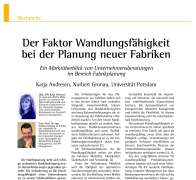
Market Survey of Consulting Firms Specialized in Factory Planning

Market Survey of Consulting Firms Specialized in Factory Planning

Katja Andresen, Norbert Gronau ORCID Icon
The article highlights the current challenges factory planning is facing in the realm of changeability and the creation of flexible structures, which adapt to changing market environments. IM has conducted a survey among factory planning companies and provides the results as well as annotating remarks in this report.
Industrie Management | Volume 20 | 2004 | Edition 4 | Pages 61-69
How to Change Cost-Effectively

How to Change Cost-Effectively

A method for the appropriate design of transformability
Christoph Heger, Hermann Holzer
In today’s changing market forecasts have become much less certain, thus seriously affecting in-house planning. The need to be able to adapt, on the other hand, is increasing. Transformability has therefore become a decisive key factor in the competitiveness of manufacturing companies in addition to the classical target factors of costs, time and quality. Nevertheless, transformability is seldom taken into sufficient consideration or implemented in practice, for it requires additional investments and the returns are not always clear. This paper describes a method that makes it possible for companies to calculate the relevant costs of changeability using the technique of scenario planning.
Industrie Management | Volume 20 | 2004 | Edition 2 | Pages 12-16
The Process Model of Factory Planning

The Process Model of Factory Planning

Mit standardisierten Prozessen zu kundenindividuellen Fabriken
Peter Nyhuis ORCID Icon, Thomas Harms, Andreas Elscher
With Standardised Processes on the Right Track to Customised Factories The approaches of factory planning that have been developed many years ago have to be adjusted to today’s challenges. Therefore the basic systematics of the Supply Chain Operations Reference- Model (SCOR-Model) are consulted and transferred to the processes of factory planning. The aim is to accelerate the planning process and to generate planning results in a higher quality while decreasing the planning effort. This will be achieved by use of a consistent process orientation which bases on standardised processes, field-tested methods, models and tools and on best-practice examples. This article explains the system and contents of the Process Model of Factory Planning and will give an impression of the first software-based prototype.
Industrie Management | Volume 20 | 2004 | Edition 1 | Pages 32-35
1 3 4