Digitalisierung

Digital Twins for Circular Economy

Digital Twins for Circular Economy

Enabling Decision Support for R-Strategies
Janine Mügge, Inka Rebekka Hahn, Theresa Riedelsheimer ORCID Icon, Johannes Chatzis
Digital twins (DT) for circular economy (CE) offer a promising approach as part of digital data ecosystems for more sustainable value creation. By mapping and analyzing product, component and material specific data along the li- fecycle, it is possible to address current challenges such as climate change and resource scarcity. Within Catena-X, specific solutions based on this cross-company exchanged data and information are developed. Here, the “R-Strategy Assistant” is presented. It is an application, which identifies the best CE-Strategy based on DT data at the end of a vehicle's life.
Industrie 4.0 Management | Volume 38 | 2022 | Edition 6 | Pages 42-46 | DOI 10.30844/IM_22-6_33-36
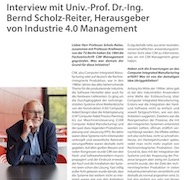
“Data Generated by Cyber-Physical Systems Will Play a Decisive Role”

"Data Generated by Cyber-Physical Systems Will Play a Decisive Role"

Interview with Prof. Bernd Scholz-Reiter, former editor of Industrie 4.0 Management
Bernd Scholz-Reiter ORCID Icon, Bernd Scholz-Reiter ORCID Icon
Professor Bernd Scholz-Reiter studied industrial engineering at the Technical University of Berlin. After several positions in Germany and abroad, he accepted the call to the University of Bremen in 2000, where he initially held the professorship of Planning and Control of Production Systems in the Department of Production Engineering. From 2002 to 2012, he also headed the Bremen Institute for Production and Logistics (BIBA). From 2012 to 2022, Bernd Scholz-Reiter was rector of the University of Bremen.
Industrie 4.0 Management | Volume 38 | Edition 6 | Pages 6-8
Work 4.0 – Logistics Working World of Tomorrow

Work 4.0 – Logistics Working World of Tomorrow

Effects and consequences of digitalization on the logistical working world
Tobias Reichert, Marc Lorscheider
In the course of digitalization, more and more digital technologies are being used in various areas of logistics. The occupational field is changing and problem-solving and abstracting skills as well as competencies in dealing with IT systems and data are increasingly required. Based on a literature review, this article provides an overview of the current situation in the logistics working world. Effects of digitalization as well as requirements and future competencies in the working world 4.0 are highlighted. Finally, a guideline for the management level is derived in order to promote the acquisition of competencies. (Only in German)
Industrie 4.0 Management | Volume 38 | 2022 | Edition 5 | Pages 30-34
Digitalization in the Supply Chain

Digitalization in the Supply Chain

Trends and fields of application in the drive technology sector of the mechanical and plant engineering industry
Leonard Overbeck, Dardan Baralija, Rainer Silbernagel, Hartmut Rauen, Jürgen Fleischer, Gisela Lanza ORCID Icon
A robust and resilient supply chain is a critical success factor for the competitiveness of manufacturing companies. However, today’s supply chain faces various challenges, such as higher complexities and increasing dynamics coming from megatrends (i. e. globalization and sustainability). The medium-sized drive technology industry, with its global supply chains and high customer requirements, is particularly affected by these challenges. Therefore, digitalization initiatives are crucial. This article analyzes current digitalization projects in the drive technology industry in order to identify relevant trends and fields of application. Synthesized from the industry's target picture for higher resilience/ flexibility, greater transparency and more sustainability along the supply chain, these provide guidance for medium-sized companies and their digitalization strategies. (Only in German)
Industrie 4.0 Management | Volume 38 | 2022 | Edition 4 | Pages 23-27
MES for Manufacturing SMEs

MES for Manufacturing SMEs

Adapted procedure model and tool for an effcient selection
Rainer Eber, Steffen Schwarzer, Daniel Miller
Manufacturing SMEs are structurally di erent from other companies and therefore have special requirments for Manufacturing Execution Systems (MES) and the associated software selection. Process models must therefore be adapted. For the identication of requirements, a systematic categorization based on existing models was performed. With the help of an existing market research platform, further selection steps were developed in order to provide a useful and easy-to-use tool for SMEs, which enables them to select efficiently sufficient MES-software according to their needs.
Industrie 4.0 Management | Volume 38 | 2022 | Edition 3 | Pages 21-24
Key Factors for Successful Supply Chain Management

Key Factors for Successful Supply Chain Management

Sebastian Trojahn, Vanessa Klementzki
Today's business world is characterized by ever-increasing complexity in nearly every dimension. Supply chains can no longer be understood in a linear fashion, but form networks across numerous supply chain participants. Globalization and crises are straining existing structures, calling into question previously set priorities and measures, and demanding new solutions. How must supply chains be structured in this constantly changing environment in order to be successful? This article highlights fields of action for successful supply chain management.
Industrie 4.0 Management | Volume 38 | 2022 | Edition 3 | Pages 48-52 | DOI 10.30844/I40M_22-3_48-52
Digitization in Supply Chain Management −Decision Support for the Selection of Suitable Technologies

Digitization in Supply Chain Management −Decision Support for the Selection of Suitable Technologies

Entscheidungsunterstützung bei der Auswahl geeigneter Technologien
Sascha Düerkop, Jakob Grubmüller, Michael Huth
The trend toward digitization o ers considerable potential; this is particularly true in supply chain management (SCM). However, not every technology is suitable for every company and its processes. This article presents a structured approach that supports companies in the selection process. The approach consists of several phases: Starting with the identi cation of business goals and ending with the selection of those technologies that seem most promising. Its applicability was tested in a research project at a logistics service provider. It is easily transferable to a concrete decision-making situation.
Industrie 4.0 Management | Volume 38 | 2022 | Edition 3 | Pages 31-34
Distribution of Qualification in Companies Becomes Measurable − Danger for Employees with Medium Level of Qualification due to Digitization

Distribution of Qualification in Companies Becomes Measurable − Danger for Employees with Medium Level of Qualification due to Digitization

Gefahr für Mitarbeiter mit mittlerer Qualifikation durch die Digitalisierung
Gerrit Sames
Employees, machines and products get connected: the 4th Industrial Revolution has begun [1]. This is a central statement on the homepage of the German „Plattform Industrie 4.0“. Meanwhile the basic ideas started to move from the shopfloor level to the level of business processes and business models. In consequence it was detected pretty early, that digitization will affect the employees and their qualification and tasks in the companies; the term Work 4.0 evolved. The following contribution emphasizes the systematization of qualifications. A new model will be displayed, that helps to bring transparency to the distribution of qualification in companies. The useability of the model is verified in two case studies. The model is a practicable instrument for companies to gain a realistic view to the upcoming challenges of the shift of qualification due to digitization.
Industrie 4.0 Management | Volume 38 | 2022 | Edition 2 | Pages 58-62
Competence Development for Managers in the Context of Digitalization

Competence Development for Managers in the Context of Digitalization

Leadership Training in Corporate Training
Tobias Wienzek, Hendrik Lager, Claudia Suhr
In the digital transformation, managers are facing changed requirements. They are important actors in the design process of the digital transformation, for which they must change their leadership behavior and acquire the corresponding competencies. In corporate practice, it is necessary to address these issues systematically in leadership training. However, such a qualification is a major challenge for companies. The article shows demands on leadership in the digital transformation and presents an innovative procedure for the competence development of managers at a provider of professional training.
Industrie 4.0 Management | Volume 38 | 2022 | Edition 2 | Pages 15-18
This Is How We Learn

This Is How We Learn

A best practice case of qualification in SMEs for Work 4.0
Marc Schwarzkopf, Susann Zeiner-Fink, Angelika C. Bullinger-Hofmann
Initiated by the digitalization, the organization of production and employees are subject to change. Innovative and digitized formats should be integrated into existing training programs. Therefore, suitable and target group-specific teaching/learning formats are needed that support participative methods and digital collaboration. For this purpose, a digital teaching and learning format for the application area of automotive engineering in SMEs was designed. This prototypical teaching/learning format was created and evaluated in an iterative process through the participation of the potential. The results show that the test subjects mainly refer to the usability criteria of DIN ISO 9241-110. Recommendations for the creation of future digital teaching and learning formats for SMEs are derived from these findings.
Industrie 4.0 Management | Volume 38 | 2022 | Edition 2 | Pages 53-57
1 3 4 5 12