Computational Intelligence

Parameter Optimization for a Brine Injector

Parameter Optimization for a Brine Injector

Development of an AI pipeline using an example from the meat industry
Tim Zeiser ORCID Icon, Theo Lutz ORCID Icon, Corinna Köters ORCID Icon, Maik Schürmeyer, Alexander Prange ORCID Icon
The production of cooked ham involves a number of challenges. In production, cuts of meat are put through in a multi-stage curing and cooking process involving brine. This can lead to fluctuations in quality due to structural defects in the meat. The result: the brine is not optimally absorbed. An AI model trained on historical data intends to solve the problem.
Industry 4.0 Science | Volume 40 | 2024 | Edition 6 | Pages 40-46
Forecasting the Business Crisis in the Auto Industry

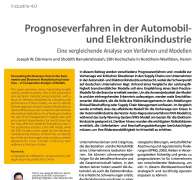
Forecasting the Business Crisis in the Auto Industry

A comparative analysis of models
Joseph W. Dörmann, Shobith Ramakrishnaiah
This paper examines various forecasting models used to predict business crises in the automotive and electronic manufacturing industries, with a focus on German companies. By comparing the performance of these models, we aim to identify the best approach for each industry. We also discuss real-world business case scenarios to demonstrate the practical implications of our findings, including the role of risk management in supply chain and procurement departments. Our results show that the most effective model for forecasting crises in the automotive industry is the VAR model, while the EWS model is best suited for the electronic manufacturing industry. Furthermore, we identify key risk factors that supply chain and procurement departments must consider enhancing their resilience in the face of crises.
Industrie 4.0 Management | Volume 39 | 2023 | Edition 5 | Pages 6
Crowd Management Considering Pandemic Security

Crowd Management Considering Pandemic Security

Rahmenkonzept für einen sicheren Messebetrieb unter Berücksichtigung von geeigneten Abständen und Routenplanung
Ann-Kathrin Rohde, Birte Pupkes, Michael Lütjen ORCID Icon, Rafael Mortensen Ernits, Dennis Keiser, Michael Freitag ORCID Icon
The COVID-19 pandemic has highlighted the additional challenges that events face in terms of appropriate crowd management. This paper is dedicated analyzing these challenges and existing approaches for the safe operation of events during pandemics. Based on this, an innovative framework is presented that uses intelligent crowd analysis and is applicable to an environment with volatile groups. In addition, the specifiv use case of trade fair events is considered in this framework.
Industrie 4.0 Management | Volume 38 | 2022 | Edition 4 | Pages 48-52
Autonomous Quality Inspection 4.0

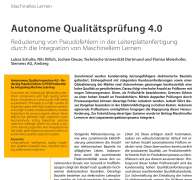
Autonomous Quality Inspection 4.0

Reducing pseudo defects in PCB production by integrating machine learning (ML)
Florian Meierhofer, Jochen Deuse ORCID Icon, Lukas Schulte, Nils Killich
Customers are increasingly demanding electronic components with high quality, which forces companies to continuously fulfil these requirements. This leads to a high number of inspection gates with high inspection severity and a high number of pseudo defects. Double inspections by process experts reduce these defects but generate high inspection costs. Autonomously acting inspection systems meet this challenge. Within this article, a machine learning algorithm was integrated into the solder paste inspection process to form an autonomous quality inspection system.
Industrie 4.0 Management | Volume 37 | 2021 | Edition 6 | Pages 52-56
Automatic Generated Roadmaps for Automated Guided Vehicles

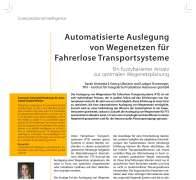
Automatic Generated Roadmaps for Automated Guided Vehicles

Ein fuzzybasierter Ansatz zur optimalen Wegenetzplanung
Sarah Uttendorf, Georg Ullmann, Ludger Overmeyer
Designing a road layout for automated guided vehicles (AGV) can be a very laborious process that is based in big parts upon the knowledge of experienced system planers. Up until now, it is not possible to save that knowledge in a form that makes it usable in an automated layout process for AGV-roadmaps. The research project aims to integrate the knowledge of the system planers in an artificial intelligence, so in the future an automated process of designing AGV roadmaps is achievable. The knowledge is implemented within a fuzzy-logic and can be used as a controller for the planning process.
Industrie Management | Volume 31 | 2015 | Edition 1 | Pages 48-52
Reinforcement Learning for Planning Working Processes

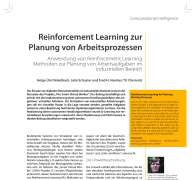
Reinforcement Learning for Planning Working Processes

Anwendung von Reinforcement Learning Methoden zur Planung von Arbeitsaufgaben im industriellen Bereich
Helge Ülo Dinkelbach, Julia Schuster, Fred H. Hamker
One of the main purposes of the „Smart Virtual Worker“-project is the application of a digital human model for the simulation of industrial work tasks. This contribution focuses on the implementation of an autonomic action selection, such that a virtual agent is able to solve tasks under certain optimization criteria. To realize the autonomic action selection, we use the Q-Learning algorithm with different extensions. In this article, we describe these different learning algorithms and we briefly describe the performance of their implementation with regard to the industrial field.
Industrie Management | Volume 31 | 2015 | Edition 1 | Pages 9-12
Intelligent Knowledge Services within Cyber-Physical Systems

Intelligent Knowledge Services within Cyber-Physical Systems

Soziotechnische Herausforderungen im Kontext von Industrie 4.0
Dieter Kreimeier, Niklas Kreggenfeld, Christopher Prinz ORCID Icon, Christoph Igel, Carsten Ullrich
As a result of continuously increasing economic constraints for the producing sector in Germany due to competitors from low-wage countries, production paradigms are changing substantially. This paradigm shift is characterized by rapidly advancing automation processes. Hence, highly complex Cyber-Physical Production Systems (CPPS) are developed and put into practice. In combination with decreasing numbers of staff and the resulting loss of knowledge, this leads to a deficit of competence required to handle the increasing complexity of CPPS. As a result, a need for innovative assistance systems arises for the support of the remaining employees. The given article describes the challenges and problems and drafts a potential technical solution as well as challenges concerning organization and staff.
Industrie Management | Volume 30 | 2014 | Edition 6 | Pages 25-29