Potenzial: Strategy

Management of Technological Capability

Management of Technological Capability

A Decision Support System for Multivendor Capable Service Companies
Wolfgang Kersten ORCID Icon, Markus Klotzbach, Moritz Petersen
Multivendor capable service companies are facing growing challenges concerning the alignment of their technological capability portfolio to dynamic market requirements. This paper presents a method that enables practitioners from technical service companies to systematically manage their capability portfolio using both qualitative and quantitative data. Thereby decision makers are provided with a tool to help them shaping the company’s service portfolio.
Industrie Management | Volume 30 | 2014 | Edition 3 | Pages 11-14
Compliance through a Sealed Cloud

Compliance through a Sealed Cloud

Hubert Jäger
For businesses, the main problem with cloud computing is the loss of control over own data. After all, one cannot know what cloud provider staff might read or copy processed or stored data. Not so with providers based on Sealed Cloud technology. This basic technology encrypts all data, and any access is rendered impossible by a series of technical measures. Not even the cloud provider has access to the data, not only during transfer and within the database, but also during data processing.
Industrie Management | Volume 29 | 2013 | Edition 4 | Pages 27-30
Champions For More Than 100 Years

Champions For More Than 100 Years

Markus Plate, Torsten Groth
The recently released book „Große deutsche Familienunternehmen“ [3] describes the history of the 50 biggest family-run companies older than 100 years. Those companies are not „Hidden Champions“ but „Champions of Survival“. Being ranked among the biggest companies in Germany after a development over more than four generations these businesses can serve as an example for outstanding management practices or at least a reason to rethink the own strategy.
Industrie Management | Volume 28 | 2012 | Edition 6 | Pages 27-30
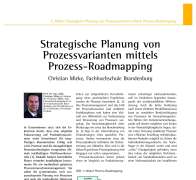
Strategic Process Planning by Process Roadmapping

Strategic Process Planning by Process Roadmapping

Christian Mieke
Process innovations should be planned at least just as systematically as product innovations. The process roadmapping is a methodology for illustrating development of processes and process variants in the future. Rising dynamics and increasing complexity let the availability of different process variants appear necessary. Roadmapping supports the procedure of defining process variants.
Industrie Management | Volume 28 | 2012 | Edition 4 | Pages 47-50
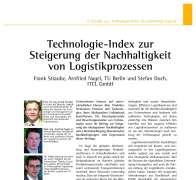
Technology-Index for Developing Sustainability in Logistics Processes

Technology-Index for Developing Sustainability in Logistics Processes

Frank Straube, Arnfried Nagel, Stefan Doch
The evidence of the ecological sustainability of logistics systems is increasingly expected by customers inside and outside the supply chain. Companies can affect their carbon footprint at different strategic levels: products, structures, processes and technologies. The potential use and evaluation of technologies and their contribution to improve ecological sustainability while taking into account economic conditions are the subject of this paper.
Industrie Management | Volume 27 | 2011 | Edition 6 | Pages 61-64
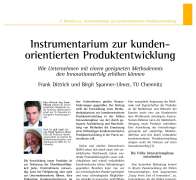
Supporting a Structured Customer Orientation

Supporting a Structured Customer Orientation

Instruments for the early innovation stage
Frank Dittrich, Birgit Spanner-Ulmer
The development of new products is necessary in order to ensure a company´s survival. But, if badly planned, this also could lead to a corporate crisis. An early customer and competition orientation results in need-based and competitive products and is therefore considered as an essential requirement for innovation success. However, due to a lack of know how concerning the application of appropriate instruments, especially small and medium sized enterprises face big challenges. In this report, the development of a method kit is introduced, which supports a customer and competition oriented product development process during the early innovation phase by providing a suitable and applicable collection of methods in order to implement the development process in practice.
Industrie Management | Volume 27 | 2011 | Edition 5 | Pages 51-554
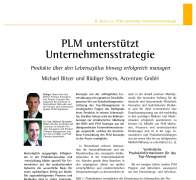
Corporate Strategy Supported by PLM

Corporate Strategy Supported by PLM

Managing Products Successfully Along the Product Lifecycle
Michael Bitzer, Rüdiger Stern, Accenture
Product innovation and development are key capabilities especially for manufacturing industries. Product Lifecycle Management (PLM) as a management concept provides processes and methodologies to establish these capabilities based on the dimensions: Organization, processes and technology. This article discusses the development of the PLM concept from an IT system purely supporting the operational level within a company - moving to a concept supporting top-management decisions regarding product strategy and portfolio. Moreover, a framework is introduced to determine an R&D and PLM Strategy based on the Corporate Business Strategy.
Industrie Management | Volume 27 | 2011 | Edition 5 | Pages 63-66
Tariff Oriented Supply Chain Management

Tariff Oriented Supply Chain Management

Auswirkungen von Freihandelszonen auf die strategische Planung
Johannes Plehn, Franz Homberger, Katharina Mariel
Global trade of finished goods as well as global sourcing of components and raw material is increasing. As a consequence, multinational corporations need to be aware of the benefits and drawbacks of global procurement and production when designing their supply chain. Thereby, custom duties can be an important driver. In this context free trade agreements and their value-content requirements are gaining importance. In this article the mechanisms of free trade agreements and the opportunities and risks for supply chain management are presented. In addition to the qualitative description of the effects of free trade agreements on the supply chain structure, an illustrative example based on the automotive industry is provided. The article concludes with an outlook on potential solution strategies.
Industrie Management | Volume 27 | 2011 | Edition 5 | Pages 77-80
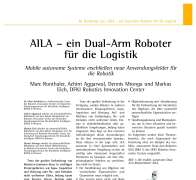
AILA – A Dual Arm Robot for Logistics

AILA - A Dual Arm Robot for Logistics

Mobile autonome Systeme erschließen neue Anwendungsfelder für die Robotik
Marc Ronthaler, Achint Aggarwal, Dennis Mronga, Markus Eich
There are numerous and relevant application domains like inspection, maintenance, surveillance, and handling of non-uniform goods where the use of robots would be beneficial. This article addresses the reasons that make it difficult for a present-day robot to master these domains. The dual arm system AILA will be presented, which takes further steps in the direction of such a use case.
Industrie Management | Volume 27 | 2011 | Edition 1 | Pages 35-38
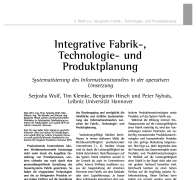
Integrative Factory, Technology and Product Planning Systemizing the Information Transfer on the Operational Level

Integrative Factory, Technology and Product Planning Systemizing the Information Transfer on the Operational Level

Systematisierung des Informationstransfers in der operativen Umsetzung
Serjosha Wulf, Tim Klemke, Benjamin Hirsch, Peter Nyhuis ORCID Icon
These days, competitive advantages for manufacturing companies can not be achieved by a detached configuration of specific processes but only within an inte-grative configuration of the complete system factory. The deployed technologies and the manufactured products have a significant influence on the configuration of a factory. To allow a better coordination between technology, product and factory planning, an approach for integrated factory coordination has been developed at the Hannover Centre for Production Techno-logy (PZH). This approach is based on the general roadmapping idea and allows the systematisation of the information transfer concerning content and time between factory, technology and product planning.
Industrie Management | Volume 26 | 2010 | Edition 1 | Pages 33-36
1 2 3 4 5