Autor: Marc Ronthaler

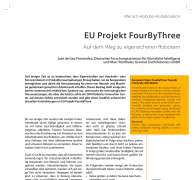
European Project FourByThree: Towards Inherently-Safe Robots

European Project FourByThree: Towards Inherently-Safe Robots

José de Gea Fernández, Marc Ronthaler
In recent years some of the characteristics of robots designed for home or service robotics have been introduced in the industrial sector, enabling the collaboration and the sharing of common workspaces between human and robots. This article reviews some of the commercially available new generation robots, the enabling technologies being developed at DFKI Robotics Innovation Center over the last years, as well as the current developments within the European project FourByThree.
Industrie 4.0 Management | Volume 32 | 2016 | Edition 2 | Pages 33-36
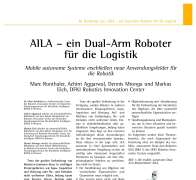
AILA – A Dual Arm Robot for Logistics

AILA - A Dual Arm Robot for Logistics

Mobile autonome Systeme erschließen neue Anwendungsfelder für die Robotik
Marc Ronthaler, Achint Aggarwal, Dennis Mronga, Markus Eich
There are numerous and relevant application domains like inspection, maintenance, surveillance, and handling of non-uniform goods where the use of robots would be beneficial. This article addresses the reasons that make it difficult for a present-day robot to master these domains. The dual arm system AILA will be presented, which takes further steps in the direction of such a use case.
Industrie Management | Volume 27 | 2011 | Edition 1 | Pages 35-38
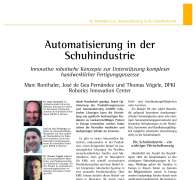
Automation in the Footwear Industry

Automation in the Footwear Industry

Innovative Robotics to Support Complex Artisan Production
Marc Ronthaler, José de Gea Fernández, Thomas Vögele
Shoe manufacturing provides employment to a large number of European citizens. Large parts of the manufacturing process are still dominated by manual work. Robotic solutions to automate and optimize the production can ensure that European companies, in particular manufacturers of high-quality, high-price fashion shoes, retain their competitive edge on the global markets. There are many sectors of industry, in particular industrial production, that have a strong need for practical, flexible, and human-like manipulation and gripping. This is true in particular for SMEs characterized by fast changing product-cycles and the need for robots that can be integrated in manual product lines. In general, all industrial sectors with a high percentage of manual labour, a large number of product variants, and non-standardized or delicate products do need robots that exhibit a general flexibility and the capacity for human-like manipulation. Shoe manufacturing is an example for an industrial sector ...
Industrie Management | Volume 27 | 2011 | Edition 1 | Pages 59-61
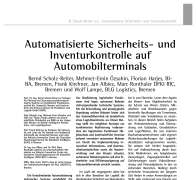
Security and Inventory Robots for Automobile Terminals

Security and Inventory Robots for Automobile Terminals

Bernd Scholz-Reiter ORCID Icon, Mehmet-Emin Özsahin, Florian Harjes, Frank Kirchner, Jan Albiez, Marc Ronthaler, Wolf Lampe
Advancements in the automation of technical systems enable the simultaneous accomplishment of multiple complex functions. Through further integration of information and communication technologies, systems will be able to communicate among each other and autonomously adapt their behaviour to changes in the environment. For the realisation of logistic functions, autonomous robots are promising systems. For the development and prototypal testing of such robots the automobile terminal was chosen due to its specific attributes and challenges. This article introduces an approach for the combination of security services and continuous inventory by means of autonomous and cooperating robots. To enhance the efficiency of automobile terminals, innovative information and communication technologies are implemented and robust autonomous robots developed.
Industrie Management | Volume 25 | 2009 | Edition 5 | Pages 31-34