Profitability

Lifecycle Cost Assessment of Different Energy Systems under Risk and Uncertainty

Lifecycle Cost Assessment of Different Energy Systems under Risk and Uncertainty

A New Approach for Economical Efficient Investigations
Waldemar Retkowski, Nils Buttler, Jorg Thöming
The impact of uncertainty and the complexity of renewable heat and hot water production generate the demand for intelligent cost performance analyses to support or provide resilient data and therefore reliable managerial decisions. Especially the risk control and the planning of invest and operating costs of energetic systems are with the help of exact mathematical models only insufficient feasible. One approach provides the monte-carlo-simulation projection with the possibility to handle deterministic and stochastic model approaches. A new approach for the model based investigations of strategic investment decisions for solar heat, geothermal heat or biomass heating systems under consideration of complex uncertainty is the objective of this contribution.
Industrie Management | Volume 29 | 2013 | Edition 6 | Pages 31-36
Eco-Innovations in Small and Medium-Sized Enterprises (SMEs)

Eco-Innovations in Small and Medium-Sized Enterprises (SMEs)

The role of public-private partnerships
Erik G. Hansen, Johanna Klewitz, Stefan Schaltegger
In the past ecological (and social) aspects were often dealt with by the legal or compliance department. Ever more often ecological issues are linked with eco-innovations. This almost paradigmatic change of perspective entails that ecological topics are not just seen as cost drivers but as a management area relevant to increase competitiveness and to create business cases for sustainability. Although this view is increasingly adopted it remains fuzzy what really constitutes processes of sustainability innovations. Large companies often have R&D and sustainability departments driving eco-innovations in a professional manner. Small and medium sized enterprises (SMEs), however, depend on other means such as public-private partnerships (PPPs) which can play an important role for the diffusion of eco-innovations in SMEs.
Industrie Management | Volume 29 | 2013 | Edition 5 | Pages 43-48
Hybrid Adaption Planning for Configuration of Network Factories

Hybrid Adaption Planning for Configuration of Network Factories

Ein Ausgangspunkt zur methodischen Gestaltung der operativen Produktionsplanung und -steuerung
Enrico Teich, Thorsten Claus
The increasing turbulence in enterprises environment becomes apparent by rising variant diversity and continuously reducing product life cycles. These results cause immense and not resolvable adaption necessities for producing companies. The approach of network factories combines system immanent and network bounded potentials to increase adaption alternatives, reduce adaption risks, and optimize agility.
Industrie Management | Volume 29 | 2013 | Edition 4 | Pages 45-48
Productivity Erosion – The Quest for Greater Value

Productivity Erosion - The Quest for Greater Value

Spurensuche nach Potenzialen höherer Wertschöpfung
Joachim Althaler, Roland Schmidt
Increased productivity is a fundamental paradigm of successful business. No wonder management efforts are focused primarily on this “golden calf” of the market economy. There are enough scientific publications dealing with this topic to fill libraries. Never before have we seen so many students educated in the field of Economics at university level. Despite knowing a great deal about tools, methods and procedures, at the place where value is created we continue to think about the same questions and the same productivity deficits: Why is it that companies continue to lose the ability to maintain lean, productive processes in spite of having access to all instruments in the field of Economics? Why do many companies permit the growth of unproductive performance even though they have just introduced controlling instruments to prevent this from happening? Why is it so difficult to achieve significant, sustainable productivity growth even though companies often have access to a broad ...
Industrie Management | Volume 29 | 2013 | Edition 3 | Pages 52-55
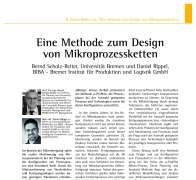
A Method to Design Process Chains in Micro Manufacturing

A Method to Design Process Chains in Micro Manufacturing

Bernd Scholz-Reiter ORCID Icon, Daniel Rippel
In the field of micro manufacturing, a highly precise adjustment of relevant process parameters is of major importance. The continuing miniaturization of work pieces and machines leads to very small tolerances. The occurrence of so called size-effects interferes with a direct application of knowledge and experiences from macro manufacturing. Moreover, the high specialization of manufacturing technologies and processes in micro manufacturing requires a careful review of each process’s suitability with respect to the involved materials and components. This article presents a method that supports process designers with structured procedures and notations, to model and evaluate technological as well as logistic dependencies along the process chain. Thereby, it supports the selection and configuration of suitable processes for a given process chain.
Industrie Management | Volume 29 | 2013 | Edition 2 | Pages 15.19
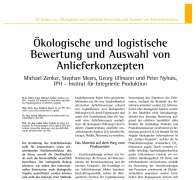
Environmental and Logistical Evaluation and Selection of Supply Concepts

Environmental and Logistical Evaluation and Selection of Supply Concepts

Michael Zenker, Stephan Meers, Georg Ullmann, Peter Nyhuis ORCID Icon
The design of the supply concept re-presents a decisive competitive factor for companies, since this significantly affects the throughput time and inventory levels. This paper explains how environmental issues can be quantified in addition to the conventional types of costs and presents a method for the selection and design of a supply concept.
Industrie Management | Volume 29 | 2013 | Edition 2 | Pages 63-65
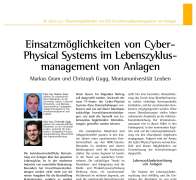
Life Cycle Management of Physical Assets

Life Cycle Management of Physical Assets

Possible applications of cyber-physical systems
Markus Gram, Christoph Gugg
The economic analysis of physical assets over the entire life cycle is essential in modern industry. Particularly, in investment decisions, not only the pure expenditure for the procurement is used. Life cycle costing considers the required investments of a production site’s life cycle as a whole. In order to reduce the life cycle costs it is necessary to identify, analyze and derive corresponding measures. In practice, the data tracking over several periods is challenging. The following paper shows how the new IT approach of cyber-physical systems can improve such data collection. Furthermore, it will be shown how this database supports future investment decisions as well as the selection of life cycle support services.
Industrie Management | Volume 29 | 2013 | Edition 1 | Pages 39-43
Change-specific Taxonomy in the Communication Process

Change-specific Taxonomy in the Communication Process

Tobias Mersmann, Tim Klemke, Peter Nyhuis ORCID Icon
Nowadays, companies deal with a hugh amount of challenges which are the reason to change the production system more and more often. To be able to do this a production system needs a sufficient degree of changeability. Caused on a change, a communication process between the user and supplier will be initialized. In an optimal communication process there will be no losses due to communication lacks. This article deals with a change-specific taxonomy which adds some items to a communication process to decrease losses during communication.
Industrie Management | Volume 28 | 2012 | Edition 6 | Pages 41-44
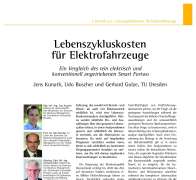
Life Cycle Costing of Electric Vehicles from a User Perspective

Life Cycle Costing of Electric Vehicles from a User Perspective

Ein Vergleich des rein elektrisch und konventionell angetriebenen Smart Fortwo
Jens Kunath, Udo Buscher, Gerhard Golze
This article addresses the question whether a purely monetary-oriented user will decide to buy an entirely electrically powered vehicle today. For a vehicle that is available with petrol, diesel and electric drive, a life cycle cost analysis is performed. For this purpose, all cash inflows and outflows over the entire life cycle are covered, placed in a framework and finally the present value is determined to evaluate the alternatives. Making reasonable estimates special input parameters are varied in order to determine the resulting cost implications.
Industrie Management | Volume 28 | 2012 | Edition 5 | Pages 9-14
Lifecycle Oriented Assessment of Resource Efficiency for Capital Goods

Lifecycle Oriented Assessment of Resource Efficiency for Capital Goods

Jan C. Aurich, Monique Adam, René C. Malak
Companies implement numerous measures to reduce the use of materials and energy in order to increase the resource efficiency. Resource efficiency has to be assessed over the whole lifecycle of a product. Therefore, an approach is requested which assesses the impacts of measures on the production and the use phase of a product.
Industrie Management | Volume 28 | 2012 | Edition 5 | Pages 57-61
1 6 7 8 14