Profitability

Resource Efficiency within Production

Resource Efficiency within Production

Verbesserung der Ressourceneffizienz durch transparenten Verbrauch von Material und Energie
Sarah Majid Ansari, Serjosha Wulf
Ecological sustainability in production does not only cause a positive contribution to environmentalism, but also leads to a longterm improvement of the companies’ competitiveness. Due to a lack of transparency, many companies face difficulties rating their own resource efficiency. This article deals with the introduction of a ratio system, which allows companies to evaluate the efficiency concerning their usage of resources. This enables companies to enhance their consumption transparency. Besides, this article discusses the challenges of using ratio systems and the comparison of ratios in general.
Industrie Management | Volume 31 | 2015 | Edition 4 | Pages 12-16
Industry 4.0 CheckUp – Leveling for Evolution

Industry 4.0 CheckUp - Leveling for Evolution

Identifizierung des Reifegrades und des Potenzials eines Unternehmens hinsichtlich des Leitgedankens „Industrie 4.0“
Michael Schenk, Eyk Flechtner, Marc Kujath, Sebastian Häberer
Research and industry have agreed on the aims of Industry 4.0. Contrary to what this suggests, a variety of issues and related challenges, e.g. complexity, big data, security, etc., will not make a revolution at the push of a button easy. Humans in particular will also play a crucial role on the way to adaptive, networked and resource efficient factories and directly influence the factory of the future. The Fraunhofer IFF Magdeburg is therefore pursuing research on collaborative robots that will assist humans.
Industrie Management | Volume 31 | 2015 | Edition 3 | Pages 21-25
Productive and Ergonomic Work in Industry 4.0

Productive and Ergonomic Work in Industry 4.0

Ganzheitliche Planung und Gestaltung menschlicher Arbeit
Peter Kuhlang, Thomas Finsterbusch, Thomas Mühlbradt, Sören Liebig
It is against the background of Industrie 4.0 that profound knowledge of the principles and basics of manual work or efficient work design, respectively, gains particular importance. It will continue to be a fair and neutral reference basis for the design of productive and ergonomic work in the Smart Factory. By collecting both time-relevant and ergonomically relevant data, MTM-HWD® (Human Work Design) a new MTM (Methods-Time Measurement) building block system offers an unprecedented quality in describing and evaluating human work. It, thus, combines work method-oriented with ergonomic work design.
Industrie Management | Volume 31 | 2015 | Edition 3 | Pages 11-15
Self-Optimization in Mechanical and Plant Engineering

Self-Optimization in Mechanical and Plant Engineering

Durch Selbstoptimierung intelligente technische Systeme des Maschinen- und Anlagenbaus entwickeln
Jürgen Gausemeier, Peter Iwanek, Mareen Vaßholz, Felix Reinhart
Mechatronic systems have to fulfill increasingly advanced functions and requirements to serve future customer needs and create reliable, resource-efficient and user-friendly systems. To realize tomorrow’s technical systems, solutions in context of self-optimization can be used. Thus, intelligent behavior can be integrated in technical systems. These systems are able to adapt their behavior autonomously and react to outer influences. The Leading-Edge Cluster “Intelligent Technical Systems OstWestfalenLippe (it’s OWL)” focuses on the described innovation leap from mechatronics to intelligent technical systems. Within this contribution we explain the capabilities of solutions in context of self-optimization on the example of machine learning methods. Furthermore, an approach for the identification of potentials for the integration of self-optimization in mechatronic systems will be introduced.
Industrie Management | Volume 30 | 2014 | Edition 6 | Pages 55-58
Recognize and Avoid Risks

Recognize and Avoid Risks

Potenziale von ganzheitlichen Produktionssystemen im Krankenhaus
Uwe Dombrowski, David Ebentreich
Risks threaten companies in all industries. Especially, if lives are threatened companies have to take measures for risk detection and prevention. The healthcare industry and especially hospitals have to identify risks as early as possible to take measures to protect patients. For this purpose the methods and tools from the lean production system can support hospital employees. Therefore, this paper analyses the support of lean production systems for improving patient safety in hospitals.
Industrie Management | Volume 30 | 2014 | Edition 5 | Pages 62-66
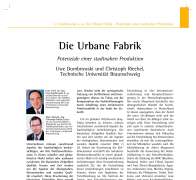
Urban Factory – Potentials of a New Factory Typology

Urban Factory - Potentials of a New Factory Typology

Uwe Dombrowski, Christoph Riechel
To remain competitive in a globalized market, enterprises must consider sustainably aspects. The classic aims of quality, costs and time are extended by aspects of the ecological, economic and social quality. The challenge to cope with these new dimensions aiming at long term success is raised by the turbulent influences in a global market with varying demands. A new factory typology, the so called urban factory, pursues the aim to exhaust the potentials of an interlinking of factory and town efficiently. The aim of this topology is to improve the competitive situation of enterprises. In this case the synergetic use of material and energy sources is in focus.
Industrie Management | Volume 30 | 2014 | Edition 4 | Pages 11-15
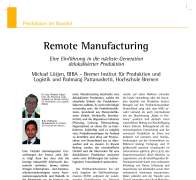
Remote Manufacturing – An Introduction into Next Generation of Delocalised Production

Remote Manufacturing - An Introduction into Next Generation of Delocalised Production

Eine Einführung in die nächste Generation delokalisierter Produktion
Michael Lütjen ORCID Icon, Padmaraj Pattanashetti
Due to a variety of technological developments within the past decade, today’s industrial working environment is changing dramatically. Information and communication technologies as well as automation and robotics are penetrating the working environment. In the context of industrial 4.0, the interaction of systems increases. Sensor data, status information and control commands are exchanged, which creates the conditions for new types of production concepts such as Remote Manufacturing. Remote Manufacturing describes a delocalized production, which removes the spatial unity of production factors. It will be no longer necessary for the elementary production factors (labor, materials, equipment) and the dispositional production factors (planning, management, control, organization) to be located at one place. In the future, it will be possible to operate production facilities abroad and to monitor the process control level from Germany. In this paper, the economic environment and the ...
Industrie Management | Volume 30 | 2014 | Edition 4 | Pages 16-20
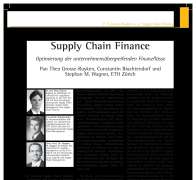
Supply Chain Finance – Optimizing the Financial Supply Chain

Supply Chain Finance - Optimizing the Financial Supply Chain

Optimierung der unternehmensübergreifenden Finanzflüsse
Pan Theo Grosse-Ruyken, Constantin Brachtendorf, Stephan M. Wagner
Today’s supply chains are characterized by strong linkages between buying and supplying firms in product development as well as production. This results in mutual dependencies and strongly interrelated product, capital and information flows. Improvement potential still exists in the optimization of supply chain finance across the supply chain partners as processes, taxes and cost of capital improvements across the supply chain generate significant savings and lead to competitive advantages. Cooperative supply chain finance approaches - e.g. debt financing support for suppliers - can turn indispensable suppliers to strategic supply chain partners. The identification of strategic suppliers and the selection of an appropriate supply chain finance strategy can be evaluated using the presented supply chain finance matrix. Furthermore, this article provides insights on how supply chain finance can be used to improve holistically the supply chain activities.
Industrie Management | Volume 30 | 2014 | Edition 4 | Pages 29-34
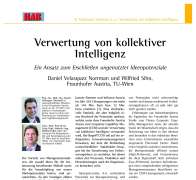
A New Approach for the Utilization of Collective Intelligence

A New Approach for the Utilization of Collective Intelligence

Ein Ansatz zum Erschließen ungenutzter Ideenpotenziale
Daniel Velasquez Norrman, Wilfried Sihn
Despite of proven immense impact on profitability, characterized with short payback periods and being recognized for its significance on the innovativeness and competiveness of a company, successful management of ideas is rare. An approach with prerequisites of a successful exception is the Corporate Capability Management (CCM) from Fraunhofer Austria. CCM is defined as the systematic and holistic approach to ongoing improvements on organization’s capabilities. The approach comprehends discrepancies between research findings on critical success factors and contemporary industrial practices.
Industrie Management | Volume 30 | 2014 | Edition 3 | Pages 15-19
Mito-based MES-Modules – Implementation and Evaluation

Mito-based MES-Modules - Implementation and Evaluation

Hartmut F. Binner
You will be presented with a tool-based approach to MES function modules selection and implementation. Classic data observations include MES and formats such as production data acquisition (PDA), machine data acquisition (MDA) and personnel data entry, but also all other processes, a timely impact on the manufacturing/production process. The MES covers typically the business, reporting and schedule the production levels of an enterprise ERP and the actual production or production process in manufacturing and automation level. In particular, the MES of continuously controlling enforcement an existing and valid planning and feedback from the process is used.
Industrie Management | Volume 30 | 2014 | Edition 2 | Pages 57-61
1 5 6 7 14