Profitability

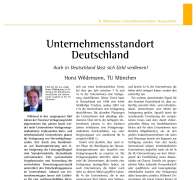
Germany as Industrial Location – Even in Germany Money Can Be Earned!

Germany as Industrial Location - Even in Germany Money Can Be Earned!

Auch in Deutschland lässt sich Geld verdienen!
Horst Wildemann
Although the relocation trend has slightly decreased during the last five years, nowadays more companies plan to shift abroad in the near future. In particular small- and medium-sized companies plan the relocation of parts of their value chain. The disadvantage of the German location can only be compensated by a combination of cost optimization and an increase of productivity. A systematic procedure and the application of sophisticated evaluation tools support the company in its process of decision making. Considering the type of business, guidelines for competitive value chain management can be developed.
Industrie Management | Volume 22 | 2006 | Edition 1 | Pages 15-18
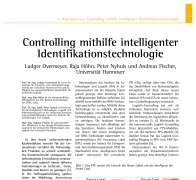
Controlling-Based Intelligent Identification Technology

Controlling-Based Intelligent Identification Technology

Ludger Overmeyer, Raja Höhn, Peter Nyhuis ORCID Icon, Andreas Fischer
In today’s prevailing buyers market, enterprises are more and more facing the necessity to meet the increasingly high requirements on delivery lead time, delivery reliability, quality and costs. Thus, the illustration, analysis and interpretation of logistic production processes becomes more and more important. For fulfilling the requirements mentioned before the production planning and control (PPC) can be supported efficiently by suitable controlling concepts. However, analyses from the Institute of Production Systems and Logistics (IFA) prove that current controlling concepts possess deficits. In this context the RFID-Technology can produce a relief. By using this technology it is possible to identify and track products contact-free and in real time. Nowadays, the applications are limited because the existing chips can only save, delete or rewrite the collected data. Therefore, the Institute of Transport und Automation Technology (ITA) developed a smart label with an integrated ...
Industrie Management | Volume 21 | 2005 | Edition 5 | Pages 17-20
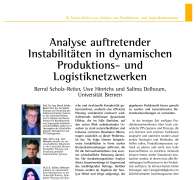
Instabilities in Dynamic Production and Logistic Networks

Instabilities in Dynamic Production and Logistic Networks

Simulation-based analysis
Bernd Scholz-Reiter ORCID Icon, Uwe Hinrichs, Salima Delhoum
Production and logistics networks are characterized by an increasing dynamic and structural complexity, which makes an efficient planning more difficult. Observed non-linear dynamic effects, which in case of similar causes can lead to different results, contribute additionally to this problem. As a consequence strong inventory fluctuations can appear among others, which represent a strong economically load for network participants. The simulation-supported analysis of these connections is the main focus of this article. Moreover as a result of the analysis ways and means are pointed out, which will help to react more adequately to the given problems.
Industrie Management | Volume 21 | 2005 | Edition 5 | Pages 25-28
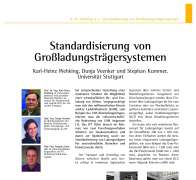
Standardisation of Large Charge Carrier

Standardisation of Large Charge Carrier

Karl-Heinz Wehking, Dunja Veenker, Stephan Kummer
In efficient process chains, economic advantages can be accomplished by the use of reusable loading devices. Due to their outer shape they allow a standardized handling of different goods using the already available equipment. Adequate design and a modular structure provide the opportunity for efficient loading and unloading processes of various goods. Keeping in mind the amount of loading devices currently in use (a few million), their economic relevance becomes apparent. The Institute for Mechanical Handling and Logistics (IFT) at the University of Stuttgart is currently working on two different research projects that involve the construction and thus optimisation of standardized loading devices for different industries and purposes.
Industrie Management | Volume 21 | 2005 | Edition 5 | Pages 49-52
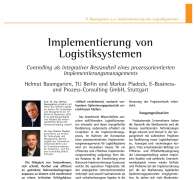
Implementation of Logistics Systems

Implementation of Logistics Systems

Controlling als integrativer Bestandteil eines prozessorientierten Implementierungsmanagements
Helmut Baumgarten, Markus Pladeck
Constant business change and shortcomings in logistics systems implementation require more efficient methods and instruments for translating new logistics concepts and technologies into daily operations of organizations. In the scope of process-oriented implementation management a new controlling approach is pointed out, which merges the factors of success and potential barriers in today’s business practice. With a specific Balanced-Implementation-Scorecard project managers are thus given an innovative instrument qualified for precisely intervening in and controlling the whole process of logistics modernisation to increase the efficiency of their implementation.
Industrie Management | Volume 21 | 2005 | Edition 3 | Pages 17-20
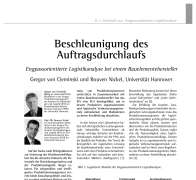
Accelerating the Order Throughput

Accelerating the Order Throughput

Engpassorientierte Logistikanalyse bei einem Bauelementehersteller
Gregor von Cieminski, Rouven Nickel
In its search for success factors that could ensure competitiveness, German industry has long recognized the potentials of the operational company organisation and of production logistics. Modern and intelligent production management combines these aspects and thus makes an important contribution to the economic success of an enterprise. The Bottleneck-oriented Logistics Analysis (BOLA) developed at the Institute of Production Systems and Logistics (IFA) of the University of Hanover is a method of logistic performance measurement, which supports production management by means of a logistic-oriented evaluation of production processes. In co-operation with a construction component manufacturer, IFA carried out a BOLA in a three-month project in order to uncover organisational and logistic potentials for improvement in the production department and to derive measures for exploiting these potentials.
Industrie Management | Volume 20 | 2004 | Edition 5 | Pages 43-46
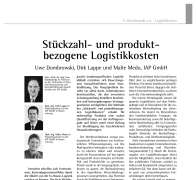
Quantity and Product-Related Logistics Costs

Quantity and Product-Related Logistics Costs

Uwe Dombrowski, Dirk Lappe, Malte Medo
Increasingly enterprises are hoping for a decline of marginal unit costs by turning away from in-house logistics. Free competition among contract logistics services is believed to open up new optimisation potentials. At the same time, performance related accounting models permit to transform the formerly fixed logistics costs into variable costs. However, because of the complexity and the customer-specific character of supply chain processes there is no standard method for the rating and selection of suitable service partners. The main problem is to provide information for a detailed description of the expected performance spectrum and thus to enable performance related contract positions. The method of „quantity and product related logistics costs” permits an exact quantification for multi stage products before placing a service order. It is a contribution to cope with the challenges described above.
Industrie Management | Volume 20 | 2004 | Edition 5 | Pages 25-27
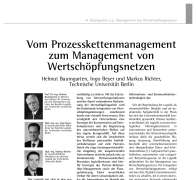
From Management of Process Chains to Management of Value Added Networks

From Management of Process Chains to Management of Value Added Networks

Helmut Baumgarten, Ingo Beyer, Markus Richter
Nowadays, logistics is seen as a strategic management instrument in order to gain and sustain competitive advantages. New information and communication technologies have substantially changed the way value chains are designed and managed. The research center InterVal analyses internet technologies in the context of supply chain collaboration. One focus is on the evaluation of appropriate management concepts and related investments in technologies.
Industrie Management | Volume 20 | 2004 | Edition 5 | Pages 9-12
Potential Analysis of Product Ramp-Up

Potential Analysis of Product Ramp-Up

Siegfried Stender, Jörg Uffmann, Ulrike Heinzle
Today, an efficient product ramp-up is a precondition of the success of a company. The ramp-up management provides the coordination and management of the ramp-up process. The Fraunhofer Institute for Manufacturing Engineering and Automation and the company Schnitzer Anlauf- und Projektmanagement GmbH has developed a tool for analysing the product ramp-up process in order to achieve potentials for optimization. Ramp-up projects can be evaluated and best practices can be identified.
Industrie Management | Volume 20 | 2004 | Edition 4 | Pages 38-40
Measuring and Controlling Supply Nets

Measuring and Controlling Supply Nets

State of the Art
Andrew J. Zeller, Peter Mertens
Most supply chain controlling approaches found in literature still focus on a single company instead of an entire net and thus do not live up to their promises. This article points out several problems that require the transition to the bird’s eye view and briefly introduces concepts that are truly inter-organizational in their nature. We close with a critical evaluation of what has been achieved in this field.
Industrie Management | Volume 20 | 2004 | Edition 3 | Pages 17-20
1 12 13 14