Profitability

Effective After Sales Service Management

Effective After Sales Service Management

Durch einen strategie- und lebenszyklusorientierten Ansatz lassen sich Potenziale ausschöpfen
Stephan M. Wagner, Thomas Zellweger, Eckhard Lindemann
Eroding margins for primary products have redirected many firms’ attention to the highly profitable After Sales Service (ASS), because of its high revenue and profit contribution. Trying to tap the high potential, companies are faced with numerous problems. This paper presents a strategy- and lifecycle-oriented approach for ASS to meet these challenges.
Industrie Management | Volume 23 | 2007 | Edition 1 | Pages 60-63
Outsourcing – An Austrian Survey

Outsourcing - An Austrian Survey

Eine empirische Untersuchung österreichischer Produktionsunternehmen
Herbert Jodlbauer, Roland Gmainer
Because competition is getting harder and harder, outsourcing becomes more important for companies. Especially lower labour costs, opening up new markets and capacity bottlenecks are the main reasons for companies to source out. The influence of outsourcing onto a company’s profit and performance was examined on the basis of a survey of Austrian production companies. As a result you can also see risks and the effects of wrong outsourcing in this paper.
Industrie Management | Volume 23 | 2007 | Edition 1 | Pages 52-55
Chances and Risks of Life Cycle Analysis

Chances and Risks of Life Cycle Analysis

Marina Dervisopoulos, Anne Schatka, Meike Torney, Marc Warwela
The operation of a capital good generates costs, which are mostly a multiple of the first investment. The value of this Life Cycle Costs is affected by the interplay between the product specific features and the customer specific operating conditions. This article aims to figure out chances and risks of Life Cycle Analysis.
Industrie Management | Volume 22 | 2006 | Edition 6 | Pages 55-58
The Importance of Operations Management in Micro Production

The Importance of Operations Management in Micro Production

Bernd Scholz-Reiter ORCID Icon, Michael Lütjen ORCID Icon, Hartmut Höhns
Recent investigations concerning the international state of the art of micro production technology [1, 2] showed, that it has to be distinguished between two main development directions regarding the manufacturing of function units on the one hand as well as complete products on the other hand. First of all there are the classical precision engineering oriented manufacturing methods [3, 4], e.g. according to the DIN 8580 [5]. Secondly manufacturing methods from the area of microsystems technology have been observed [3, 4]. The integration process of different product functions into one part or component geometry, which is running parallel to the miniaturisation, is a specific challenge regarding the field of micro manufacturing [1]. This affects especially the product and production process development, concerning the precision engineering oriented manufacturing methods. This paper addresses problems regarding the operations management of precision-engineering-oriented micro-production ...
Industrie Management | Volume 22 | 2006 | Edition 4 | Pages 9-14
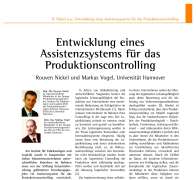
Developing an IT-System for the Logistic Controlling of Production Processes

Developing an IT-System for the Logistic Controlling of Production Processes

Rouven Nickel, Markus Vogel
In cooperation with seven industrial enterprises of different branches the institute of Production Systems and Logistics developed in the course of a research project an IT-System for the Logistic Controlling of Production Processes. The project was funded by the Stiftung Industrieforschung. The IT-System supports logisticians of enterprises by the logistic controlling of production processes and by associated planning and design of improvements.
Industrie Management | Volume 22 | 2006 | Edition 4 | Pages 61-64
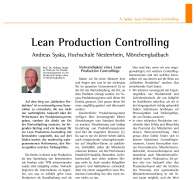
Lean Production Controlling

Lean Production Controlling

Andreas Syska
On the track to lean production it is necessary to develop new ratios, which should not only show us ex post what worked well and bad on the shopfloor. They should also help us to monitor and to improve the process itself. Important issues thereby are the capability of the workers and the flexibility of the production. Prof. Syska for these purposes has developed a concept for a lean production-controlling with ratios which is based on three columns: on the one hand the of the market perceived performance, on the other hand the process factors an as the third column the powering factors which are necessary for the change process.
Industrie Management | Volume 22 | 2006 | Edition 4 | Pages 33-36
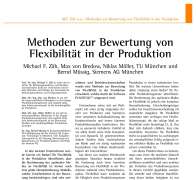
Methods for Flexibility Evaluation in Production

Methods for Flexibility Evaluation in Production

Michael F. Zäh, Max von Bredow, Niklas Möller, Bernd Müssig
Most enterprises have identified the need for flexibility, but the selection of the right degree of flexibility is a complex task. Sophisticated methods, which consider uncertainties in the valuation model, are time consuming and require a supporting software tool. The existing ones are applicable for very specific planning tasks only. In this paper, a methodology to support the valuation of manufacturing flexibility and PLANTCALC™, a supporting software tool, are presented. Both have been developed in a joint research project of the Institute for Machine Tools and Industrial Management and the Siemens AG.
Industrie Management | Volume 22 | 2006 | Edition 4 | Pages 29-32
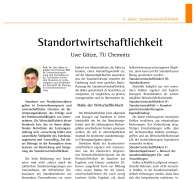
Location Profitability

Location Profitability

Uwe Götze
Plant locations are considered as important determinants of economic success and competitiveness in academic research as well as in practice. The profitability of these locations or rather of their value creating activities represents a key figure for plant management and controlling. The purpose of this paper is to develop a system for evaluating and improving plant location profitability.
Industrie Management | Volume 22 | 2006 | Edition 4 | Pages 45-48
Medium-Sized Businesses and Cooperations

Medium-Sized Businesses and Cooperations

Success by Systematical Outsourcing
Jens Gericke
Many companies have difficulties managing the recent situation of competition. Some companies achieve only small cost savings through the use of rationalization strategies. Network cooperations, however, offer many possibilities to successfully take advantage of efficiency increasing synergy effects. All participating companies can concentrate harder on their core business and achieve other features in cooperation with partner companies. This development concerns major enterprises as well as medium-sized businesses. While Outsourcing can be seen as a routine job for major enterprises, it poses problems for medium-sized businesses. These companies are lacking the necessary experience as well as tools to evaluate Outsourcing. This contribution points out the problems, that are related to Outsourcing in medium-sized businesses and demonstrates solutions.
Industrie Management | Volume 22 | 2006 | Edition 3 | Pages 45-48
Potential Oriented Selection of Digital Manufacturing Systems

Potential Oriented Selection of Digital Manufacturing Systems

A New Method for Selecting Components of Digital Manufacturing Systems
Arno Ritter, Timm Kuhlmann
Digital manufacturing systems are too expensive and not capable to produce the expected benefit for the company. This prejudice about the digital manufacturing systems is spread through out the most midsized companies. Because of the complexity of this new technology especially in its impacts to the company this prejudice is difficult to disprove. The IPA method DigiPlan-Check offers an efficient method for a fast picture of the company’s potentials. Based on these potentials a selection of digital manufacturing system components is possible. The result are valuable experiences where and how the digital manufacturing system will deliver its benefit. And all this will be done while considering the individual characteristics of the company and not common sense.
Industrie Management | Volume 22 | 2006 | Edition 2 | Pages 53-56
1 11 12 13 14