Leadership

Time Management – a Long-term and Structured Way of Utilizing Time

Time Management - a Long-term and Structured Way of Utilizing Time

Langfristig strukturiert mit der eigenen Zeit umgehen
Aurelia Drocur
Suggestions, techniques, strategies and ideas for optimizing time management are dime a dozen. But not all of these general methods can really change the long-term and structured way of utilizing time. One fails mostly because the method is not implemented consistently or the technique cannot be transferred to the daily routine. In order to change in the long run, prior knowledge and customization to the individual requirements are essential. This is shown by new findings of scientific research. The bottom line is that there are some really helpful techniques when it comes to time management but that the problem mostly is not starting new strategies but maintaining them.
Industrie Management | Volume 29 | 2013 | Edition 3 | Pages 73.76
Diversity as a Potential for Innovation

Diversity as a Potential for Innovation

Creativity and innovativeness of new product development teams between diversity and communication
Anja Kreidler, Meike Tilebein ORCID Icon
Through their diversity of competences and knowledge, heterogeneous new product development teams have a high potential for innovativeness. On the one hand, team diversity helps to deal with complex tasks and to improve the development of new products. On the other hand, a high level of diversity can lead to communication and cooperation barriers within the team, obstructing teamwork and hence hindering creativity and innovativeness. Therefore, finding the right constellation in this conflict between diversity and communication - exploiting the benefits whilst avoiding the hindrances - contributes to helping develop the full potential for innovation. This paper describes the different influences of diversity on the innovativeness of NPD teams and gives practical implications for managing heterogeneous teams.
Industrie Management | Volume 28 | 2012 | Edition 3 | Pages 47-50
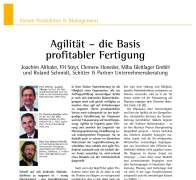
Agility – The Key to Profitable Manufacturing

Agility - The Key to Profitable Manufacturing

Joachim Althaler, Clemens Honeder, Roland Schmidt
Reacting quickly to rapidly changing market needs is, unsurprisingly, a basic requirement for profitable manufacturing. Why turn what is common sense into a science? Agility is the new buzzword. But is it merely „old wine in new bottles“ like so many things in the field of logistics or is it an interesting or even the decisive approach towards ensuring profitable production? Agility in its final perception is an organizations’ ability to swiftly and specifically utilize all available forces in order to fulfill an order. That is to meet requirements with agility. Agility and the excessive focus on detail and planning are oxymorons which are frequently found in both individuals and scientific literature. Agility is the manifestation of good leadership and is pretty much the opposite of planning optimization, high detailing and comprehensive forecasts which is why it is so difficult to describe it within the classic mainstream of logistics research. What really makes production ...
Industrie Management | Volume 28 | 2012 | Edition 2 | Pages 34-37
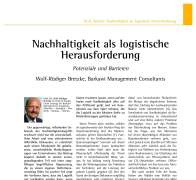
Sustainability as a Logistic Challenge: Potentials and Barriers

Sustainability as a Logistic Challenge: Potentials and Barriers

Potenziale und Barrieren
Wolf-Rüdiger Bretzke
The current discussion on sustainability lacks a firm foundation on a clear and unambiguous definition of this pivotal concept. This impedes a concentrated discussion among scientists as well as politicians and managers on a subject-matter concerning the future of mankind. It gives room for hollow commitments of companies claiming publicly to be „green“. The article therefore starts by proposing a clear and unambiguous definition which can fill this gap. Based on this preliminary work the author argues that logistics cannot become sustainable if it remains in a position where it only has to ensure the demands of other departments’ means (especially those of marketing) thus neglecting fundamental interdependencies. Logisticians often claim systems thinking as the dominant perspective of their work. Based on a practical example the author shows that systems thinking can only work as a door opener to sustainability if it is applied to the company as a whole.
Industrie Management | Volume 27 | 2011 | Edition 6 | Pages 65-68
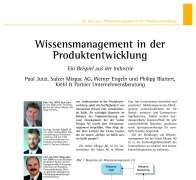
Knowledge Management of Product Development

Knowledge Management of Product Development

an Industry Example
Paul Jutzi, Werner Engeln, Philipp Blattert
Today knowledge is the company’s main resource. To be competitive, companies need qualified employees who are able to use their knowledge for solving problems. Especially in the field of product development it is essential that relevant knowledge is available. Knowledge Management is one important module of the concept of Lean Development. The Sulzer Mixpac AG has established Lean Development in its structure, while knowledge management has been introduced to the organization. This article provides background information. Sulzer Mixpac has followed the Toyota principle: “Before we build cars, we build people!”
Industrie Management | Volume 27 | 2011 | Edition 4 | Pages 43-46
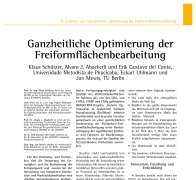
Holistic Optimization of Sculptured Surfaces Manufacturing (HoliMan)

Holistic Optimization of Sculptured Surfaces Manufacturing (HoliMan)

Klaus Schützer, Alvaro J. Abackerli, Erik Gustavo del Conte, Eckart Uhlmann ORCID Icon, Jan Mewis
The mould and die industry is characterized by permanently rising competitive pressure. Competitiveness has to be increased with higher productivity through declined machining times and costs as well as the same or higher quality of the products to be machined. A key technology to reach these objectives is the 5-Axes HSC machining of sculptured surfaces, whose potentials are currently used but not bailed out. Therefore the main objective of the BRAGECRIM pro-ject “Holistic Optimization of Sculptured Surface Manufacturing” (HoliMan) is to identify and exploit the production accuracy and efficiency increasing potential. In this project Brazilian and German researchers work together on the holistic optimization of sculptured surface manufacturing by considering the significant impacts of the manufacturing process on the work-piece quality.
Industrie Management | Volume 27 | 2011 | Edition 2 | Pages 23-26
Leadership and Training of Military Personnel

Leadership and Training of Military Personnel

The demands made by multinational missions
Robert Prader, Linz-Ebelsberg
The demands on military personnel during international missions are subject to major change. There is a need for proactive and decisive soldiers from all armies who are willing to take on responsibility. This requires  change in both the education and training as well as in the handling of directives and restricting rule systems. Comparisons with leadership needs in the economy are desirable.
Industrie Management | Volume 26 | 2010 | Edition 2 | Pages 25-27
Employee Involvement

Employee Involvement

Ein Weg zur Ertragssteigerung
Fritz G. Habel
The author worked for a food company as a member of the board of directors over nearly 30 years. He shows the approach to the development from an old fashioned company with over 100 years of tradition into a modern and successful enterprise. As a tool for a restructuring process, the company chose to “involve the employees in decision making”. Apart from the approach to this process, the author shows that this way of employee involvement allows generating significant financial improvements.
Industrie Management | Volume 26 | 2010 | Edition 2 | Pages 15-18
Leadership As the Primary Enabler of Productivity

Leadership As the Primary Enabler of Productivity

Joachim Althaler, Alexander Kügele, Roland Schmidt
Companies are established, grow and prosper and also go bankrupt during the course of a lifetime. However, how can it be possible that a company selling the same products in the same market manufactured by the same employees shortly after coming very close to bankruptcy subsequently turns into a flagship company? Is it possibly that only very subtle differences combined with the attitude of those involved are the factors which make a difference? Firm goals and brilliant leadership are the keys to successful business reengineering. Leadership is much more than mere management. An example taken from the machine-building industry emphasizes the significance of leadership for success.
Industrie Management | Volume 26 | 2010 | Edition 2 | Pages 21-24
Sustainable and Energy Efficient Logistics

Sustainable and Energy Efficient Logistics

Conception and Evaluation of Cross-company Logistic Models
Wilfried Sihn, Felix Meizer, René Leitner, Margarethe Prochazka
The strong geographical dislocation of automotive production networks is responsible for the increasing traffic volume between Western and Eastern Europe. The limited volume of shipments of individual companies often prevents them from accessing cost-efficient and highly productive transportation networks. This paper depicts then great potential of novel regional, cross-company transport bundling for enterprises and it proposes a simulation and evaluation model as well as an organisation model for a cross-company co-operation.
Industrie Management | Volume 26 | 2010 | Edition 2 | Pages 73-76
1 3 4 5 6