Leadership

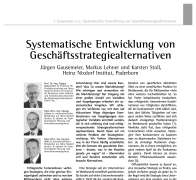
Systematic Development of Business Strategy Alternatives

Systematic Development of Business Strategy Alternatives

Jürgen Gausemeier, Markus Lehner, Karsten Stoll
Successful enterprises pursue strategies, which are unique and for this reason cannot easily be imitated by competitors. Such strategies are based on a smart combination of various strategic variables. These variables are the result of the characteristic questions of strategy development: Who are our customers? What are our products and services? How are these products and services provided? The handling of a vast amount of strategic variables requires a systematic approach. Therefore we introduce a method which combines characteristics of strategic variables on a discursive way which leads to coherent and promising strategy alternatives. Hence we solve another problem in the context of strategy development: We provide alternatives which are often omitted in practical experience due to time constraints. To overcome the limits of usual thinking - next to things being “en vogue” in industry - and to make substantiated decisions alternatives are necessary.
Industrie Management | Volume 25 | 2009 | Edition 4 | Pages 41-44
The Employed Entrepreneur – How Work life will develop after the post-industrial Revolution

The Employed Entrepreneur - How Work life will develop after the post-industrial Revolution

Das Arbeitsleben nach der post-industriellen Revolution
Dominik T. Matt
Growing competition, new technologies and global markets force companies to act in an increasingly fast and market-oriented way, leading inevitably to changes in organization and company culture. Rigid and function-oriented organizational structures will be substituted by flexible, project-oriented or even virtual organizations. Collaboration will change quickly according to the new requirements. Different people, whole enterprises or only parts of a company will be able to temporarily build virtual teams or companies, locally or within networks. Against the background of this fundamentally changing work environment, companies’ requirements regarding employees and the mechanisms of collaboration will substantially change. This paper gives a closer look at these new requirements and will highlight some possible future solution ideas.
Industrie Management | Volume 25 | 2009 | Edition 2 | Pages 33-35
Efficient Human-Machine Co-operation by Means of Cognitive Automation

Efficient Human-Machine Co-operation by Means of Cognitive Automation

Axel Schulte, Claudia Meitinger
In the development of uninhabited aerial vehicles (UAVs) oftentimes the focus is upon the enhancement of the vehicle and its automated functions. In fact, the aspects related to human-machine-interaction are mostly neglected. An unmanned vehicle should not be mistaken for an unmanned system with a human operator, although not being aboard. From accident analysis in civil air transport human factor problems resulting from too complex automation are well documented for a long time. Starting from a more human-centered perspective, this contribution describes the approach of cognitive and co-operative automation in order to mitigate such problems by establishing a close-partner work relationship between human operators and automated functions. First applications have already been developed and provide prove of concept.
Industrie Management | Volume 24 | 2008 | Edition 4 | Pages 29-32
Autonomous Control in Intralogistics

Autonomous Control in Intralogistics

Cognitive Spatial Representations for Autonomous Vehicles
Arne Schuldt, Björn Gottfried
Autonomous vehicles are employed in intralogistics in order to transport work pieces between different workplaces. Previous guidance systems are based on wire-guided tracks or optical following of surface markings. In the first case, the possibility to change the production layout is rather limited. In the second case, abrasion can significantly decrease recognition rates. In contrast, humans easily succeed in navigation tasks, even in dynamic environments. A promising approach is therefore to apply a cognitively motivated spatial representation for autonomous vehicles. This article presents BA23, a set of 23 qualitative relations for qualitative spatial reasoning, and discusses its application in intralogistics.
Industrie Management | Volume 24 | 2008 | Edition 4 | Pages 41-44
Complexity = Criminality?

Complexity = Criminality?

Ein neuer Ansatz für die nachhaltige Variantenbereinigung
Norbert Große Entrup
The increasing individualization of the customer needs and through this the rising number of product variants led to higher complexity in almost all enterprise processes. Customers are served by new products, in partly new markets and whatever a customer wishes is also taken into account. Over the time the product complexity increases more and more in the business fields and gets almost incalculable. Procedures are necessary, which are able to distinguish economic and not economic variants and provide a lasting guarantee of an optimal diversity of variants.
Industrie Management | Volume 23 | 2007 | Edition 6 | Pages 63-65
Long-Term Acting Product Change Teams

Long-Term Acting Product Change Teams

Effektive Nutzung bestehenden Wissens zur gezielten Umsetzung technischer Produktänderungen in der Anlaufphase
Bernd Scholz-Reiter ORCID Icon, Farian Krohne
For an efficient implementation of technical product changes, industrial companies need to use a goal-oriented procedure as well as an effective application of already existing knowledge about previous product changes. Mostly, product changes are implemented by using standardised workflows, which are controlled and documented by common workflow-management-systems. The administration effort of these systems often causes delayed implementation of product changes. In this context companies try to optimise the product change process by implementing new application systems and by integrating existing isolated applications in these systems. The organisation of subgroups, who finally implement the product change, is often neglected. Thereby, the development of new approaches in this area may close the gaps in order to make knowledge available.
Industrie Management | Volume 22 | 2006 | Edition 6 | Pages 31-33
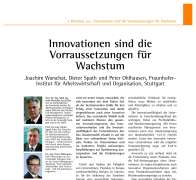
Innovation is the Prerequisite of Growth

Innovation is the Prerequisite of Growth

Joachim Warschat, Dieter Spath, Peter Ohlhausen
This article tries to answer the question what implications innovation management will have on the future performance of companies. For this purpose a new approach has been developed that considers the time factor to be the determining element for the success of an innovation which also includes an invention. The developed model analyses the entire innovation process on several levels as well as the innovation performance and innovation capability of a company. This model permits to highlight critical elements within the company and the specific project, on the basis of existing data. This allows to give recommendations for optimisation and to evaluate modifications.
Industrie Management | Volume 22 | 2006 | Edition 5 | Pages 51-54
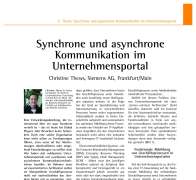
Synchronous and Asynchronous Communication in Corporate Portals

Synchronous and Asynchronous Communication in Corporate Portals

Christine Thews
Nowadays it is not unusual that the R & D departments of global players might be spread over several locations worldwide. Whenever fast decisions are to be made in many times such an organization can lead to delays. Web based corporate portals with synchronous and asynchronous features of communication have been approved as a practical solution. Within a service oriented architecture it not only illustrates comprehensibly overlapping business processes, it also offers staff members so-called „Collaboration Services“ which substantially simplify teamwork.
Industrie Management | Volume 22 | 2006 | Edition 5 | Pages 55-58
Identification of Cooperation Potentials in Existing Inter-Company Networks

Identification of Cooperation Potentials in Existing Inter-Company Networks

Stephan Killich, Christopher M. Schlick
For already cooperating businesses, a question that often occurs is: which potential cooperation activities under the given conditions can be developed and how can they be evaluated? To the authors’ knowledge, there is no structured and validated procedure for the identification and evaluation of existing cooperation potentials. This usually occurs through a subjective assessment by cooperation experts and is highly dependent on the experience of the persons involved. Therefore a method is presented which makes a structured and valid identification of cooperation potentials in existing inter-company relations possible.
Industrie Management | Volume 22 | 2006 | Edition 3 | Pages 15-18
Integrated Transportation Planning Within and Between Freight Forwarders

Integrated Transportation Planning Within and Between Freight Forwarders

Herbert Kopfer, Marta Anna Krajewska
Horizontal cooperations offer a wide spectrum of possibilities for efficiency improvement within a company. At first, the decisions of the integrated operational transportation planning are presented in order to analyse the collaboration aspects. Next, different possibilities of broadening the introduced problem in terms of collaboration between several autonomous subsidiaries of one company are presented.
Industrie Management | Volume 22 | 2006 | Edition 3 | Pages 75-77
1 4 5 6