Leadership

Identification of Cooperation Potentials in Existing Inter-Company Networks

Identification of Cooperation Potentials in Existing Inter-Company Networks

Stephan Killich, Christopher M. Schlick
For already cooperating businesses, a question that often occurs is: which potential cooperation activities under the given conditions can be developed and how can they be evaluated? To the authors’ knowledge, there is no structured and validated procedure for the identification and evaluation of existing cooperation potentials. This usually occurs through a subjective assessment by cooperation experts and is highly dependent on the experience of the persons involved. Therefore a method is presented which makes a structured and valid identification of cooperation potentials in existing inter-company relations possible.
Industrie Management | Volume 22 | 2006 | Edition 3 | Pages 15-18
Integrated Transportation Planning Within and Between Freight Forwarders

Integrated Transportation Planning Within and Between Freight Forwarders

Herbert Kopfer, Marta Anna Krajewska
Horizontal cooperations offer a wide spectrum of possibilities for efficiency improvement within a company. At first, the decisions of the integrated operational transportation planning are presented in order to analyse the collaboration aspects. Next, different possibilities of broadening the introduced problem in terms of collaboration between several autonomous subsidiaries of one company are presented.
Industrie Management | Volume 22 | 2006 | Edition 3 | Pages 75-77
Complexity-Based Design of Collaborations

Complexity-Based Design of Collaborations

A Chance to Save Germany’s Industrial Locations
Günther Schuh ORCID Icon, Alexander Schauer, Sebastian Döring
The intensive international competition exerts strong cost pressure on Germany’s producing companies. Hence, managers more and more decide to relocate industrial locations to foreign countries in order to reduce their costs. However, not all possibilities to strengthen and to sustainably save Germany’s industrial locations have been tapped, yet. One step towards this that is supposed by companies to keep a high potential, is to collaborate. A new approach for the design of collaborations focussing complexity drivers shall raise the probability of success of collaborative goods and services.
Industrie Management | Volume 22 | 2006 | Edition 3 | Pages 72-74
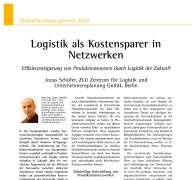
Increasing Efficiency in Production Networks with Future Logistics

Increasing Efficiency in Production Networks with Future Logistics

Effizienzsteigerung von Produktionsnetzen durch Logistik der Zukunft
Jonas Schöfer
Industrial companies as well as small and medium sized enterprises engage themselves more and more in international production networks. Each networkpartner aims on building and maintaining business relationships to the best partner for any specific task. This leads to an increasing amount of goods being transported from partner to partner and leads to an immense logistics effort. These logistics tasks are responsible for major cost blocks in most companies. Organisations will have to react to the increasing demand for on time delivery with organisational as well as technological solutions to maintain their competitive advantage.
Industrie Management | Volume 22 | 2006 | Edition 1 | Pages 44-46
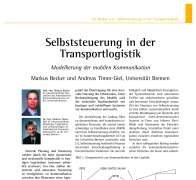
Autonomous Control in Transport Logistics: Modelling Communication

Autonomous Control in Transport Logistics: Modelling Communication

Modellierung der mobilen Kommunikation
Markus Becker, Andreas Timm-Giel
High dynamics and structural complexity in current and future logistic systems are complicating central planning and control. For enabling a more decentralised and autonomous control, communication between the elements of the logistical network are necessary for the provisioning of the information needed. This article details the modelling of the communication between the components. This modelling contains source and sink of the information as well as the amount of data, frequency of transmission, quality of service and the moment of transmission for a reasonable usage of the information. The technical feasibility with current and upcoming communication systems is evaluated under consideration of the model.
Industrie Management | Volume 21 | 2005 | Edition 5 | Pages 71-74
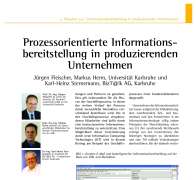
Process-Orientated Information Retrieval On-Demand in Producing Enterprises

Process-Orientated Information Retrieval On-Demand in Producing Enterprises

Jürgen Fleischer, Markus Herm, Karl-Heinz Sternemann
Due to increasing pressure of competition accompanied with the developments in information technology many companies consider speeding up and improving their business processes with regard to major orientation towards their customers. Employees which are involved in these business processes have to be supported by an improved and tailored information supply. One possibility for this support by new Information Compative Technologies (ITC) will be shown in this article on the basis of an example for a customer complaint process.
Industrie Management | Volume 21 | 2005 | Edition 1 | Pages 17-20
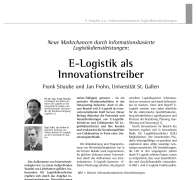
New Market Opportunities Through Information-Based Logistics Services:

New Market Opportunities Through Information-Based Logistics Services:

E-Logistics as Innovation Driver
Frank Straube, Jan Frohn
The emergence of internet technologies has led to a fundamental transformation of value chains. For logistics service providers in particular new revenue sources and new roles in supply chains evolve. E-logistics helps to reduce the transaction costs in supply chains and hence increases the willingness for outsourcing. The ability to integrate seamlessly into customer processes, which can be referred to as collaboration capability, is a central competitive factor in the outsourcing industry. Also in this area e-logistics plays the role of an innovation driver. This article discusses the potentials and barriers of e-logistics initiatives and collaboration for logistics service providers and their customers and structures the design parameters of collaboration through a methodology.
Industrie Management | Volume 20 | 2004 | Edition 5 | Pages 39-42
Versatile Production Networks by Means of Intermediary Services

Versatile Production Networks by Means of Intermediary Services

Niklas Stracke
One main impetus for the participation of enterprises in cooperations can be characterized by the e-business phenomenon. Increased supplier demands concerning flexibility, costs, and quality require a flexible potential to participate in constantly new cooperations. The model concept illustrated in this article is supposed to support the mutability of enterprises by use of intermediary services between cooperating units that are suitable to aid the partnership.
Industrie Management | Volume 20 | 2004 | Edition 2 | Pages 43-46
Cooperation in Project-oriented Production

Cooperation in Project-oriented Production

Jan C. Aurich, Peter Barbian, Kutay Köklü
In order to meet rising and fast changing requirements companies have to reconfigure their production systems in ever shorter periods. The temporary character of production systems, the rise of complexity as well as a rising number of intra- and inter-organizational cooperation are the logical results of this development. Managing the production as a project is an innovative and promising concept for coping with the resulting challenges. This article introduces the concept of a Project-oriented Production and describes a way for the cooperative planning and designing of modular production systems within 3D planning rooms.
Industrie Management | Volume 19 | 2003 | Edition 5 | Pages 58-61
1 5 6