Logistics

Higher Responsiveness in Transcorporate Cooperations

Higher Responsiveness in Transcorporate Cooperations

Flexibility contracting as a medium
Nikolai Iliev, Paul Schönsleben
Quantity flexibility contracts are a prevalent medium in industrial practice aiming at reducing demand and inventory risks with increased fill rates and higher responsiveness. Meanwhile researchers have proved the advantage of such contracts by simulation models. But it still lacks tangible methods for estimating negotiable costs and also for implementation on operational level. Against this background a software supported tool will be presented closing the gaps in scientific formulation of flexibility oriented contract clauses. Furthermore the tool enables an efficient display of additional costs and gives hints for the parameterisation of ERP-(Enterprise Resource Planning)-systems.
Industrie Management | Volume 22 | 2006 | Edition 3 | Pages 19-22
The Portal Robot – The Optimization of Logistic Systems by a Worldwide Novelty

The Portal Robot - The Optimization of Logistic Systems by a Worldwide Novelty

Optimierung logistischer Prozesse durch eine Weltneuheit
Stephan Tank, Wolfgang Echelmeyer
Continuity and reliability in the fully automated unloading process are the greatest strengths of the new “portal robot”, a logistics system worldwide unique. Its task is unloading cubic goods out of containers or swap bodies. The robot is working with a stable process safety and high process speed. It may be used in combination with various logistic systems. When integrated early, possibly in the stadium of planning new centres of distribution, the realisation can become yet more profitable.
Industrie Management | Volume 22 | 2006 | Edition 2 | Pages 13-16
Real Time Factory Cockpit for Medium-Sized Businesses

Real Time Factory Cockpit for Medium-Sized Businesses

Ralf Kapp, Jan le Blond, Stephan Schreiber, Matthias Pfeffer, Engelbert Westkämper
This technical contribution presents a digital planning environment for an integrated facility layout and logistics planning. The aim is a noticeable reduction of time and effort for middle- and long-term facility planning and production planning. Therefore current data from the shop floor and order management are provided in an object-oriented consistent digital structure. This data is used to forecast the need for action and to deduct alternative solutions. Planning becomes more effective, long-term planning tasks become day-to-day activities so that the flexibility of the enterprise increases.
Industrie Management | Volume 22 | 2006 | Edition 2 | Pages 49-52
Development and Implementation of Telematic Concepts in Logistics

Development and Implementation of Telematic Concepts in Logistics

Hartmut F. Binner
“Telematic” means any form of telecommunication based on information technology, whose functionality is guaranteed by software applications and where the information can be proceeded online and free from mediabreaks after the electronic transmission. In logistics, many different telematic solutions can be used especially within the distribution process of the different persons involved in the process.
Industrie Management | Volume 22 | 2006 | Edition 2 | Pages 61-64
Advanced Production Control for Machine Concepts

Advanced Production Control for Machine Concepts

Innovative Manufacturing Technologies—A scenario for 2020
Katja Windt, Julia Bendul
In 2020 production and logistics are faced by a changed periphery of manufacturing. New manufacturing technologies, machine concepts and groundbreaking manufacturing control will be the main fields of innovation in the range of production and logistics. Starting from a scenario of production in 2020 the following concept identifies the drivers of innovation for industrial engineering and in particular for production logistics, that reflect the increasing dynamics and complexity of the changing environment, and points out the resulting fields of innovation.
Industrie Management | Volume 22 | 2006 | Edition 1 | Pages 31-34
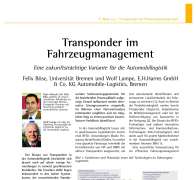
Assignment of Transponders in the Range of Automobile Management

Assignment of Transponders in the Range of Automobile Management

Eine zukunftsträchtige Variante für die Automobillogistik
Felix Böse, Wolf Lampe
The assignment of transponders in the field of automobile logistics is currently confined to few applications in closed circuits. The main reasons are high costs as well as insufficient standardisation and performance of RFID-systems. Combined with other new information and communication technologies RFID becomes increasingly important for positioning and communication tasks. Based on the processes of an idealised E.H.Harms Automobile-Logistics terminal this article describes the basic options of utilizing transponders in this specific industry and introduces a potential solution to cope with unsatisfactory cost-benefit ratios.
Industrie Management | Volume 21 | 2005 | Edition 5 | Pages 29-32
Controlling the Interdependencies of Manufacturing Enterprise Logistics

Controlling the Interdependencies of Manufacturing Enterprise Logistics

Gregor von Cieminski, Peter Nyhuis ORCID Icon
Due to the complexity of the interdependencies in enterprise logistics, manufacturing companies often have difficulties in meeting their logistic objectives. They struggle to take measures that effectively influence their logistic performance. The Institute of Production Systems and Logistics (IFA) is developing illustrative models that describe and quantify the logistic interdependencies. The models form a basis for strategies and procedures, with which manufacturing controls can control the interdependencies.
Industrie Management | Volume 21 | 2005 | Edition 5 | Pages 41-44
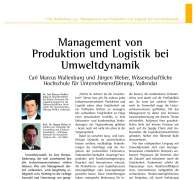
Management of Production and Logistics Under External Dynamics

Management of Production and Logistics Under External Dynamics

Carl Marcus Wallenburg, Jürgen Weber
Producing companies are increasingly facing external dynamics. To remain successful in the long run their management will have to keep up to this challenge. Thus it is important to choose and implement the right concepts and instruments to deal with dynamics. This article offers an overview on different approaches and a closer insight into the concept of Supply Chain Event Management.
Industrie Management | Volume 21 | 2005 | Edition 5 | Pages 45-48
Mobile SCEM

Mobile SCEM

Agent-Based Event Management in Global Supply Networks
Karl Kurbel, Denny Schreber
Managing disruptions and unplanned events in large dynamic supply networks is a difficult task. Intelligent agents and mobile technologies can help to make essential information about the flow of goods available quickly and efficiently. Through mobile access to information, decision makers are enabled to act and react faster, while some problems may be solved by agents directly. This paper describes an approach for effective Supply Chain Event Management (SCEM) using agent and mobile technologies. A peer-to-peer architecture for agent communication and access to back-office systems by agents is outlined.
Industrie Management | Volume 21 | 2005 | Edition 5 | Pages 21-24
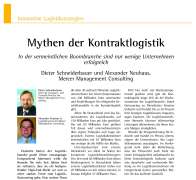
Myths in Contract Logistics

Myths in Contract Logistics

Only Few Logistics Providers are Profitable
Dieter Schneiderbauer, Alexander Neuhaus
Contract logistics is not a dynamic growth market. This is the conclusion of "Myths in Contract Logistics," a recent study from Mercer Management Consulting. The study explodes a number of myths that have had a big impact on market performance for years: that there is a sharp trend toward logistics outsourcing, that logistics is a highly profitable high-end market, that profitable logistics providers only require low investment capital - and that satisfied customers remain loyal over long periods of time. Mercer investigated more than thirty leading logistics companies worldwide with a total sales revenue of 228 billion euros and makes suggestions for successful business designs in the contract logistics sector.
Industrie Management | Volume 21 | 2005 | Edition 5 | Pages 68-70
1 16 17 18 19