Logistics

Mobile SCEM

Mobile SCEM

Agent-Based Event Management in Global Supply Networks
Karl Kurbel, Denny Schreber
Managing disruptions and unplanned events in large dynamic supply networks is a difficult task. Intelligent agents and mobile technologies can help to make essential information about the flow of goods available quickly and efficiently. Through mobile access to information, decision makers are enabled to act and react faster, while some problems may be solved by agents directly. This paper describes an approach for effective Supply Chain Event Management (SCEM) using agent and mobile technologies. A peer-to-peer architecture for agent communication and access to back-office systems by agents is outlined.
Industrie Management | Volume 21 | 2005 | Edition 5 | Pages 21-24
Autonomous Cooperating Logistic Processes for Automobile Terminals

Autonomous Cooperating Logistic Processes for Automobile Terminals

Felix Böse, Jakub Piotrowski, Katja Windt
Logistic systems of automobile terminals are characterised these days by central planning and control processes, which do not allow fast and flexible adaptation of order processing to changing environmental influences caused by the dynamic and complexity in logistics. Process flows of cars on an automobile terminal such as delivery, storage and technical treatment are supported by a conventional, centralised logistic system. By establishing autonomous cooperating logistics processes, the automobiles will be enabled to act independently according to their own objectives and navigate through the logistics network themselves. This paper introduces first approaches of autonomous cooperation in the context of logistics and investigates potential applications in automobile logistics on the example of E. H. Harms Auto-Terminal-Hamburg GmbH & Co. KG.
Industrie Management | Volume 21 | 2005 | Edition 4 | Pages 37-40
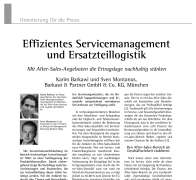
Efficient Service Management and Spare Parts Logistics

Efficient Service Management and Spare Parts Logistics

Mit After-Sales-Angeboten die Ertragslage nachhaltig stärken
Karim Barkawi, Sven Montanus
The stagnation of capital spending in the capital goods market leads to longer product lifecycles. For this reason the demand for support services and spare parts is continuously increasing as those are needed for maintenance and repairs. For suppliers of capital goods this means opportunity and challenge at the same time: While highly profitable after-sales services can compensate declining new product sales the after-sales business requires efficient service organisations which make support services and spare parts available, according to service level agreements.
Industrie Management | Volume 20 | 2004 | Edition 5 | Pages 32-34
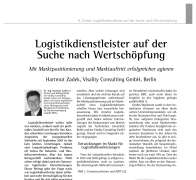
Logistics Service Providers Searching for Possibilities to Create Value

Logistics Service Providers Searching for Possibilities to Create Value

Mit Marktpositionierung und Marktauftritt erfolgreicher agieren
Hartmut Zadek
Logistics service providers do not only want to grow and to increase their turnover, but they also want to handle more profitable performances provided for their customers. However, since September 2001 this has not been an easy venture considering the low economic performance and the weakness relating to market conditions. On the other hand, economic situation-caused problems are often an opportunity for companies from industry and trade to rethink their own core businesses. Often even logistics services will be outsourced. This article describes the possibilities for logistics service providers on the market, especially how they can create more value for their customers and their own business.
Industrie Management | Volume 20 | 2004 | Edition 5 | Pages 47-50
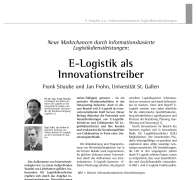
New Market Opportunities Through Information-Based Logistics Services:

New Market Opportunities Through Information-Based Logistics Services:

E-Logistics as Innovation Driver
Frank Straube, Jan Frohn
The emergence of internet technologies has led to a fundamental transformation of value chains. For logistics service providers in particular new revenue sources and new roles in supply chains evolve. E-logistics helps to reduce the transaction costs in supply chains and hence increases the willingness for outsourcing. The ability to integrate seamlessly into customer processes, which can be referred to as collaboration capability, is a central competitive factor in the outsourcing industry. Also in this area e-logistics plays the role of an innovation driver. This article discusses the potentials and barriers of e-logistics initiatives and collaboration for logistics service providers and their customers and structures the design parameters of collaboration through a methodology.
Industrie Management | Volume 20 | 2004 | Edition 5 | Pages 39-42
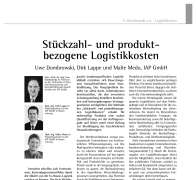
Quantity and Product-Related Logistics Costs

Quantity and Product-Related Logistics Costs

Uwe Dombrowski, Dirk Lappe, Malte Medo
Increasingly enterprises are hoping for a decline of marginal unit costs by turning away from in-house logistics. Free competition among contract logistics services is believed to open up new optimisation potentials. At the same time, performance related accounting models permit to transform the formerly fixed logistics costs into variable costs. However, because of the complexity and the customer-specific character of supply chain processes there is no standard method for the rating and selection of suitable service partners. The main problem is to provide information for a detailed description of the expected performance spectrum and thus to enable performance related contract positions. The method of „quantity and product related logistics costs” permits an exact quantification for multi stage products before placing a service order. It is a contribution to cope with the challenges described above.
Industrie Management | Volume 20 | 2004 | Edition 5 | Pages 25-27
Value Added Management in a Virtual Supply Chain Organization (VISCO)

Value Added Management in a Virtual Supply Chain Organization (VISCO)

Herwig Dullnig
Planning and organising of value added processes can be optimized by supply chain management. Therefore, creating a virtual supply chain organization (VISCO) is suggested. The main tasks are building up a specific organization for the collaboration, applying modern information and communication technologies, and implementing innovative logistics systems in the VISCO. Furthermore, it is necessary to harmonize the different plans of the companies involved. With the help of a special value added management in the VISCO it is possible to improve the effectiveness and efficiency of the value added process significantly.
Industrie Management | Volume 20 | 2004 | Edition 5 | Pages 51-54
Measuring and Controlling Supply Nets

Measuring and Controlling Supply Nets

State of the Art
Andrew J. Zeller, Peter Mertens
Most supply chain controlling approaches found in literature still focus on a single company instead of an entire net and thus do not live up to their promises. This article points out several problems that require the transition to the bird’s eye view and briefly introduces concepts that are truly inter-organizational in their nature. We close with a critical evaluation of what has been achieved in this field.
Industrie Management | Volume 20 | 2004 | Edition 3 | Pages 17-20
Dynamic In-House Logistics at Visteon

Dynamic In-House Logistics at Visteon

Alexandra Kühn, Stephan Ripp, Günther Schuh ORCID Icon
Visteon is one of the largest automotive suppliers world-wide and is focused on innovation and permanent improvement. For Visteon that means the consistent implementation of Lean Manufacturing concepts. Thereby lean in-house logistics represent a core aspect. For that reason the Visteon plant at Düren is developing innovative concepts for the dynamic controlling of the overall material flow together with the chair of production systematics of the university of Aachen. With the implementation of the simple yet flexible variant Kanban system Visteon plant Düren is obtaining a leading position with regard to innovative in-house logistics.
Industrie Management | Volume 20 | 2004 | Edition 3 | Pages 21-24
Optimisation of Air Cargo Networks

Optimisation of Air Cargo Networks

Knotenübergreifende Bewertung und Gestaltung zeitpunktgeführter Luftfrachtprozesse mittels Simulation von Teilnetzen
Harald Sieke, Andreas Quick
Airports as trans-shipment centres, within the transport networks of the world-wide air transport, represent complex knots of huge logistic networks. Cargo handling at airports is significantly determined by the location, the design and dimensioning of the cargo terminal, as well as by the internal and external handling relations. The examination and implementation of the modelling and simulation of relevant processes within a realistic part of an air cargo network is the focal point of this article. Its aim is to evaluate and design air cargo processes between two air cargo hubs and their respective origin and destination airports as a whole. It is shown that individual approaches to reduce costs of the parties involved are not as efficient as considering the whole transport network including all external handling relations.
Industrie Management | Volume 20 | 2004 | Edition 3 | Pages 59-62
1 17 18 19