Environmental Aspects of Vendor Managed Inventory

JournalIndustrie 4.0 Management
Issue Volume 34, 2018, Edition 6, Pages 56-60
Open Accesshttps://doi.org/10.30844/I40M_18-6_56-60
Bibliography Share Cite Download

Abstract

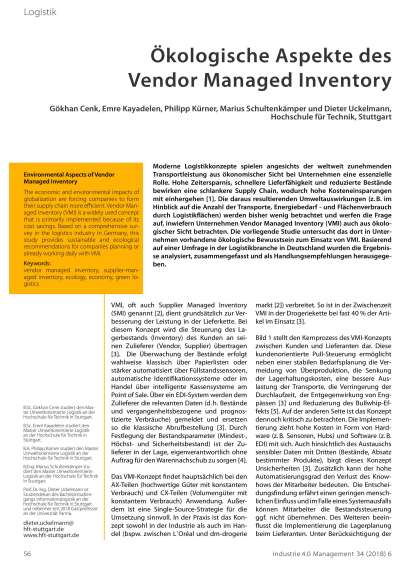
The economic and environmental impacts of globalization are forcing companies to form their supply chain more efficient. Vendor Managed Inventory (VMI) is a widely used concept that is primarily implemented because of its cost savings. Based on a comprehensive survey in the logistics industry in Germany, this study provides sustainable and ecological recommendations for companies planning or already working daily with VMI.

Keywords


Bibliography

[1] Klaus, Peter: Lexikon Logistik. Wiesbaden 2008.
[2] Hausladen, Iris: IT-gestützte Logistik: Systeme – Prozesse – Anwendungen. Wiesbaden 2014.
[3] Werner, Hartmut: Supply Chain Management: Grundlagen, Strategien, Instrumente und Controlling. Wiesbaden 2017.
[4] Seidenschwarz, Werner: Marktorientiertes Prozessmanagement: Wie Process Mass Customization Kundenorientierung und Prozessstandardisierung integriert. München 2012.
[5] John, Wang: Management Innovations for Intelligent Supply Chains. Hershey 2012.
[6] Wagner, Stefan M.; Kemmerling, Rene: Handling Nonresponse in Logistics Research. In: Journal of Business Logi- stics 31 (2010) 2, S. 357-381.
[7] KfW Bankengruppe: KFW-Befragung zu den Hemmnissen und Erfolgsfaktoren von Energieeffizienz in Unternehmen. URL: https://www.kfw.de/Download-Center/Konzernthemen/Research/ PDF-Dokumente-Sonder- publikationen/Sonderpublikation.pdf, Abrufdatum 23.04.2018.
[8] Zenker, M.; Meers, S.; Ullmann, G.; Nyhuis, P.: Ökologische und logistische Bewertung und Auswahl von Anlieferkonzepten. In: Industrie Management 29 (2013) 2, S. 63-65.
[9] Wiese, Jonas: Slow Logistics: eine simulationsgestützte Analyse der ökonomischen und ökologischen Potentiale der Sendungsbündelung. Bamberg 2017.
[10] Angerer, A: Out-of-Stock im Handel: Ausmass-Ursachen-Lösungen. URL: https://www.gefahrgut-online.de/fm/3576/Angerer.pdf, Abrufdatum 25.04.2018.
[11] Schmied, M.: Umweltorientierte Logistikstrategien: Beweggründe, Ansatzpunkte, Instrumente. In: INFRAS/ Öko-Institut (Hrsg): Hochschule für Technik. Stuttgart 2017.
[12] Cernavin, Oleg; Schröter, Welf; Stowasser, Sascha: Prävention 4.0: Analysen und Handlungsempfehlungen für eine produktive und gesunde Arbeit 4.0. Berlin Heidelberg New York 2017.
[13] Vogel Communications Group GmbH & Co. KG: Vendor Managed Inventory optimiert Lagerdiposition. URL: https://www.mm-logistik.vogel.de/vendor-managed-inventory-optimiert-lagerdisposition-a-673607/, Abrufdatum 22.07.2018
[14] Verband der Automobilindustrie: RFID im Behältermanagement der Supply Chain. URL: https://www.vda.de/dam/vda/publications/2015/vda-5501-rfid-im-behaeltermanagement-v2-1/VDA_5501%20RFID%20Behaeltermanagement%20V%20 2%202%20Juli%202016.pdf, Abrufdatum 02.05.2018.
[15] Eßig, M.; Witt, M.: Öffentliche Logistik: Supply Chain Management für den öffentlichen Sektor. Berlin Heidelberg New York 2008.
[16] Umweltbundesamt: Postfossile Energieversorgungsoptionen für einen treibhausgasneutralen Verkehr im Jahr 2050: Eine verkehrsträgerübergreifende Bewertung. URL: https://www.umweltbundesamt.de/sites/default/files/medien/378/publikationen/texte_30_2015_postfossile_energieversorgungsoptionen.pdf, Abrufdatum 29.04.2018.

Your downloads


You might also be interested in
Serious Gaming and the Energy Transition

Serious Gaming and the Energy Transition

Collaborative knowledge generation and interactive understanding of complex interrelationships
Janine Gondolf ORCID Icon, Gert Mehlmann, Jörn Hartung, Bernd Schweinshaut, Anne Bauer
Conveying the complexity and multifaceted nature of the energy transition to a broad audience is a challenge. This article demonstrates how interactive serious games on a multitouch table can help make connections tangible and comprehensible. The games and the table were used in various conversational contexts. These are presented here in three case vignettes based on participant observation of the different applications, as well as situated and shared reflection. The vignettes demonstrate how interaction can trigger epistemic processes, enable shifts in perspective, and foster collective thinking, all of which are necessary for shaping the future of society as a whole.
Industry 4.0 Science | Volume 42 | 2026 | Edition 2 | Pages 62-69
Industrial Transformation via a Machining Learning Factory

Industrial Transformation via a Machining Learning Factory

A learning module to foster competencies for a sustainability-driven transformation
Oskay Ozen ORCID Icon, Victoria Breidling ORCID Icon, Stefan Seyfried ORCID Icon, Matthias Weigold
Sustainability-enhancing transformation processes are necessary in all sectors if we are to remain within planetary boundaries. This also applies to the industrial sector as a significant emitter of greenhouse gases. Employees need new competencies to master this complex task of industrial transformation. These range from CO2 equivalents accounting to the development and evaluation of transformation scenarios, including technical measures. The learning module developed here addresses these competency requirements and uses the example of the ETA factory to show how a competency-oriented learning module for industrial transformation can be structured. It essentially comprises four phases: data collection and CO2 equivalents accounting, cause analysis, development of measures and evaluation of measures.
Industry 4.0 Science | Volume 42 | Edition 2 | Pages 38-47 | DOI 10.30844/I4SE.26.2.38
Experiencing Digital Twins in Production and Logistics

Experiencing Digital Twins in Production and Logistics

The fischertechnik® Learning Factory 4.0 as a development platform for possible expansion stages
Deike Gliem ORCID Icon, Sigrid Wenzel ORCID Icon, Jan Schickram, Tareq Albeesh
The fischertechnik® Learning Factory 4.0 has proven to be a suitable experimental environment for testing digital twins. Depending on the targeted maturity stage, the functions of a digital twin range from status monitoring and forecasting to the operational control of production and logistics systems. To systematically classify these functions, this article presents a maturity model that serves as a framework for the development of a digital twin. Building on this, selected use cases are implemented in a test and development environment based on a system architecture with multi-layered logic structure. These initial implementations serve to highlight application purposes, relevant methods, and typical challenges and potentials in the transfer to real factory environments.
Industry 4.0 Science | Volume 42 | Edition 2 | Pages 30-37 | DOI 10.30844/I4SE.26.2.30
AI Implementation in Industrial Quality Control

AI Implementation in Industrial Quality Control

A design science approach bridging technical and human factors
Erdi Ünal ORCID Icon, Kathrin Nauth ORCID Icon, Pavlos Rath-Manakidis, Jens Pöppelbuß ORCID Icon, Felix Hoenig, Christian Meske ORCID Icon
Artificial intelligence (AI) offers significant potential to enhance industrial quality control, yet successful implementation requires careful consideration of ethical and human factors. This article examines how automated surface inspection systems can be deployed to augment human capabilities while ensuring ethical integration into workflows. Through design science research, twelve stakeholders from six organizations across three continents are interviewed and twelve sociotechnical design requirements are derived. These are organized into pre-implementation and implementation/operation phases, addressing human agency, employee participation, and responsible knowledge management. Key findings include the critical importance of meaningful employee participation during pre-implementation, and maintaining human agency through experiential learning, building on existing expertise. This research contributes to ethical AI workplace implementation by providing guidelines that preserve human ...
Industry 4.0 Science | Volume 42 | 2026 | Edition 1 | Pages 120-127 | DOI 10.30844/I4SE.26.1.112
Has the Time Come for an Energy Revolution in Intralogistics?

Has the Time Come for an Energy Revolution in Intralogistics?

The current status of hydrogen fuel cell-powered MHE
Gustav Bösehans, Joseph W. Dörmann
Hydrogen fuel cells promise to be a sustainable alternative to fossil fuel or battery-electric material handling equipment (MHE) in various production or warehouse contexts. Short refuelling times, an absence of carbon emissions, and constant power input put fuel cell-powered MHE at an advantage in high-intensity work environments. However, various barriers to the adoption of fuel cells remain, including considerations surrounding cost and efficiency.
Industry 4.0 Science | Volume 41 | 2025 | Edition 6 | Pages 74-80
Loam Construction and Wooden Shelving

Loam Construction and Wooden Shelving

A contribution to sustainability in warehouse logistics
Viviano De Giacomo ORCID Icon, Nathalie Fritsch ORCID Icon, Jakob Kennert ORCID Icon, Dieter Uckelmann ORCID Icon
This study examines the contribution of natural building materials, in particular loam and wood, to the sustainable development of logistics infrastructure, assessing ecological, economic, and technical dimensions across the entire life cycle. Potentials, restrictions, and supportive framework conditions are identified based on literature analyses and expert interviews. Wood proves to be technically mature and ecologically advantageous, especially in high rack construction, while loam offers high potential for energy- and resource-efficient construction. The study concludes with recommendations for research, policy, and practice to establish circular construction methods in logistics.
Industry 4.0 Science | Volume 41 | Edition 6 | Pages 82-89