Autor: Bernd Scholz-Reiter

Procedure for the Identification of Change Drivers

Procedure for the Identification of Change Drivers

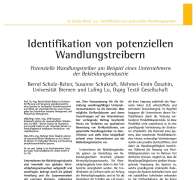
Potenzielle Wandlungstreiber am Beispiel eines Unternehmens der Bekleidungsindustrie
Bernd Scholz-Reiter ORCID Icon, Susanne Schukraft, Mehmet-Emin Özsahin, Luling Lo
Today, companies operating in the textile industry are integrated within value chain networks. Due to the global distribution and the cooperation with external partners, these companies underlie several influencing factors. In the case that the reaction to these influencing factors is not possible with the use of the existing flexibility, a basic adaption of the company structure is required. The potential to undergo these necessary changes is also named as changeability. To create changeable network structures it is firstly necessary to know about potential influencing factors and their impacts onto the company. The paper on hand therefore describes a procedure for the identification and evaluation of potential change drivers and introduces identified, potential change drivers using the example of a company that is active in the field of the apparel industry.
Industrie Management | Volume 28 | 2012 | Edition 6 | Pages 19-22
Accurate Detection of Surface Defects in the Micro Range

Accurate Detection of Surface Defects in the Micro Range

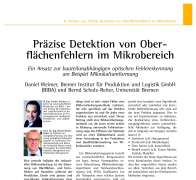
Ein Ansatz zur bauteilunabhängigen optischen Fehlererkennung am Beispiel Mikrokaltumformung
Daniel Weimer, Bernd Scholz-Reiter ORCID Icon
Surface inspection and defect detection during manufacturing is a fundamental task for industrial image processing. Based on reliable and accurate defect detection systems changing process behaviour, like blunt tools, can be detected. In many areas like Si-wafer production, optical quality control is still state of the art. Nevertheless, in many cases a completely new and specialised image processing technique will be developed for every new problem. This contribution demonstrates a method for a general image processing technique for industrial surface inspection which is not limited to a specific hardware or defect type. The system is part of the Collaborative Research Center (CRC) 747 “Micro Cold Forming” and will be evaluated in a real cold forming process.
Industrie Management | Volume 28 | 2012 | Edition 5 | Pages 61-64
Approximation and Robustness of Dynamic Production networks

Approximation and Robustness of Dynamic Production networks

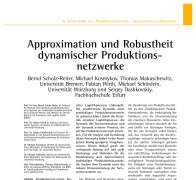
Bernd Scholz-Reiter ORCID Icon, Michael Kosmykov, Thomas Makuschewitz, Fabian Wirth, Michael Schönlein, Sergey Dashkovskiy
Global production networks connect partners with outstanding expertise, and make use of regional cost advantages for purchasing and production operations. This development leads to an increasing structural complexity of the networks, which is accompanied by a closer collaboration of dynamic logistics processes. Hence, the resulting dynamics of a large-scale production network is characterized by the dynamics of the individual logistics processes, the dynamics of the network structure and dynamics of the external processes that affect the production network. However, in practice a lack of adequate procedures for the analysis and design of these networks can be observed. The presented article addresses this need by introducing tools and methods for the approximation of large-scale production networks, analysis of their dynamics and the robust design of the network resources.
Industrie Management | Volume 28 | 2012 | Edition 4 | Pages 51-56
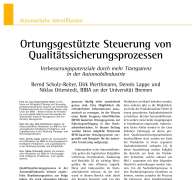
Location-Based Controlling of Rework Processes

Location-Based Controlling of Rework Processes

Verbesserungspotenziale durch mehr Transparenz in der Automobilindustrie
Bernd Scholz-Reiter ORCID Icon, Dirk Werthmann, Dennis Lappe, Niklas Otterstedt
Quality assurances in the automotive industry pose additional processing times which are highly fluctuating and difficult to calculate. Within the rework processes the registration of vehicle positions is done manually. As a result the available information is not continuous and sufficient for an efficient control of these processes. Radio frequency identification (RFID) based positioning systems are one possibility to track the vehicles in the rework process automatically and to provide the required information. This paper presents the potential of a RFID-based positioning system in the rework area as well as examples for technical realization.
Industrie Management | Volume 28 | 2012 | Edition 1 | Pages 22-26
Prediction of Customer Demands

Prediction of Customer Demands

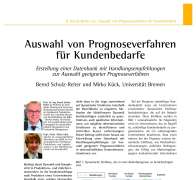
A data base containing recommendations for the choice of appropriate forecasting methods
Bernd Scholz-Reiter ORCID Icon, Mirko Kück
Due to dynamics and complexity within production and delivery networks, customer demands are often highly volatile. In order to achieve a well-founded production planning and control, future customer demands have to be predicted precisely. Classical statistical forecasting methods are often easy to apply but are not able to react on dynamic effects within the data. Methods of nonlinear dynamics consider qualitative in addition to quantitative information within past order data to find possible deterministic structures and, as a result, to achieve better forecasts of the future. This article deals with the development of a data base containing recommendations to choose suitable prediction methods in different situations.
Industrie Management | Volume 28 | 2012 | Edition 1 | Pages 61-65
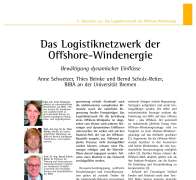
Logistic Network of Offshore Wind Energy and Its Dynamic Effects

Logistic Network of Offshore Wind Energy and Its Dynamic Effects

Bewältigung dynamischer Einflüsse
Anne Schweizer, Thies Beinke, Bernd Scholz-Reiter ORCID Icon
The relevance of wind energy for the German energy supply increases steadily. This development is driven by the German withdrawal from nuclear energy as well as the ambitious climate policy goals. Furthermore, the fossil energy resources are limited. The logistic network which is needed to create an offshore-wind park is affected by dynamic disturbances like weather conditions as well as other influences. They have an impact on the material-pull which is initiated by the offshore construction site. Already scheduled processes cannot be proceeded which necessitates rescheduling of material flow process-plans. Sometimes material is also pushed back into the network.
Industrie Management | Volume 27 | 2011 | Edition 6 | Pages 13-16
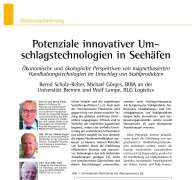
Potentials of Innovative Handling Technologies in Seaports

Potentials of Innovative Handling Technologies in Seaports

Ökonomische und ökologische Perspektiven von magnetbasierten Handhabungstechologien im Umschlag von Stahlprodukten
Bernd Scholz-Reiter ORCID Icon, Michael Görges, Wolf Lampe
The handling of general cargo in seaports is a time-consuming and resource-intensive activity. The implementation of novel handling technologies opens new potential to improve the handling process and its sustainability as well. This paper introduces a magnet system based approach for handling steel products in seaports and addresses its economical and ecological potentials. It presents a detailed event driven process chain model (EPC) of the handling process and an analysis of the corresponding potentials. Besides process related potentials like decreasing operative costs or increasing the process stability, this paper presents the capability of this new technology to reduce the ecological effects by saving dunnage.
Industrie Management | Volume 27 | 2011 | Edition 6 | Pages 38-42
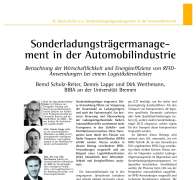
Special Load Carrier Management in the Automotive Industry

Special Load Carrier Management in the Automotive Industry

Betrachtung der Wirtschaftlichkeit und Energieeffizienz von RFID-Anwendungen bei einem Logistikdienstleister
Bernd Scholz-Reiter ORCID Icon, Dennis Lappe, Dirk Werthmann
During the last decades, automotive manufacturers have outsourced many processes. Hence, complex networks consisting of automotive manufacturers, suppliers and logistics service providers have grown in the automotive industry. The resulting transports of components in these networks often require special load carriers. Consequently, companies nowadays face the challenge to handle a growing number of load carriers. For improving the load carrier management a higher transparency is required regarding the load carriers in the whole network. Transparency can be assured by the application of radio frequency identification technology. However, especially logistics service providers have to invest in this technology, which can be implemented in different ways. In this paper, some application possibilities are described and analyzed regarding economic and energy efficiency.
Industrie Management | Volume 27 | 2011 | Edition 6 | Pages 77-81
Sustainable Development of Employees

Sustainable Development of Employees

Support through the Use of a Management System
Bernd Scholz-Reiter ORCID Icon, Thies Beinke
The article discusses opportunities for supporting the sustainable development of employees in a teaching and research institute by the use of management systems. Within this discussion, the areas of management, sustainability and human resources will be explicated and interlinked in a prototypical management system.
Industrie Management | Volume 27 | 2011 | Edition 4 | Pages 9-13
Planning and Optimization of Changeable Global Value Added Networks

Planning and Optimization of Changeable Global Value Added Networks

Gisela Lanza ORCID Icon, Raphael Moser, Bernd Scholz-Reiter ORCID Icon, Mehmet-Emin Özsahin, Susanne Schukraft, Pamela Meil, Franziska Rasp
Due to the concentration of core competences and the utilisation of international location advantages successful German production companies face a situation with globally dispersed sites in global value added networks. The ongoing globalisation, which includes the integration of external sites, suppliers and partners, leads to complex interactions within networks. However, these interactions are not or are simply partially known and not predictable so far. Being able to control dramatic dynamics in the behaviour of global value added networks, German production companies will be positively affected by globalisation in the future. Therefore, changeable global value added networks which can be quickly adjusted to dynamics become crucial. The paper on hand describes an approach for the planning and optimization of adaptable global value added networks. Background is the approach of the research project “planning and optimization of changeable global value added networks” (POWer.net) ...
Industrie Management | Volume 27 | 2011 | Edition 3 | Pages 57-60
1 2 3 9