Circularity Navigator |
Digital decision support for anchoring design for circularity in product development

| Journal | Industry 4.0 Science |
| Issue | Volume 40, 2024, Edition 1, Pages 6-13 |
| Open Access | https://doi.org/10.30844/I4SE.24.1.6 |
| Bibliography | Share | Cite | Download |
Abstract
Article
The requirements for the circularity of products are currently increasing, not only from an environmental perspective, but also due to legal constraints and standards such as the EU Ecodesign Directive [1]. Companies must therefore implement specific circularity measures that start as early as possible in product development. The identification of such measures and their operational implementation is the subject of the “DfC-Industry” research project at Pforzheim University, which is funded by the German Federal Ministry of Economics.
The challenge lies in the implementation-oriented provision of approaches that are applicable to a wide range of products and go beyond the familiar checklist-based solutions and LCA software add-ons for integration into existing CAD software [2]. Although these provide the users with inspiration, they often start too late in the product development process (PDP) and are often unsatisfactory from the point of view of many product developers due to the low level of concretization. With the help of literature- and expert-based decision support and the transfer to a digital tool, a user-oriented instrument is therefore to be created that overcomes the shortcomings of existing solutions and ensures the circular design of future products.
Method development from decision tree to digital tool
The operationalization of Design for Circularity (DfC) in PDP is a complex task due to the large number of dimensions and levels of action. To master this task, decision matrices and decision trees can provide practical support to the actors in the PEP [3].
As part of the method development project, three dimensions of the circular economy were defined, which would later serve as the basis for the development of decision matrices:
- CBM = Circular Business Models: circular business models and strategies
- LCI = Life Cycle Intensity: Classification of the main environmental impact of a product. This environmental impact is identified on the basis of a life cycle assessment (LCA) and assigned to a specific life cycle phase
- EDA = Ecodesign requirements: Directives such as the EU Directive 2009/125/EC [1] provide generic requirements for circular product design
The decision matrices, which were each formed from two of these three dimensions, then enable the comparison of different variants and offer assistance in the decision-making process through an evaluation grid. In addition, dependencies and interactions can be identified [4, 5]. The combination of the three dimensions results in the following three matrices [3]:
In the LCI x EDA matrix, the life cycle intensities are compared with the ecodesign approaches and evaluated. Suitable EDAs were assigned based on the product life cycle phase with the largest ecological “hotspots”, i.e. the phase with the highest potential for improvement. This matrix thus evaluates the ecological (or “circular”) contribution of these EDAs for the selected LCI and is used for prioritization.
The CBM x LCI matrix combines the LCIs with sensible and applicable CBMs. It evaluates the circular contribution of the business model for the specific product type and prioritizes the CBMs for the specific product with its respective LCI.
The CBM x EDA matrix combines the CBMs with all EDAs and thus serves to evaluate the meaningfulness and feasibility of the EDAs in the event of the implementation of specific CBMs.
The decision-making process can be started from either a strategic (strategic level: business model) or a product-related starting point (product level: new or subsequent development) [3]. In both cases, the matrices form the basis of a decision tree whose path leads to technical principles of circularity implementation, the Circular Design Principles (CDP).
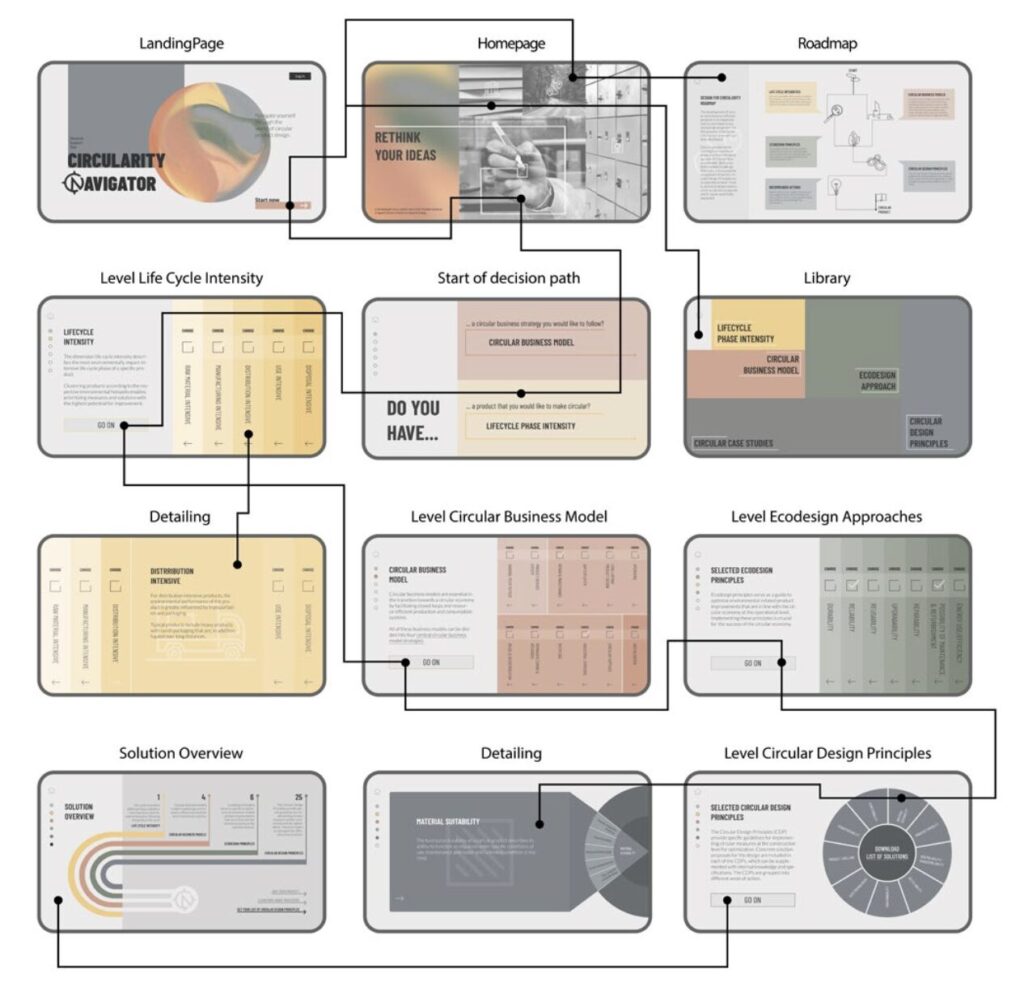
For the user-oriented preparation of these scientific findings, the decision tree was prepared for a transfer into a digital tool using the wireframing method. A wireframe is a graphical representation of a user interface that is used in the design of websites, applications or products. This visualization illustrates the basic layout and design elements (Figure 1) and can serve as the basis for technical implementation [6]. The web application was implemented on the basis of Next.js frameworks with a central database for the decision matrices and explanatory texts. New features were defined and successively implemented in iterative steps between the UX/UI and software development teams.
The Circularity Navigator now guides product developers through the decision dimensions. Based on the assessments in the matrices, the variety of circular design principles and the associated selection of design solutions are reduced, while the selection is made easier. The final development result of the Circularity Navigator will be a web application that can be integrated into existing product development methods or used as a stand-alone solution for generating ideas in innovation management.
Embedding the Circularity Navigator into product development processes
The use of the Circularity Navigator in the PDP is intended to influence the way products are designed and thus contribute significantly to the success of the circular economy. At an operational level, the EDAs provide targeted improvements of the environmental compatibility of products [1]. The assignment and description of the EDAs for the Circularity Navigator was based on a company-specific stage-gate process in collaboration with company experts.
An interactive workshop at the beginning of product development is recommended when using the Circularity Navigator in companies. Participants are not expected to have any prior knowledge of circularity. The workshop, which should ideally be conducted with all stakeholders, serves to jointly and efficiently identify circular concepts and requirements for the PDP. The key stakeholders who play a decisive role in the overall course of the process are project managers, development engineers, technical experts, material developers, cost engineers, LCA experts, purchasers, production planners and, depending on the development situation, other external stakeholders such as customers or decision-makers. In the subsequent phases of product development, the Circularity Navigator is used by the respective responsible stakeholders in development [7].
It is important for product developers to know the design measures for circular products. At this stage, the Circularity Navigator not only provides support with a product-specific selection of EDAs, but also with the technical detailing of a respective EDA at a design level, the CDPs. In addition to the information on product structure and product properties, knowledge of the ideal implementation time is also crucial for the implementation of circularity approaches:
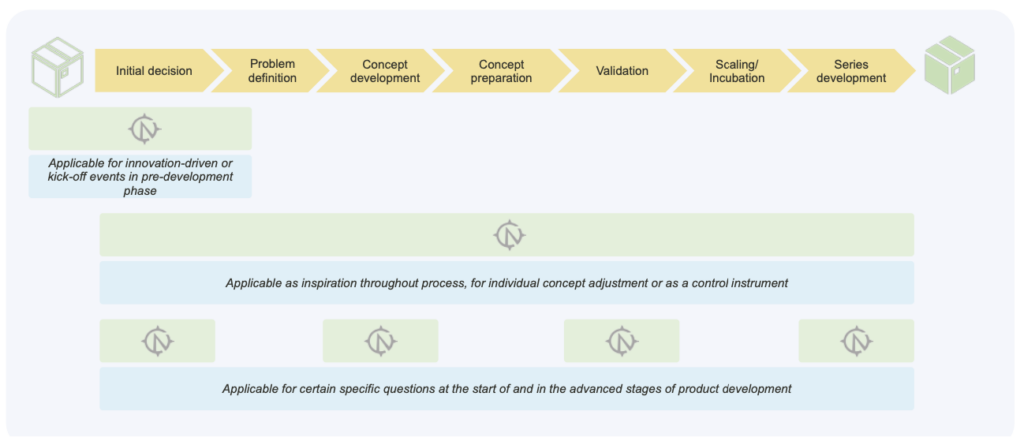
The Circularity Navigator can be used from the idea generation phase to select product-specific EDAs and add them to the requirements list as technical action measures. Depending on the (further) development of the concept, the Circularity Navigator can also be used for additional product adaptations or to review circular measures that have already been applied or are still open. It also serves as a knowledge pool or as a reference work for open questions regarding circular strategies.
Once all selected CDPs have been successfully implemented, series development of the products begins after the incubation and scaling phase. In Figure 2, the product development process is linked to the sensible application times of the Circularity Navigator, whereby deviations in the PDP occur depending on the company. The solutions shown here serve as examples.
The integration of the Circularity Navigator in the PEP enables the simple and systematic consideration of circular economy and environmentally relevant information and its constructive use. The tool provides recommendations tailored to user-specific products and business models. It is particularly effective in companies that already have preliminary ecological product studies or circular business models in place.
Application example for the Circularity Navigator
The method presented above can be used as an example for the circularity-oriented development of a vacuum cleaner and thus illustrates the decision path of the Circularity Navigator. The vacuum cleaner is representative of the “electrical appliance” product category [8]. Figure 3 shows a schematic representation of the example decision path of this electrical appliance.
The decision-making process begins at the “product” level: the product is classified as ”use intensive” based on published investigations. [9] The utilization phase is therefore chosen as the entry point or definition for the LCI x CBM matrix. This classification filters for business model fields with circular characteristics, such as “repair and maintenance”, “sharing” or “upgrading”, using the LCI x CBM matrix. The specific selection depends on the requirements of the development project and on company policy. In our example, the “repair and maintenance” business model is pursued, which is characterized by the extension of the useful life and the increase in functionality through preventive maintenance and repair services. [10]
In the next step, the CBM x EDA matrix is used to identify EDAs that are compatible with the selected business model. In the context of “repair and maintenance”, the basic EDAs for successful implementation include “repairability”, “upgradability” and the “possibility of maintenance and repair”. In the next step, the Circularity Navigator generates a list of CDPs with exemplary solution approaches for the product developer. The reparability of a product can have a positive effect on functionality and enable reuse [11].
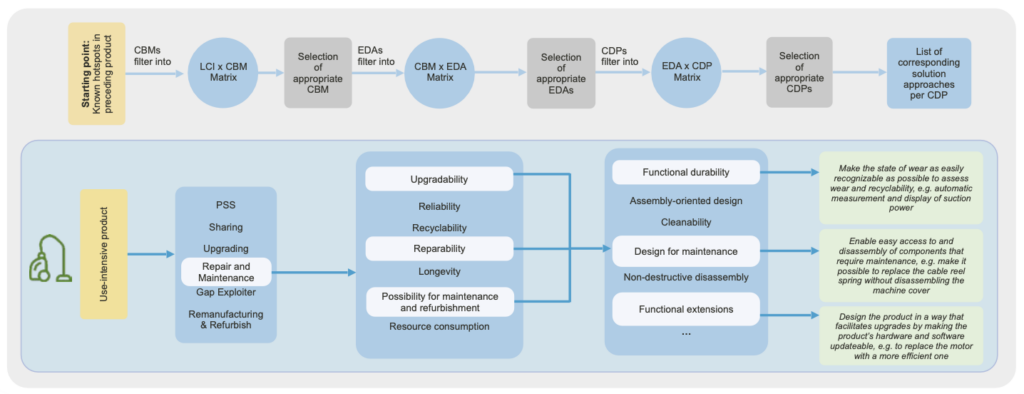
In concrete terms, this can be achieved through a product architecture that allows, for example, the additional provision of functions and replaceable components during the use phase [12]. A longer service life, during which the product is available in a defined operational condition, is the aim of the EDA “Possibility of maintenance and repair” [11]. To maintain this condition, the technical principle of functional durability (defined as the ability to function as required under certain conditions of use, maintenance and repair until a limited condition is reached) can be applied [13]. At the design level, for example, the level of wear can be adjusted by employing specially designed replaceable elements [12]. Ideally, the state of wear should also be easily recognizable so that its level can be assessed. Using the example of a vacuum cleaner, this could be achieved by measuring and displaying the current suction power.
Discussion and recommendations for action
The identification and selection of approaches for a circular design is a complex process due to the large number of options and dependencies. The Circularity Navigator facilitates this process by reducing complexity through a systematic approach and at the same time can be used flexibly in the PDP. The tool can be used as a source of inspiration and an orientation aid during the innovation phase, but does not provide any construction-specific design recommendations. The level of detail provided by the CDPs also provides orientation regarding specific product solutions and reduces the scope for interpretation of generically formulated sustainability requirements. The Circularity Navigator also serves as a knowledge database due to the option of adding company-specific solutions and up-to-date information from the field of the circular economy.
For companies, the tool can be used to derive recommendations for action for circular product design. It enables access to cycle-oriented design from different directions, either based on specific business models or specific products. In principle, the early involvement of the various stakeholders is necessary in order to enable the consideration of options from individual departments with their individual restrictions and specifications. During the course of the PDP, it is also advantageous to regularly question design optimizations in order to open up the scope for solutions across the development steps and quality gates. Finally, in its function as a knowledge base, the Circularity Navigator ensures an easily accessible and centralized consolidation of DfC criteria in product development.
In future, extension of the tool is planned to enable a quantitative circularity assessment of product variants based on key figures as well as more in-depth support for the user in selecting a suitable business model. The aim is also to automate the derivation of product specifications, their evaluation and the recommendation of optimizations. In the development of circular products, participants in the PEP can thus benefit from design optimizations that can be evaluated using multiple criteria.
This article was created as part of the “DfC-Industry” project, which is funded by Project Management Jülich and the German Federal Ministry of Economic Affairs and Climate Action (BMWK) as part of the Resource Efficiency funding program in the context of the energy transition for the project duration from 01.02.2022 – 31.01.2024 under the funding code FKZ 03EI5005A. The project partners Robert Bosch GmbH, iPoint-systems GmbH and the German Research Center for Artificial Intelligence GmbH/Smart Enterprise Engineering are involved in the project under the leadership of the Institute for Industrial Ecology (INEC) at Pforzheim University of Applied Sciences.
Bibliography
[1] European Commission: Proposal for a Regulation of the European Parliament and of the Council establishing a framework for setting Ecodesign requirements for sustainable products and repealing Directive 2009/125/EC (2022).[2] Tura, N.; Hanski, J.; Ahola, T.; Stahle, M. Piiparinen, S.; Valkokari, P.: Unlocking circular business: A framework of barriers and drivers. In: Journal von Cleaner Production 212 (2019), S. 90-98. DOI: 10.1016/j.jclepro.2018.11.202.
[3] Pruhs, A.; Kusch, A.; Viere, T.; Woidasky, J.: Operationalisierung von „Design for Circularity“ in der industriellen Produktentwicklung. In: Stuttgarter Symposium für Produktentwicklung 2023, S. 271-281.
[4] Grünig, R.; Kühn, R.: Entscheidungsverfahren für komplexe Probleme. Ein heuristischer Ansatz. 4. Auflage. Berlin Heidelberg.
[5] Schawel, C.; Billing, F.: Top 100 Management Tools. Das wichtigste Buch eines Managers: ABC-Analyse bis Zielvereinbarung, 4. Auflage. Wiesbaden 2004.
[6] Gudoniene u. a.: The Scenarios of Artificial Intelligence and Wireframes Implementation in Engineering Education (2023). Sustainability. DOI: doi.org/10.3390/su15086850).
[7] Pruhs, A.; Kusch, A.; Bertagnolli, F.; Viere, T.; Woidasky, J.: Produktentstehungsprozess mit der Lean Methode Makigami – Eine optimierte Produktentwicklung zur Integration eines nachhaltigen und zirkulären Produktdesigns. In: Industrie 4.0 Management 39 (2023) 6, S. 55-60. DOI: doi.org/10.30844/IM_23-6_61-65.
[8] Umweltbundesamt: Elektrogerät. Staubsauger. URL: www.umweltbundesamt.de/umwelttipps-fuer-den-alltag/elektrogeraete/staubsauger#was-sie-beim-kauf-ihres-staubsaugers-beachten-sollten, Abrufdatum 10.11.2023.
[9] Pérez-Belis, V.; Bakker, C.; Juan, P.; Bovea, M. D.: Environmental performance of alternative end-of-life scenarios for electrical and electronic equipment: A case study for vacuum cleaners. In: Journal von Cleaner Production 159 (2017), S. 158-170. DOI: 10.1016/j.jclepro.2017.05.032, 2017.
[10] Lüdeke-Freund, F.; Gold, S.; Bocken, N.: A Review and Typology von Circular Economy Business Model Patterns. In: Journal of Industrial Ecology 23 (1), S. 36-61. DOI: 10.1111/jiec.12763.
[11] DIN EN 45554:2020-10: Allgemeine Verfahren zur Bewertung der Reparier-, Wiederverwend- und Upgradebarkeit energieverbrauchsrelevanter Produkte; Deutsche Fassung EN 45554:2020.
[12] Bender, B.; Gericke, K.: Pahl/Beitz Konstruktionslehre. Methoden und Anwendung erfolgreicher Produktentwicklung, 9. Auflage. Berlin Heidelberg 2021.
[13] DIN EN 45552:2020-05: Allgemeines Verfahren zur Bewertung der Funktionsbeständigkeit energieverbrauchsrelevanter Produkte; Deutsche Fassung EN 45552:2020.
Your downloads
Solutions: Product Development
You might also be interested in