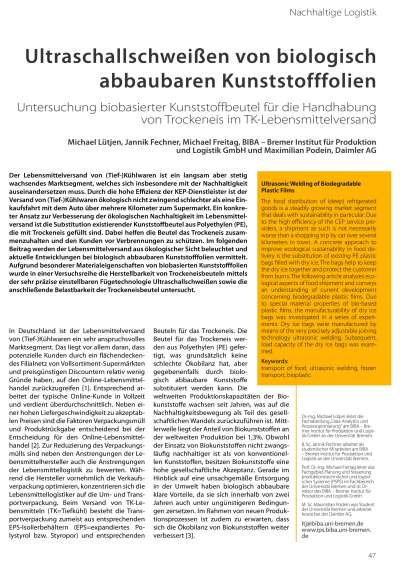
Ultrasonic Welding of Biodegradable Plastic Films

Untersuchung biobasierter Kunststoffbeutel für die Handhabung von Trockeneis im TK-Lebensmittelversand

JournalIndustrie 4.0 Management
Issue Volume 35, 2019, Edition 6, Pages 47-50
Share Cite Download

Abstract

The food distribution of (deep) refrigerated goods is a steadily growing market segment that deals with sustainability in particular. Due to the high efficiency of the CEP service providers, a shipment as such is not necessarily worse than a shopping trip by car over several kilometers in town. A concrete approach to improve ecological sustainability in food delivery is the substitution of existing PE plastic bags filled with dry ice. The bags help to keep the dry ice together and protect the customer from burns. The following article analyzes ecological aspects of food shipment and conveys an understanding of current development concerning biodegradable plastic films. Due to special material properties of bio-based plastic films, the manufacturability of dry ice bags was investigated in a series of experiments. Dry ice bags were manufactured by means of the very precisely adjustable joining technology ultrasonic welding. Subsequent, load capacity of the dry ice bags was examined.

Access limited

You are currently not logged in / not yet registered.

In order to download the desired file(s), you must be logged in and have an appropriate inclusive subscription. Alternatively, you can also obtain access by paying a one-off fee.

Subscription included Purchase
without 29,00 €
Digital 27,55 €
Expert 26,10 €
Professional 0,00 €

Download for one time 29,00 €

All prices include 7% VAT

After purchasing access rights, you will automatically be redirected back to this page.

You might also be interested in

AI-Powered Lubrication Strategies for Thread Forming

AI-Powered Lubrication Strategies for Thread Forming

Adaptive spray jet control to increase process reliability and tool life
Reinhard Schmied, Marco Susic, Christian Donhauser ORCID Icon
Thread forming requires precise lubricant application because high contact pressures and process temperatures strongly influence tool loading, friction, and process stability. Although minimum quantity lubrication (MQL) systems are widely used, current spray-based approaches can still suffer from spray losses, insufficient wetting of the thread grooves, and unstable droplet transport. This article presents a concept for adaptive precision lubrication in thread forming based on computational fluid dynamics (CFD)-supported flow analysis, experimental validation, and artificial intelligence (AI)-assisted optimization. The focus is on droplet size, spray jet geometry, nozzle position, ambient flow conditions, and their influence on wetting intensity. Preliminary simulation-based investigations indicate that data-driven optimization can help identify wetting deficiencies and support the development of future control strategies for resource-efficient lubricant application.
Industry 4.0 Science | Volume 42 | 2027 | Edition 3 | Pages 76-83
Industrial Application of Immersive Technologies

Industrial Application of Immersive Technologies

Exploring XR solutions for training, instruction, design review, and assembly planning
Andreas Straube ORCID Icon, Faikar Zakky Haidar ORCID Icon, Matheus Lenzi dos Santos ORCID Icon, Kussai AI Jairoud ORCID Icon, Eduardo Koscianski ORCID Icon
In recent years, the decreasing cost and improved usability of immersive hardware and software have made extended reality (XR) increasingly attractive for industrial applications. Stand-alone systems with inside-out tracking and camera-based pass-through enable accessible mixed reality (MR) solutions. At the same time, emerging no-code software platforms allow engineers to create XR environments without programming expertise, broadening adoption across production settings. This paper explores key industrial application areas of immersive technologies through selected commercially available XR software solutions for product and process training, spatial instructions and guides, collaborative design review, and assembly and production planning.
Industry 4.0 Science | Volume 42 | 2026 | Edition 3 | Pages 38-47 | DOI 10.30844/I4SE.26.3.4
Learning Factories for the Future of Manufacturing in Brazil

Learning Factories for the Future of Manufacturing in Brazil

Advancing manufacturing through technology and skills development
Manufacturing firms in developing countries face challenges in closing productivity gaps while adopting Industry 4.0 technologies. Learning factories are one helpful approach to countering these challenges. One such example is the learning factory Fábrica do Futuroin São Paulo, Brazil, which has engaged students, supported competence development, and collaborated with industry in applied research, functioning as a hub for advanced manufacturing initiatives.
Serious Gaming and the Energy Transition

Serious Gaming and the Energy Transition

Collaborative knowledge generation and interactive understanding of complex interrelationships
Janine Gondolf ORCID Icon, Gert Mehlmann, Jörn Hartung, Bernd Schweinshaut, Anne Bauer
Conveying the complexity and multifaceted nature of the energy transition to a broad audience is a challenge. This article demonstrates how interactive serious games on a multitouch table can help make connections tangible and comprehensible. The games and the table were used in various conversational contexts. These are presented here in three case vignettes based on participant observation of the different applications, as well as situated and shared reflection. The vignettes demonstrate how interaction can trigger epistemic processes, enable shifts in perspective, and foster collective thinking, all of which are necessary for shaping the future of society as a whole.
Industry 4.0 Science | Volume 42 | 2026 | Edition 2 | Pages 62-69
Experiencing Digital Twins in Production and Logistics

Experiencing Digital Twins in Production and Logistics

The fischertechnik® Learning Factory 4.0 as a development platform for possible expansion stages
Jan Schickram, Tareq Albeesh, Deike Gliem ORCID Icon, Sigrid Wenzel ORCID Icon
The fischertechnik® Learning Factory 4.0 has proven to be a suitable experimental environment for testing digital twins. Depending on the targeted maturity stage, the functions of a digital twin range from status monitoring and forecasting to the operational control of production and logistics systems. To systematically classify these functions, this article presents a maturity model that serves as a framework for the development of a digital twin. Building on this, selected use cases are implemented in a test and development environment based on a system architecture with multi-layered logic structure. These initial implementations serve to highlight application purposes, relevant methods, and typical challenges and potentials in the transfer to real factory environments.
Industry 4.0 Science | Volume 42 | Edition 2 | Pages 30-37 | DOI 10.30844/I4SE.26.2.30
Collaborative Robots in Production Environments

Collaborative Robots in Production Environments

Employee qualification and acceptance for human-machine interaction
Tobias Wienzek ORCID Icon, Mathias Cuypers ORCID Icon
The introduction of new technologies poses a major challenge, especially for small and medium-sized enterprises (SMEs). At the same time, SMEs must rise to this challenge in order to keep pace technologically and economically. Employee acceptance is an important factor in ensuring that both the introduction and the long-term use of a technology are successful. At the same time, the introduction process also has a central influence on acceptance in the long term. This article uses the implementation of collaborative robotics as an example for examining such an introduction process, identifying the key factors that influence employee acceptance and the important role played by advanced employee training. It serves to highlight how the introduction process and employee training are seamlessly interlinked.
Industry 4.0 Science | Volume 42 | 2026 | Edition 2 | Pages 14-21 | DOI 10.30844/I4SE.26.2.14
This entry was posted in Uncategorized. Bookmark the permalink.