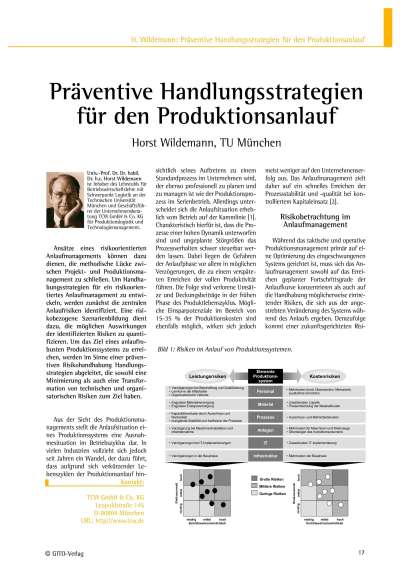
Preventive Operation Strategies for Ramp-up

JournalIndustrie Management
Issue Volume 20, 2004, Edition 4, Pages 17-20
Share Cite Download

Abstract

Approaches for a risk oriented ramp-up management can suit the purpose of closing the methodical gap between project management and production management. To develop management strategies for a risk oriented ramp-up management central ramp-up risks for a green field plant have been identified in the first step. A risk oriented scenario model leads to a quantification of possible effects resulting from the identified risks. To reach the goal of creating a ramp-up robust production system management strategies have been derived as constitutional elements of a preventive risk management. The management strategies aim at a minimisation as well as transformation of technical and organisational risks.

Your downloads


Solutions: Production Control Risk Management

You might also be interested in

Audio-Immersive Learning in Continuing Vocational Education

Audio-Immersive Learning in Continuing Vocational Education

From linear audio playback to AI-supported conversational learning companions
Tim Beichter, Vanessa Hartmann, Katharina Hölzle ORCID Icon, Manuel Kaiser
Artificial intelligence is increasingly shaping continuing vocational education and training by enabling the personalization of individual learning experiences. At the same time, audio-based learning formats are attracting growing interest among learners because of their flexibility and suitability for workplace learning. However, a conceptual framework for AI-supported audio learning, as well as the potential of combining artificial intelligence with audio-based learning, has received little attention to date. This paper therefore presents a conceptual perspective on the design possibilities and educational potential of AI-supported audio learning formats.
Industry 4.0 Science | Volume 42 | 2026 | Edition 5 | Pages 102-108 | DOI 10.30844/I4SE.26.5.12
Explaining AI in Industrial Production in an Accessible Way

Explaining AI in Industrial Production in an Accessible Way

Requirements for AI demonstrators to promote acceptance
Jennifer Link ORCID Icon, Markus Harlacher ORCID Icon, Colin Srebny, Sascha Stowasser ORCID Icon
Artificial intelligence (AI) offers a wide range of possibilities in industrial production, but it also presents challenges regarding employee acceptance. AI demonstrators are therefore of central importance, as they enable hands-on experience with AI. However, there has been a lack of systematically identified requirements for demonstrators that specifically promote acceptance and address negative emotions. Using a multi-stage research design, 69 requirements were identified, structured into functional requirements, quality requirements, and boundary conditions.
Industry 4.0 Science | Volume 42 | 2026 | Edition 5 | Pages 6-14 | DOI 10.30844/I4SE.26.5.1
Work Design in the Use of Autonomous Systems

Work Design in the Use of Autonomous Systems

Addressing the shortage of skilled workers
Tim Jeske ORCID Icon, Sascha Stowasser ORCID Icon, Nicole Ottersböck, Sebastian Terstegen, Rasmus Adler ORCID Icon
Companies are increasingly challenged to address shortages of skilled workers while meeting rising demands for productivity, flexibility, and innovation. Because labor supply can only be expanded to a limited extent, there is a growing focus on designing work systems with productivity in mind. Autonomous systems offer significant potential in this regard. Their implementation requires not only technical adjustments but, above all, changes in organization, skills, and work design. This article analyzes empirically grounded change requirements in existing work systems as well as associated economic potential.
Industry 4.0 Science | Volume 42 | 2026 | Edition 5 | Pages 44-50 | DOI 10.30844/I4SE.26.5.5
Cooperation Routines of Complementors in Digital Ecosystems

Cooperation Routines of Complementors in Digital Ecosystems

A microfoundation of integrative dynamic capability
Christian Zabel ORCID Icon, Tahir Schmidt ORCID Icon
Complementors are central to value creation in digital ecosystems yet have limited leverage and must adapt through dynamic capabilities. Building on the Profiting From Innovation Framework, this study examines how integrative capabilities manifest for complementors through cooperative routines. Based on a systematic literature review of Scopus-indexed studies from 2020 to mid-2025 focusing on the microfoundation “orchestrating ecosystem actors”, we identify two routine clusters. Complementors cooperate with other complementors via partner sensing, scouting, coalitions, resource sharing, and risk allocation while protecting critical assets. They cooperate with platform owners via multichannel boundary spanning, quality signaling, governance compliance, boundary resource integration, and co-development, while facing the risk of owner entry. Research gaps concern the formalization of cooperation routines, taxonomy, and B2B contexts.
Industry 4.0 Science | Volume 42 | 2026 | Edition 4 | Pages 22-28 | DOI 10.30844/I4SE.26.4.3
Platform Adoption as a Dynamic Capability

Platform Adoption as a Dynamic Capability

How SMEs overcome barriers to adoption of B2B collaboration platforms
Nikolai Schäfer ORCID Icon, Marcel Hülsbeck ORCID Icon
Digital collaboration and innovation platforms offer SMEs significant potential to compensate for structural resource weaknesses and to participate in innovation ecosystems. Nevertheless, adoption in the B2B context remains low. This paper examines adoption barriers based on a systematic literature review using Teece’s dynamic capabilities approach. The analysis suggests that recurring obstacles can be structured along three dimensions: Sensing—lack of ecosystem awareness, absence of scanning routines; Seizing—IP concerns, governance uncertainty, adoption fatigue; Reconfiguring—closed-innovation culture, lack of absorptive capacity. Building on this, a practice-oriented capability-building framework is developed with recommendations for action.
Industry 4.0 Science | Volume 42 | 2026 | Edition 4 | Pages 42-48 | DOI 10.30844/I4SE.26.4.5
Industry 4.0—Progress and Digitalization in Limbo

Industry 4.0—Progress and Digitalization in Limbo

Status of sustainable transformation and digitalization in production engineering
Christian Donhauser ORCID Icon, Daniel Riepl
Digitalization projects help users represent complex processes more simply and efficiently. However, there are many obstacles to implementation. Reluctance to implement these projects is palpable. This affects, among others, employers and employees, who may fall behind economically by waiting or avoiding change. These observations can be traced back to an overarching research question: What barriers and systemic challenges hinder sustainable transformation within the context of Industry 4.0, particularly when considering human labor in production engineering? What questions are the affected stakeholders asking? The primary goal of this long-term research project is to define these questions decisively and in detail in order to develop a conceptual foundation that integrates research, teaching, and technological development and thus combines the potential of digital technologies with the experiential and practical knowledge of production workers.
Industry 4.0 Science | Volume 42 | 2026 | Edition 3 | Pages 56-60
This entry was posted in Uncategorized. Bookmark the permalink.