Ideating Ethical AI Business Models |
A dual card approach for the ethical development of AI business models

| Journal | Industry 4.0 Science |
| Issue | Volume 42, Edition 1, Pages 40-49 |
| Open Access | https://doi.org/10.30844/I4SE.26.1.38 |
| Bibliography | Share | Cite | Download |
Abstract
Keywords
Article
Artificial intelligence (AI) is rapidly becoming a central element of business strategy and operations. It enables data-driven decision-making, increases process efficiency, and supports the development of new products and services [1–3]. In industrial contexts, applications such as predictive maintenance and real-time production optimization illustrate AI’s transformative potential. As a result, AI is no longer a support function but a strategic driver of business model innovation [4–6].
However, the adoption of AI also introduces critical challenges. These include risks related to privacy, algorithmic bias, lack of transparency, and job displacement [7, 8]. Public discourse and regulatory developments increasingly reflect these concerns. The European Union’s AI Act, for example, underscores the growing expectation that AI systems must not only be effective but also fair, accountable, and transparent [9–12].
For small and medium-sized enterprises (SMEs), the implementation of AI presents a dual challenge. On the one hand, SMEs are under pressure to innovate and compete through AI-based solutions. On the other hand, they often lack the internal resources and expertise needed to navigate both the technological complexity and emerging ethical and legal expectations [13]. Existing business model tools such as the Business Model Canvas [14] and the Business Model Navigator [5] provide valuable structure but were not designed with the unique features of AI systems in mind, particularly during the early stages of innovation.
This paper presents a practice-oriented tool to address this gap. The tool consists of two complementary sets of cards: AI Business Model Cards, which reflect empirically grounded patterns for AI-based value creation, and AI Ethics Principles Cards, which translate abstract ethical principles into actionable prompts for early-stage reflection. Together, these cards provide practical support for interdisciplinary teams in structuring ideation, aligning strategic and ethical considerations, and prototyping AI-enabled business models.
The paper begins by outlining the theoretical and practical limitations of existing business model frameworks in the context of AI. It then describes the development of the card-based tool, followed by a detailed account of its application in a co-creation setting with a medium-sized industrial company. The results highlight how structured tools can support organizations in aligning AI-driven innovation with ethical considerations, leading to more trustworthy business model development.
Background: Ethics from the outset
AI is increasingly influencing how organizations conceptualize and deliver value. Traditional business model tools such as the Business Model Canvas [14] and the Business Model Navigator [5] have provided foundational frameworks for strategic innovation. These tools help teams break down complex business logic into modular elements and have become a standard practice across industries, particularly in small and medium-sized enterprises. However, they were not originally developed with the adaptive, data-driven nature of AI in mind.
The Business Model Canvas utilizes nine building blocks to map out key areas, including customer segments, value propositions, and revenue streams. In contrast, the Business Model Navigator emphasizes a pattern-based approach structured around four guiding questions: Who is the customer? What is offered? How is it delivered? How is value captured? [5]
AI technologies can simultaneously reshape all four core elements of a business model. They influence who the relevant customer is (e.g., by enabling B2B2C or multi-user configurations), redefine what is offered (e.g., through adaptive or data-enriched services), transform how value is delivered (e.g., via real-time automation or delegated decision-making), and shift how value is captured (e.g., through usage-based pricing or data monetization). Yet, most existing business model patterns do not reflect these developments. As such, extending or rethinking established frameworks is necessary to fully explore the strategic and ethical implications of AI-driven innovation.
AI systems are characterized by learning, personalization, and contextual adaptation [15]. They often operate in non-linear ways, adjusting to input data, usage environments, or system feedback. As a result, they challenge established design assumptions around fixed value propositions or predictable user behavior. In practice, SMEs in particular struggle to articulate these dynamic features within conventional modeling tools.
Recent research has begun addressing this gap. Soudi and Bauters [16] identified a set of AI-specific business model patterns, such as “AI-charged service providers” and “AI development facilitators”, which help structure innovation logic in contexts where AI transforms both the offering and its delivery. This taxonomy, for example, demonstrates how AI requires not only new technologies but also new ways of thinking about value creation and capture.
The complexity deepens further when ethical considerations are taken into account. AI systems often deal with sensitive data, make consequential decisions, or influence human behavior, raising concerns about transparency, fairness, and autonomy [9, 10]. These ethical aspects are not peripheral. They are becoming central to both regulatory compliance, as reflected in the EU AI Act [12], and to long-term organizational trust.
However, ethical considerations remain poorly integrated into most business model innovation tools. Barton and Pöppelbuß [9] found that, while practitioners frequently cite the importance of ethical alignment, they often lack concrete tools for addressing it during the early stages of design. Human-centered innovation approaches such as service design or design thinking [15] provide useful framing but typically do not offer structured guidance for addressing the ethical tensions specific to AI.
The dynamic, data-driven logic of AI systems, the growing ethical demands, and the lack of practical reflection methods pose a distinct challenge for SMEs. Unlike larger firms, SMEs often operate with limited strategic and technical resources, yet they are exposed to similar technological, regulatory, and ethical pressures [13]. While ethical AI principles such as fairness, transparency, and accountability are now widely promoted, most available frameworks remain too generic or complex to be actionable in SME contexts. Moreover, SMEs are rarely involved in the development of these guidelines, and practical tools that align AI innovation with ethical readiness are largely missing [13].
This underscores the need for accessible, implementation-oriented methods that support both innovation and ethical reflection from the outset. To address this challenge, we introduce a modular tool that supports both AI-specific business model exploration and value-based ethical reflection.
Card design
This study followed a design-oriented approach [17, 18] to develop a practical tool that supports SMEs in creating AI-based business models while integrating ethical considerations from the outset. The project spanned three years (2021-2024) and was conducted in collaboration with SEEPEX GmbH, a medium-sized industrial company, exploring how to transform internal analytics capabilities into externally valuable AI services. This setting provided a concrete environment for shaping, testing, and refining the tool in practice.
The initial research phase combined a literature review and 18 semi-structured interviews with professionals experienced in AI strategy, digital innovation, and business development. Interviews were coded using a grounded theory-inspired coding approach, following the Gioia methodology [19]. This analysis revealed key challenges, including a lack of shared terminology for AI business design, a lack of guidance for identifying AI-specific business model patterns, and limited methods for addressing ethical concerns in early-stage design.
In response, we developed a modular, card-based tool consisting of two complementary sets:
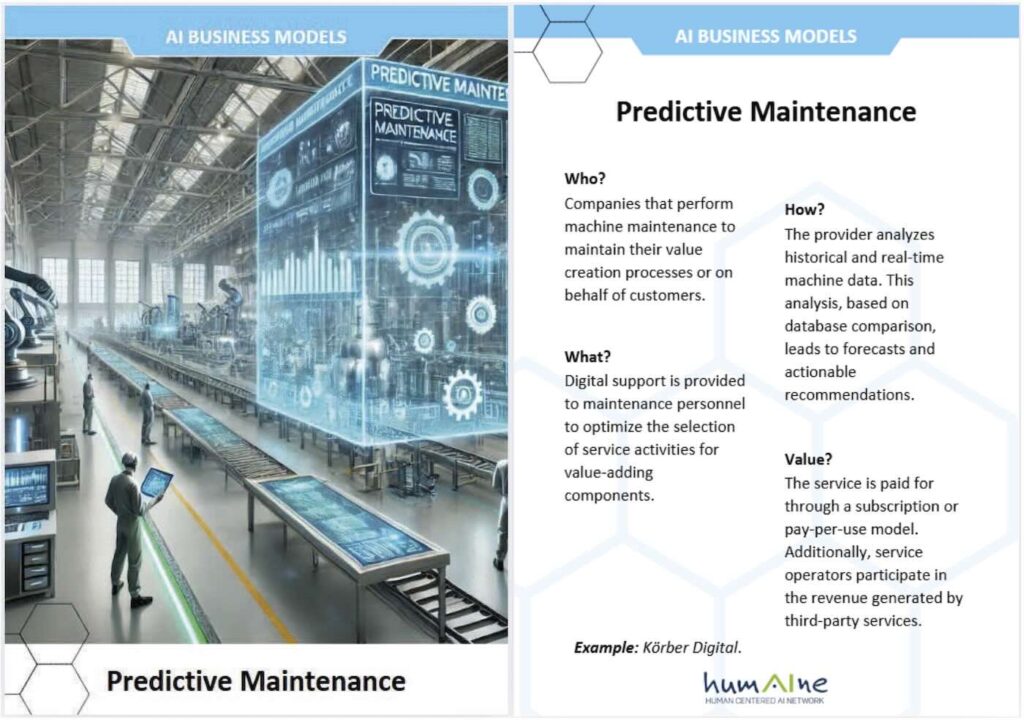
- AI Business Model Cards: This set includes 20 recurring patterns of AI-enabled value creation, delivery, capture, and customer orientation (Fig. 1). The cards are based on empirical research and structured according to business model frameworks such as the Business Model Navigator [5]. Each card includes a title and a visual on the front and provides a concise description, a practical example, and a guiding question on the reverse side (Fig. 2). To keep the table concise, we provide only examples of the value proposition (‘what’) for each card. The complete set of cards, however, also addresses aspects of value delivery and value capture.
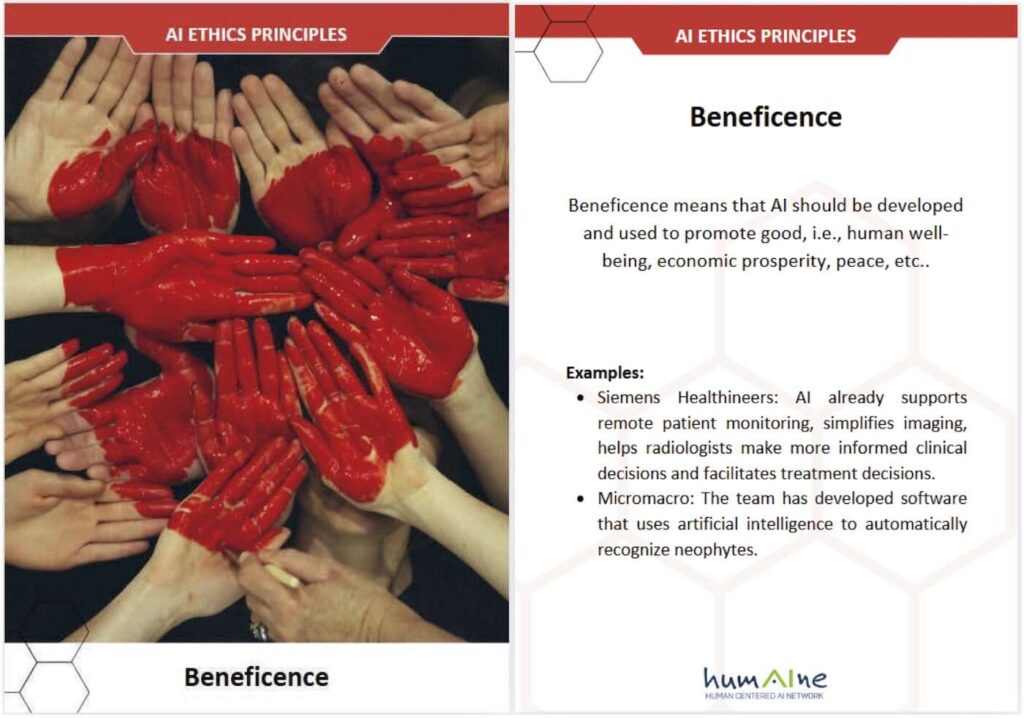
- AI Ethics Principles Cards: This set translates six abstract ethical principles, such as transparency, justice, beneficence, non-maleficence, autonomy, and data security, into actionable prompts. Each card features a title and icon on the front, accompanied by a brief definition and an application example on the back (Fig. 3). These cards are designed to support early reflection and structured discussion rather than serve as compliance instruments [9, 10].
The cards were refined through multiple design iterations informed by user feedback and empirical validation in three co-creation workshops with SEEPEX and other project and industry partners, held between 2022 and 2024. These sessions followed a design thinking format, incorporating tools such as the Business Model Canvas, scenario mapping, and concept sketching. All workshops were documented through facilitator notes and workshop artifacts, which informed subsequent improvements in content structure, usability, and integration.
![Figure 1: Overview of AI Business Model Pattern names and their value proposition (i.e., the “What?”) (own illustration based on the authors’ development, grounded in the Business Model Navigator [5]).](https://industry-science.com/wp-content/uploads/2026/02/Barton_I4S-26-1_Figure-1-802x1024.jpeg)
Case Study: Co-creating AI-based business model innovations with SME
To explore the practical application of the tool, we conducted a co-innovation process with SEEPEX GmbH, a medium-sized industrial company specializing in pump and flow technologies. Operating in a competitive global B2B market, the company faced pressure to differentiate its offerings, optimize service operations, and identify new digital growth opportunities. With increasing interest in AI, the organization sought structured external support to assess how AI could be integrated into its business model in a strategically sound and ethically grounded manner.
The scope of the pilot project focused on the early stages of business model development, particularly the Explore and Ideate phases. While the five-phase framework (Fig. 4) served as an overall orientation, the card-based tool was used explicitly in the first two phases to support structured opportunity identification and idea generation. The process involved an interdisciplinary internal team from product management, business development, service operations, and data analytics, supported by external researchers with expertise in business model innovation, AI ethics, and human-centered design.
Collaboration took place over a series of three workshops focusing on exploration, ideation, and prototyping. For these workshops, co-creative methods and established tools, including the Business Model Canvas and Value Proposition Canvas, were used in combination with the card sets.
![Figure 4: Business model innovation process [9].](https://industry-science.com/wp-content/uploads/2026/02/Barton_I4S-26-1_Figure-4-1024x560.jpeg)
EXPLORE: Understanding the current landscape
The first phase focused on analyzing the organization’s current business logic and identifying potential areas for AI opportunities. A structured intake process included a digital maturity assessment, semi-structured interviews, and a business model-mapping session using the Business Model Canvas and Value Proposition Canvas. This helped pinpoint value delivery bottlenecks and underutilized data assets. Ethical framing was introduced early on, capturing initial concerns such as workforce impact, transparency in AI-supported decisions, and fairness in service delivery. These themes informed the subsequent phases.
IDEATE: Generating and evaluating business model options
Building on the identified opportunity areas, the team explored a wide range of AI-enabled business model configurations. During a dedicated ideation workshop, the AI Business Model Cards were used to structure thinking around value creation, delivery, and capture. The cards helped frame over a dozen concept ideas, including predictive maintenance-as-a-service and intelligent customer support solutions. To integrate ethical foresight, the AI Ethics Principles Cards were introduced. These guided teams to reflect on potential risks, responsibilities, and user trust considerations. Concepts were then assessed for feasibility, desirability, ethical risk, and strategic fit. Three high-potential ideas were chosen for further development.
PROTOTYPE: Developing and refining concepts
Although the original research activities did not formally include the Prototype, Test, and Realize phases, the company independently extended four selected ideas into prototypical business model templates for further analysis. These trial configurations provided the basis for potentially new business models tailored to evolving customer needs and AI-enabled service opportunities. To illustrate how early ideation informed concrete outcomes, two of the four prototypes are described below. Each is grounded in patterns introduced through the AI Business Model Cards and adapted to SEEPEX’s industrial service context.
The Smart Diagnostic Support pattern describes AI applications that enhance users’ ability to monitor and maintain equipment by generating automated insights from operational data. It is particularly relevant in scenarios where human expertise remains central but can be augmented by AI-driven recommendations. SEEPEX translated this logic into a Self Service prototype. Customers access and interpret pump performance data through the SEEPEX Analytics Platform, receiving automated suggestions for maintenance, troubleshooting, and energy optimization. The model thereby reduces downtime and operating costs without requiring ongoing expert interaction. It appeals in particular to technically capable customers who prefer digital tools that support autonomous decision-making.
The Operations Support Service pattern focuses on AI-supported operational decision-making in close cooperation with a service provider. It typically involves delegated monitoring responsibilities and continuous guidance, especially for customers who seek reliability without managing the complexity themselves. SEEPEX adapted this into the Digital Full Service prototype. In this model, SEEPEX experts continuously monitor the pumps and proactively initiate maintenance actions. Customers outsource operational risk and resource effort while benefiting from increased reliability and reduced internal workload. The model supports trust-based, long-term service relationships and is particularly attractive for clients with limited in-house maintenance capacity.
Together, these prototypes represent distinct positions on a spectrum of customer involvement and operational responsibility. The collaboration ultimately resulted in a portfolio of AI-based business model configurations that reflect differing service preferences and risk-sharing arrangements. While the card-based tool was used primarily during the early ideation phase, its structured prompts, ethical principles, and modular patterns informed downstream prototyping activities. Although these configurations were not formally tested or implemented, the case highlights how abstract design patterns can serve as a bridge between ethical foresight and applied business model development.
Conclusion: Tools for early ideation
This paper introduces modular tools designed to support SMEs in developing AI-based business models that embed ethical reflection from the outset. By combining pattern-based guidance (AI Business Model Cards) with value-based prompts (AI Ethics Principles Cards), the tool addresses a critical gap in existing frameworks. Its integration into the early stages of a five-phase innovation process help structure ideation, align interdisciplinary perspectives, and raise awareness of ethical risks and responsibilities.
The case study demonstrated the tool’s practical relevance, especially during the Explore, Ideate, and Prototype phases, where teams benefit from structured inspiration and shared language. While the tools’ influence extends indirectly into the Test and Realize phases, their primary strength lies in helping organizations identify promising concepts and anticipate ethical implications early on.
For companies, particularly those with limited internal resources, the card sets offer a low-threshold and flexible format to support strategy workshops, innovation sprints, or AI readiness assessments. As AI continues to shape how organizations create and capture value, structured and ethically grounded tools like these can help build not only better business models but also more trustworthy innovation practices. Future research should further validate and test these cards across diverse industry contexts to evaluate their transferability.
This research and development project is funded by the German Federal Ministry of Research, Technology and Space (BMFTR) within the “The Future of Value Creation – Research on Production, Services and Work” program (02L19C200) and managed by the Project Management Agency Karlsruhe (PTKA). The authors are responsible for the content of this publication.
This is an original article. The German translation can be accessed via DOI: 10.30844/I4SD.26.1.40
Bibliography
[1] Kaplan, A.; Haenlein, M.: Siri, Siri, in my hand: Who’s the fairest in the land? On the interpretations, illustrations, and implications of artificial intelligence. In: Bus. Horiz. 62 (2019) 1, pp. 15-25. DOI: 10.1016/j.bushor.2018.08.004.[2] Hahn, C.; Traunecker, T.; Niever, M.; Basedow, G. N.: Exploring AI-Driven Business Models: Conceptualization and Expectations in the Machinery Industry. In: 2020 IEEE International Conference on Industrial Engineering and Engineering Management (IEEM), Dec. 2020, pp. 567-570. DOI: 10.1109/IEEM45057.2020.9309824.
[3] Sidorenko, E. L.; Khisamova, Z. I.; Monastyrsky, U. E.: The Main Ethical Risks of Using Artificial Intelligence in Business. In: Ashmarina, S. I.; Mantulenko, V. V. (eds.): Current Achievements, Challenges and Digital Chances of Knowledge Based Economy. Cham: Springer International Publishing, 2021, pp. 423-429. DOI: 10.1007/978-3-030-47458-4_51.
[4] Burström, T.; Parida, V.; Lahti, T.; Wincent, J.: AI-enabled business-model innovation and transformation in industrial ecosystems: A framework, model and outline for further research. In: J. Bus. Res. 127 (2021), pp. 85-95. DOI: 10.1016/j.jbusres.2021.01.016.
[5] Gassmann, O.; Frankenberger, K.; Choudury, M.: Geschäftsmodelle entwickeln: 55 innovative Konzepte mit dem St. Galler Business Model Navigator. Carl Hanser Verlag GmbH Co KG, 2020.
[6] Paschen et al.: Collaborative intelligence: How human and artificial intelligence create value along the B2B sales funnel | Elsevier Enhanced Reader.
[7] Breidbach C. F.; Maglio, P.: Accountable algorithms? The ethical implications of data-driven business models. In: J. Serv. Manag. 31 (2020) 2, pp. 163-185. DOI: 10.1108/JOSM-03-2019-0073.
[8] Jorzik, P.; Klein, S. P.; Kanbach, D. K.; Kraus, S.: AI-driven business model innovation: A systematic review and research agenda. In: J. Bus. Res. 182 (2024), p. 114764. DOI: 10.1016/j.jbusres.2024.114764.
[9] Barton, M.-C.; Pöppelbuß, J.: Prinzipien für die ethische Nutzung künstlicher Intelligenz. In: HMD Prax. Wirtsch. 59 (2022) 2, pp. 468-481. DOI: 10.1365/s40702-022-00850-3.
[10] Floridi, L. et al.: AI4People—An Ethical Framework for a Good AI Society: Opportunities, Risks, Principles, and Recommendations. In: Minds Mach. 28 (2018) 4, pp. 689-707. DOI: 10.1007/s11023-018-9482-5.
[11] Spiekermann, S. et al.: Values and Ethics in Information Systems. In: Bus. Inf. Syst. Eng. 64 (2022) 2, pp. 247-264. DOI: 10.1007/s12599-021-00734-8.
[12] Regulation (EU) 2024/1689 of the European Parliament and of the Council of 13 June 2024 laying down harmonised rules on artificial intelligence and amending Regulations (EC) No 300/2008, (EU) No 167/2013, (EU) No 168/2013, (EU) 2018/858, (EU) 2018/1139 and (EU) 2019/2144 and Directives 2014/90/EU, (EU) 2016/797 and (EU) 2020/1828 (Artificial Intelligence Act) (Text with EEA relevance). 2024. URL: http://data.europa.eu/eli/reg/2024/1689/oj/eng, accessed 30.06.2025.
[13] Soudi, M. S.; Bauters, M.: AI Guidelines and Ethical Readiness Inside SMEs: A Review and Recommendations. In: Digit. Soc. 3 (2024) 1, p. 3. DOI: 10.1007/s44206-024-00087-1.
[14] Osterwalder, A.; Pigneur, Y.: Business Model Generation: A Handbook for Visionaries, Game Changers, and Challengers. John Wiley & Sons, 2010.
[15] Knickrehm, C.; Voss, M.; Barton, M.-C.: Can you trust me? Using AI to review more than three decades of AI trust literature. 2023.
[16] Weber, M.; Beutter, M.; Weking, J.; Böhm, M.; Krcmar, H.: AI Startup Business Models. In: Bus. Inf. Syst. Eng. 64 (2022) 1, pp. 91-109. DOI: 10.1007/s12599-021-00732-w.
[17] Peffers, K.; Tuunanen, T.; Rothenberger, M. A.; Chatterjee, S.: A Design Science Research Methodology for Information Systems Research. In: J. Manag. Inf. Syst. 24 (2007) 3, pp. 45-77. DOI: 10.2753/MIS0742-1222240302.
[18] Hevner, A. R.: A Three Cycle View of Design Science Research.
[19] Gioia, D. A.; Corley, K. G.; Hamilton, A. L.: Seeking Qualitative Rigor in Inductive Research: Notes on the Gioia Methodology. In: Organ. Res. Methods 16 (2013) 1, pp. 15-31. DOI: 10.1177/1094428112452151.
Your downloads
Potentials: Business Models
Solutions: Product Development
You might also be interested in