process model

A Machine Learning Compass for Product Development and Production

A Machine Learning Compass for Product Development and Production

Identification and planning of machine learning algorithms in manufacturing companies
Alexander Jacob, Carmen Krahe, Rebecca Funk, Gisela Lanza ORCID Icon
Engineers are often uncertain about the application of machine learning (ML) due to the amount of different machine learning methods and the complexity of modeling. Thus, the use of ML applications in manufacturing companies remains behind the technical possibilities. This paper presents an intuitive ML guideline for engineers to reduce this uncertainty. The guideline comprises a process model with AI-based solutions to common problems of product development and production. An industrial example is used to demonstrate the functionality and the possibilities of the guide.
Industrie 4.0 Management | Volume 37 | 2021 | Edition 2 | Pages 7-11
Introduction of Digital Twins

Introduction of Digital Twins

Development of a procedure for technology migration
Markus Kreutz, Michael Lütjen ORCID Icon, Michael Freitag ORCID Icon
The digital twin is well on the way to becoming an elementary part of the corporate world. Corporate leaders hope that these intelligent images of an increasingly dynamic corporate reality will significantly reduce complexity. Ideally, model-based analyses and (partially) automated decisions using methods of simulation technology and artificial intelligence based on optimized IoT data management can make their contribution to corporate agility. In addition to the definition of terms/concepts, the paper will discuss current challenges and present various examples of their application. Based on these ideas, a process model for the introduction of digital twins in terms of technology migration will be presented.
Industrie 4.0 Management | Volume 36 | 2020 | Edition 4 | Pages 40-44
Product Modularization Along the Supply Chain

Product Modularization Along the Supply Chain

How the Implementation Succeeds
Martin Brylowski, Henning Schöpper ORCID Icon, Marwin Krull
The advancing technological change, the globalization of markets as well as increasing customer requirements have led to a significant increase in complexity in manufacturing companies and their supply chains. Companies and entire value chains are countering this development with product modularization strategies. In this context, however, the investigation of the influences of product modularization on the supply chain receives little attention. This can lead to unused potentials and additional risks, such as the loss of core competencies. Therefore, this article deals with necessary processes and success factors that result from a joint consideration of product modularization along the supply chain. On the basis of a systematic analysis of scientific literature and guideline-supported expert interviews, a process model with different phases and steps was developed and currently necessary success factors were identified.
Industrie 4.0 Management | Volume 35 | 2019 | Edition 5 | Pages 50-54 | DOI 10.30844/I40M_19-5_S50-54
Process Model for the Industry 4.0

Process Model for the Industry 4.0

Structured Introduction and Implementation of Digitalizations Measures in the Manufacturing Industry
Simon Hennegriff, Sebastian Terstegen, Sascha Stowasser, Holger Dander ORCID Icon, Patrick Adler
Comparison and evaluation from research findings of 28 process models considering digitalization measures are presented. Furthermore, our own-developed process model, based upon interviews with professional managers, is reported. Our process model enables managers to deal with technology coming along with industry 4.0, such as the implementation of socio-technologies.
Industrie 4.0 Management | Volume 35 | 2019 | Edition 3 | Pages 47-50
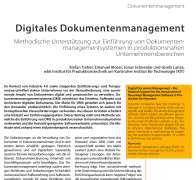
Digital Document Management – Methodical Support for the Introduction of Document Management Software in Production Environment

Digital Document Management - Methodical Support for the Introduction of Document Management Software in Production Environment

Methodische Unterstützung zur Einführung von Dokumenten-managementsystemen in produktionsnahen Unternehmensbereichen
Stefan Treber, Emanuel Moser, Jonas Schneider, Gisela Lanza ORCID Icon
Industrial companies face the challenge to manage an increasing number of documents digitally and reliably. Document Management Software (DMS) enables the efficient generation, retrieval and filing of documents. However, the range of software solutions is vast. Furthermore, many introduction projects fail due to inherent organizational challenges. This article introduces a methodology for preparing the successful implementation of a DMS in both theory and practice.
Industrie 4.0 Management | Volume 33 | 2017 | Edition 4 | Pages 17-20
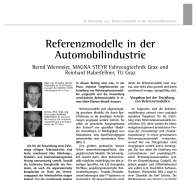
Reference Models in the Automotive Industry

Reference Models in the Automotive Industry

Bernd Wiermeier, Reinhard Haberfellner
The necessary work steps for the development of an automotive are distributed more and more across boarders of divisions, locations and enterprises. Both the technical complexity of products and the organizational complexity regarding the degree of integration are increasing. In order to understand, plan, logically map, and successfully manage the very complex product structure and the highly networked product development-process, commonly accepted structure or process models are used. The creation of these models can be supported by reference-models. In this article a field tested approach for modelling reference-process-models and application of different reference models in a multi-level-model will be shown.
Industrie Management | Volume 23 | 2007 | Edition 3 | Pages 47-50
Cooperative Product Development in Shipbuilding

Cooperative Product Development in Shipbuilding

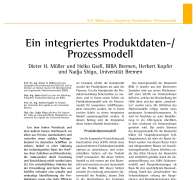
An integrated product data-/process-model
Dieter H. Müller, Heiko Gsell, Herbert Kopfer, Nadja Shigo
To cope with the hard global competition in shipbuilding and to secure a high volume of orders for German shipyards there is a need for strengthening research and development in shipyards. An economic development of ships needs a quick and distinct identification of product data as well as a high efficiency of the processes which are linked with these data. To achieve these demands an integration of a product data model and of a process model is necessary witch is described in this paper.
Industrie Management | Volume 22 | 2006 | Edition 3 | Pages 65-68
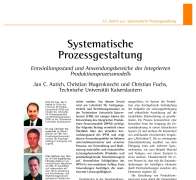
Systematic Process Design

Systematic Process Design

Development state and applications of the integrated production process model (IPPM)
Jan C. Aurich, Christian Wagenknecht, Christian Fuchs
The design of cross-enterprise production processes can be significantly supported by the systematic usage of process modeling methodologies. The following paper shows current and future research work concerning the Integrated Production Process Model (IPPM). Major improvements are related to the integration both of physical and non-physical products and the closed description of cross enterprise production processes. An integrated modeling methodology based on a predefined process module library supports the design process.
Industrie Management | Volume 21 | 2005 | Edition 4 | Pages 23-27
The Process Model of Factory Planning

The Process Model of Factory Planning

Mit standardisierten Prozessen zu kundenindividuellen Fabriken
Peter Nyhuis ORCID Icon, Thomas Harms, Andreas Elscher
With Standardised Processes on the Right Track to Customised Factories The approaches of factory planning that have been developed many years ago have to be adjusted to today’s challenges. Therefore the basic systematics of the Supply Chain Operations Reference- Model (SCOR-Model) are consulted and transferred to the processes of factory planning. The aim is to accelerate the planning process and to generate planning results in a higher quality while decreasing the planning effort. This will be achieved by use of a consistent process orientation which bases on standardised processes, field-tested methods, models and tools and on best-practice examples. This article explains the system and contents of the Process Model of Factory Planning and will give an impression of the first software-based prototype.
Industrie Management | Volume 20 | 2004 | Edition 1 | Pages 32-35
Collaborative Technical Services within the Manufacturing Industry

Collaborative Technical Services within the Manufacturing Industry

Tanja Klostermann, Thomas Specht
Latest developments within the production engineering area carry out a more higher complexity of products combined with an increasing need of customer integrated services. Due to the hereby resulting high investments of time and money it is necessary to develop a methodological approach of the service engineering process as well as the collaboration within the partnering networks. Single enterprises use already different types of Internet enabled collaborative technologies but an enterprise widespreading collaborative development and use of services is not occuring in a sufficient way so far. The paper de-scribes a problem-adequate design of a collaborative technical service within a production network between customers, manufacturers and suppliers. The paper’s result is to demonstrate collaboration service facilities in order to increase the effectivity and efficiency of service processes.
Industrie Management | Volume 19 | 2003 | Edition 5 | Pages 66-69