Logistik

Modelling and Measurement of Flexibility

Modelling and Measurement of Flexibility

Wiebke Hartmann, Tim D. Busse, Peter Nyhuis ORCID Icon, Sebastian Beck
In an increasingly turbulent environment, today enterprises are confronted with the challenge of aligning available capacities with the capacities required using targeted measures. An approach is presented to support the selection of measures quantitatively.
Industrie Management | Volume 27 | 2011 | Edition 1 | Pages 62-64
Configuration of  a Charging Infrastructure for Electric Vehicles

Configuration of a Charging Infrastructure for Electric Vehicles

Ein Ansatz zur modellgestützten Entscheidungsfindung
Michael Schenk, Holger Seidel, Ramon Ebert
Drive-train electrification intended to create sustainable mobility by enhancing efficiency and identifying supplements and alternatives to crude oil is integral to many vehicle manufacturers’ strategies. However, innovations in the field of electromobility, i.e. mobility rendered possible by electrically powered vehicles, will only establish themselves when they generate genuine value added for customers and are environmentally compatible. Thus, cost effective configuration of a ubiquitous (public, semi-public) infrastructure that supports the use and market launch of electric vehicles constitutes one of the key challenges and will necessitate support from new planning approaches and models.
Industrie Management | Volume 26 | 2010 | Edition 6 | Pages 53-56
Characteristics of IoT in the Logistics Sector

Characteristics of IoT in the Logistics Sector

First consequences for the professional education
Karl Hribernik, Lars Windelband, Felix Hunecker, Carl Hans, Klaus-Dieter Thoben ORCID Icon
The vision of the “Internet of Things” describes networked, interactive objects which are capable of autonomous decision-taking. The potentials of this vision for logistics in the automotive and food sector go from tracking and tracing throughout the supply-chain, via quality assurance and monitoring through to new service models and consequently completely novel sources of revenue. Key elements of the “Internet of Things” such as auto-identification technology or sensors are already mature and ready to be used in logistics. On the basis of a series of industry case studies, this article describes the current situation in industry with regards to these technologies and identifies future potential. To facilitate the analysis, it presents an instrument by which the level of implementation of the technologies of the “Internet of Things” can be measured.
Industrie Management | Volume 26 | 2010 | Edition 5 | Pages 27-30
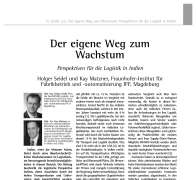
Perspectives for Logistics in India

Perspectives for Logistics in India

Perspektiven für die Logistik in Indien
Holger Seidel, Kay Matzner
An engine of Asian development, India holds outstanding potential for investment in its logistics sector, which is experiencing above average rates of growth. However, high transport costs and long delivery times greatly detract from India’s prospects in the logistics sector. Despite these problems, India still offers investors excellent long-range prospects since it is working hard to eliminate the recognized problems.
Industrie Management | Volume 25 | 2009 | Edition 6 | Pages 63-65
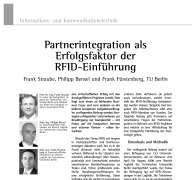
Partner Integration as a Key Success Factor for RFID Implementation

Partner Integration as a Key Success Factor for RFID Implementation

Frank Straube, Philipp Bensel, Frank Fürstenberg
sperous technology - until 2010 79 % of the users plan to extend the usage of RFID in logistics. However, the majority of users lacks in economic success with their current RFID applications. The reasons lie in the difficulties of building a solid business case and the complexity of the implementation itself. This article presents strategies of successful companies - focusing on partner integration - to cope with this complexity.
Industrie Management | Volume 25 | 2009 | Edition 5 | Pages 18-22
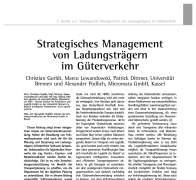
Strategic Management of Swap Bodies in Freight Transportation

Strategic Management of Swap Bodies in Freight Transportation

Christian Gorldt, Marco Lewandowski, Patrick Dittmer, Alexander Podlich
In this paper we show an integrative solution to freight traffic reduction. Beside telematic systems we also regard software for planning and control of swap bodies in the area of courier express and parcel provider. The objective is to design a decision support tool for transport planning to support users to solve their daily problems of tour planning. The software prototype introduced in this contribution was provided in the context of the BMWi promoted project Inwest and will be evaluated in field test in third quarter of 2009.
Industrie Management | Volume 25 | 2009 | Edition 4 | Pages 25-28
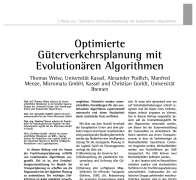
Optimized Transport Planning Based on Evolutionary Algorithms

Optimized Transport Planning Based on Evolutionary Algorithms

Thomas Weise, Alexander Podlich, Manfred Menze, Christian Gorldt
In this paper we introduced in transport planning based on evolutionary algorithms. The objective is to design a decision support tool for transport planning manager to support the planning process. An important criterion is to minimize the transportation (km) by using this tool. The prototype introduced in this paper was tested with real business data to check the suitability for transportation planning. Furthermore, different settings for the evolutionary algorithm are experimentally studied their utility is verified with statistical tests.
Industrie Management | Volume 25 | 2009 | Edition 3 | Pages 37-40
Effects of the Demographic Change on Internal Logistics

Effects of the Demographic Change on Internal Logistics

Approaches for the preservation of the worker’s ability to work in logistics systems
Dennis Walch, Willibald A. Günthner, Martin Neuberger
The demographic change will be one of the big challenges for operational logistics in the upcoming years. With the aging of logistics workers, physical constraints increase especially when employment is characterized by high physical stress (e.g. like in production and logistics). That causes higher demands on the design of logistics workplaces. But how can companies react to this, taking into account that value added orientation leads to new demands to workers? Is there a chance that the increasing percentage of elder employees can properly fulfil the demands in the future? Whereas the ergonomic design of workplaces is the precondition, an intelligent labour organisation with diversified stress can preserve the worker’s ability to work.
Industrie Management | Volume 25 | 2009 | Edition 2 | Pages 67-70
Autonomous Control in Intralogistics

Autonomous Control in Intralogistics

Cognitive Spatial Representations for Autonomous Vehicles
Arne Schuldt, Björn Gottfried
Autonomous vehicles are employed in intralogistics in order to transport work pieces between different workplaces. Previous guidance systems are based on wire-guided tracks or optical following of surface markings. In the first case, the possibility to change the production layout is rather limited. In the second case, abrasion can significantly decrease recognition rates. In contrast, humans easily succeed in navigation tasks, even in dynamic environments. A promising approach is therefore to apply a cognitively motivated spatial representation for autonomous vehicles. This article presents BA23, a set of 23 qualitative relations for qualitative spatial reasoning, and discusses its application in intralogistics.
Industrie Management | Volume 24 | 2008 | Edition 4 | Pages 41-44
Ramp-Up and Phase-Out-Management

Ramp-Up and Phase-Out-Management

Challenges of Logistics at the Beginning and End of the Product Life Cycle
Therese Kirsch, Wolfgang Buchholz
With time, products lose their attractiveness on the market, technology becomes outdated or customer demands are no longer met. To keep up success, companies need to replace old products. This means a huge amount of product changes for a manufacturer that differentiates through customer-focused product design and continuous product innovations. Ramp-up and phase-out-management are critical factors of success. As the product life cycles shorten due to the dynamism of the technology and markets, payback periods for the development costs reduce, too. In order to maintain profitability or to increase it, it is necessary to minimise the cost and time of product changes. This article shows how logistics contribute handling a lot of complex ramp-ups and phase-outs with optimal cost and in a short time.
Industrie Management | Volume 24 | 2008 | Edition 3 | Pages 45-48
1 4 5 6 7