Logistik

Automatic Assessment of Physical Workload in Order Picking Systems

Automatic Assessment of Physical Workload in Order Picking Systems

Bewertung der physischen Belastung von Arbeitsplätzen in der Kommissionierung durch das WMS
Myriam Koch, Willibald A. Günthner
In order picking, the workers lift, lower, push and pull variable loads. This manual handling is a common cause of musculoskeletal disorders. In order to assess the risk of musculoskeletal disorders, risk assessments in order picking are nowadays performed manually. This article presents an approach how to integrate two methods of risk assessment in warehouse management systems so the physical workload in order picking systems can be determined automatically.
Industrie Management | Volume 30 | 2014 | Edition 1 | Pages 47-50
Combination of Production Characteristics Curves and the Process Chain Paradigm

Combination of Production Characteristics Curves and the Process Chain Paradigm

Holger Beckmann, Frederik Döbbeler, Oliver Künzler, Michael Lücke
Nowadays factories have to withhold an ever rising pressure to succeed. Customer demands become more demanding and goods have to be available within shorter lead times and lower prices. Flexibility, reliability and resilience are key factors for companies. Against this background, there is a need in companies for constant analysis of their business processes. The process perspective that was established in the industry since the 1980s will be addressed in the following by using the “Dortmunder Process Chain Model”. A permanent preparedness for change relies on being able to report about the plant’s status quo at all times. Therefore valuation methods and key figures are needed that represented by production characteristics curves in this paper. After an introduction to these two topics, the combination of both to one process based valuation method will be outlined. The intended methodology will represent a holistic decision model for plant controlling. This approach is being ...
Industrie Management | Volume 30 | 2014 | Edition 1 | Pages 22-26
Transfer of Research and Development Results to Standardisation Processes

Transfer of Research and Development Results to Standardisation Processes

A Procedure Model Based Approach and its Application in the Field of Offshore Wind Energy Logistics
Michael Görges, Annette Schimmel
Standardisation of industrial solutions is a crucial factor for the competitiveness of whole industry sectors. Especially young and immature industries, like the offshore wind energy sector, may benefit from standardised processes. Several research and development projects address information flow and the planning in this field. The standardisation of the projects results may improve the performance of the whole supply chain. However, the transfer of research and development results to standardisation processes is a challenging task. Thus, this paper introduces a procedure model for the identification and evaluation of research and development results for standardisation.
Industrie Management | Volume 29 | 2013 | Edition 5 | Pages 11-14
Changeability as Enabler for Sustainable Logistics

Changeability as Enabler for Sustainable Logistics

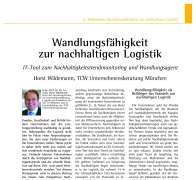
IT-Tool zum Nachhaltigkeitstrendmonitoring und Wandlungsagent
Horst Wildemann
Customers, society and politics challenge companies to ensure the sustainability of their value creation. Many stakeholder groups have an eye on the logistics. These groups constantly raise new requirements and regulations affecting companies’ businesses.  This is the reason why it is not sufficient anymore to react on changing requirements. Companies can gain competitive advantages if they anticipate trends in sustainability and react immediately. In this context, this article presents an approach for trend monitoring and a change agent suppor-ting to react effectively and efficiently on trends in sustainability.
Industrie Management | Volume 29 | 2013 | Edition 5 | Pages 35-38
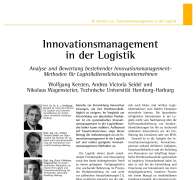
Innovation Management in Logistics

Innovation Management in Logistics

Analysis and Validation of Innovation Management Methods for Logistic Service Providers
Wolfgang Kersten ORCID Icon, Andrea Victoria Seidel, Nikolaus Wagenstetter
Technological progress, stringent competitive conditions and continually changing customer behaviour force the logistics industry to develop innovative solutions to generate long-term competitive advantage. Compared to the development of physical products, a systematic innovations management has not been established in logistics yet. Grounded in the analysis of interviews with experts from industry, this article puts forward requirements with respect to innovation management implementation and suggests the use of specific methods.
Industrie Management | Volume 28 | 2012 | Edition 6 | Pages 31-34
Approaches to Support Discrete-event Simulation as a Knowledge-intensive Process

Approaches to Support Discrete-event Simulation as a Knowledge-intensive Process

Dennis Abel, Markus Schmitz, Sigrid Wenzel ORCID Icon
Planning, design and continuous improvement of today’s complex corporate structures and technical systems require a sophisticated level of extensive know-ledge of technology, processes and IT. To apply planning and simulation tools effectively and efficiently engineers and plant operators have to rise to the challenge to use their knowledge in a goal-oriented way and to expand it within creative processes. Consequently, knowledge is more than ever a key productivity factor and an important component of corporate capital. Against this background, the article discusses possibilities for systematization and standardization in simulation studies and especially approaches to increase productivity in simulation studies by supplying assistance functions as well as systematic evaluation methodologies.
Industrie Management | Volume 28 | 2012 | Edition 3 | Pages 7-11
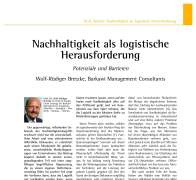
Sustainability as a Logistic Challenge: Potentials and Barriers

Sustainability as a Logistic Challenge: Potentials and Barriers

Potenziale und Barrieren
Wolf-Rüdiger Bretzke
The current discussion on sustainability lacks a firm foundation on a clear and unambiguous definition of this pivotal concept. This impedes a concentrated discussion among scientists as well as politicians and managers on a subject-matter concerning the future of mankind. It gives room for hollow commitments of companies claiming publicly to be „green“. The article therefore starts by proposing a clear and unambiguous definition which can fill this gap. Based on this preliminary work the author argues that logistics cannot become sustainable if it remains in a position where it only has to ensure the demands of other departments’ means (especially those of marketing) thus neglecting fundamental interdependencies. Logisticians often claim systems thinking as the dominant perspective of their work. Based on a practical example the author shows that systems thinking can only work as a door opener to sustainability if it is applied to the company as a whole.
Industrie Management | Volume 27 | 2011 | Edition 6 | Pages 65-68
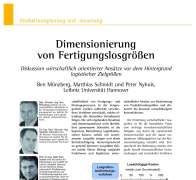
Discussing Lot Sizing Approaches

Discussing Lot Sizing Approaches

Their influence on economic production
Ben Münzberg, Matthias Schmidt, Peter Nyhuis ORCID Icon
Lot sizing is a substantial factor of economic production. There are various lot sizing approaches considering the same cost factors in different ways. Their results are usually quite similar. A common weakness of all lot sizing approaches is the limited consideration of relevant cost factors. The costs which are neglected usually rise with increasing lot sizes. This leads to illusory exact results because too large lots are calculated generally. This paper compares functions and results of different lot sizing approaches and discusses neglected cost factors.
Industrie Management | Volume 27 | 2011 | Edition 5 | Pages 22-26
Need for Vocational Training and Intelligent Cargo

Need for Vocational Training and Intelligent Cargo

Begleitung der Einführung von IuK-Technologien in der Logistik
Jannicke Baalsrud Hauge, Marcus Seifert, Stefan Wiesner
It is expected that employment will increase in the next 5 years. Furthermore, several surveys examining the training needs state that there is a large need for improving the qualification of employees working at all different positions within the supply chain. The need for qualified persons cannot only be fulfilled by motivating the employees in continuous learning. This article shows an approach used for vocational training in the field of Intelligent Cargo.
Industrie Management | Volume 27 | 2011 | Edition 4 | Pages 77-81
The Influence of Future Macroeconomic Developments on Logistics

The Influence of Future Macroeconomic Developments on Logistics

Pan Theo Grosse-Ruyken, Ruben Jönke, Stephan M. Wagner, J. Rod Franklin
Logistics has changed extensively in recent decades. Initially characterized by the classical functional structuring procurement - production - distribution, the task of logistics in our days is to integrate value chains into global networks. In future, logistics challenges will proceed even faster. Logisticians from science and practice estimate that the next 10 years will bring as many changes as the past 50 years. To keep pace with this dynamic change the knowledge about future developments and trends that will shape the logistics of tomorrow is key to success. From our perspective, four global core developments will significantly influence the planning, coordination and proceeding of product flows in the future: supply chain risk, technology, environment and geopolitical orientation and change of social structures. These developments open up opportunities for logistics but include also major challenges.
Industrie Management | Volume 27 | 2011 | Edition 2 | Pages 27-32
1 3 4 5 7