Logistik

Future Topics in Logistics

Future Topics in Logistics

Falk Mikosch
In future, classic logistical targets will be supplemented by the target “safeguarding of resources”. In view of the close chaining of logistic processes, holistic and sustainable approaches are needed to achieve an optimum oriented economic and ecological general condition of logistic systems. This article introduces the need of new strategies in logistics and the relevance of new concepts to increasing the logistical performance.
Industrie Management | Volume 24 | 2008 | Edition 2 | Pages 9-10
Extending the Service Business in China

Extending the Service Business in China

Heiko Gebauer, Felix Pütz, Fabrice Seite
Confronted with intensive product price competition in China, industrial firms are forced to invest in extending the service business. Extending the service business is far from easy. Chinese competitors offer faked spare parts. Local service skills are very poor and service requirements force industrial firms to invest in logistic infrastructure. This article offers a guideline for managers seeking to professionalize the human resource management in the service organization, to adapt service offerings to the local customer needs, and to set-up a logistic infrastructure.
Industrie Management | Volume 24 | 2008 | Edition 1 | Pages 19-22
Logistics Research and Training

Logistics Research and Training

Programs provided by foreign research organizations in China
Michael Schenk, Tobias Reggelin, Kay Matzner
Given the current and anticipated future economic development in China, annual growth rates around 10 % and the opening of the Chinese market to logistics services, foreign logistics service providers are expecting annual growth of 30 % in this particularly lucrative market segment. One of the greatest challenges is the lack of sufficiently qualified Chinese logistics experts. This presents foreign research organizations and enterprises an opportunity to become active in China.
Industrie Management | Volume 24 | 2008 | Edition 1 | Pages 12-14
Modularisation of Logistics Systems

Modularisation of Logistics Systems

A Contribution to Complexity Management
Frank Straube, Axel Mayer
Complexity of industrial enterprises increases. Responsible for this trend are external drivers like the individualisation of products, the fierce global competition and the speed of technological developments which lead to reduced product life and innovation cycles. Companies react to external complexity by building internal complexity, logistics as a cross functional unit is especially affected. For example, a great number of different customers demand a heterogenic product program which results in operating an increasing quantity of variants. Because of the growing internal complexity a lot of promising logistical solutions are not realised. This article shows an approach how to create an organisational framework - based on the formal principle “Modularisation” - which allows logistics to regain adaptability and mutability by reducing internal complexity.
Industrie Management | Volume 23 | 2007 | Edition 6 | Pages 53-55
Digital Factory Supports Planning of Final Assembly

Digital Factory Supports Planning of Final Assembly

Thorsten Vollstedt, Steffen Körner
Production planning within the Mercedes Car Group is challenged by reduction of development times while increasing the product portfolio and quality. New approaches were necessary to implement the factorys needs into the product development as early as possible. 5 Years ago the Digital Factory was founded to secure that no production is started without a digital validation of product, production process and tools. Today the final assembly planning at DaimlerChrysler follows an integrated workflow of final assembly, Logistics and facility planning.
Industrie Management | Volume 23 | 2007 | Edition 5 | Pages 60-62
Ecological Aspects Logistics

Ecological Aspects Logistics

Bernd Scholz-Reiter ORCID Icon, Felix Böse, Uwe Hinrichs, Christian Toonen
Against the backdrop of increasing importance of ecological aspects within all company functions, logistics has to be repositioned to comply with upcoming ecological challenges. This article introduces the concept of ecologistics and its measures within all fields of corporate logistics. As an example distribution logistics is detailed in its effort to consider ecological relevant aspects within the planning and control and the configuration of logistical structures.
Industrie Management | Volume 23 | 2007 | Edition 5 | Pages 15-18
Activity-Based Costing in Logistic Areas

Activity-Based Costing in Logistic Areas

Prozessorientierung erhöht Kostentransparenz
Jochen Deuse ORCID Icon, Christian Goldscheid, Yvonne Finke
A crucial criterion for the competitiveness of logistic areas (besides the efficency of logistic processes) is cost transparency, i. e. the cost allocation to performed logistic services. Since logistic processes unlike production processes do not generate material goods but services, it is very common to find cost structures where traditional cost accounting systems lead to distortion of costs. Activity-based costing facilitates process-oriented cost calculation and cost allocation to service processes.
Industrie Management | Volume 23 | 2007 | Edition 5 | Pages 35-38
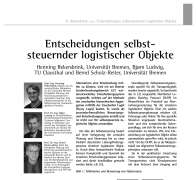
Decisions of Autonomously Controlled Logistic Objects

Decisions of Autonomously Controlled Logistic Objects

Henning Rekersbrink, Bjørn Ludwig, Bernd Scholz-Reiter ORCID Icon
Autonomously controlled transportation processes require decision making of logistic objects regarding routing alternatives. In this contribution a multicriterial evaluation assessment procedure is introduced basing on the fuzzy hierarchical aggregation, adapted and further developed at the CRC 637 “Autonomous Control of Logistic Processes” at Bremen University. The main design focus was user-friendliness within autonomous control and other fields of application. The example of use is a hierarchical structure of the subcriteria characterising the routing alternatives of an autonomous package. It is shown that the procedure can consider unprecise and fuzzy formulated knowledge directly in the model, while parameter adjusting was reduced to a minimum. Different weightings and compensation effects of subcriteria are depicted. The contribution shows the evaluation on a two-subcriteria basis and the possibilities of multicriterial evaluation as well. The evaluation of hard and soft ...
Industrie Management | Volume 23 | 2007 | Edition 4 | Pages 25-30
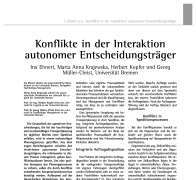
Conflicts Among Decision Makers in the Freight Forwarding Company

Conflicts Among Decision Makers in the Freight Forwarding Company

Ina Ehnert, Marta Anna Krajewska, Herbert Kopfer, Georg Müller-Christ
An integrated operational transportation planning within a freight forwarding company demands a multilevel planning process involving several stages of decision makers. Interactions among the involved autonomous workers generate conflicts. The barriers created by such conflicts should be removed in order to generate a positive emergence of the planning processes. On the basis of theoretical frames for conflict management the possibilities of coping with the conflicts arising in the freight forwarding company are introduced.
Industrie Management | Volume 23 | 2007 | Edition 4 | Pages 31-33
Economic Evaluation of Information in Industrial Logistics

Economic Evaluation of Information in Industrial Logistics

Challenges and first thoughts about value orientation in information logistics
Michael Eßig, Michael Rüdiger
Up to now there are few approaches to an evaluation of information in logistics. However, with the increasing establishment of logistics as a corporate leadership function and a visible increase of the focus on company spanning control of supplier-buyer relationships as part of Supply Chain Management, we also see an increase in the need for an evaluation of information. This article attempts to give first thoughts about an economic evaluation of information in logistics and also attempts to substantiate the need for continued research in this subject area. The presented approach is the Total Logistics Information Value which consist of the company specific contributions of information logistics to the Economic Value Added on the one hand, and the information logistically relevant value added by the suppliers on the other hand.
Industrie Management | Volume 23 | 2007 | Edition 4 | Pages 45-48
1 5 6 7