IoT

Analyzing Work Processes with Motion Capture Systems

Analyzing Work Processes with Motion Capture Systems

Solution and implementation principles
Hermann Lödding ORCID Icon, Silas Pöttker ORCID Icon, Tim Jansen ORCID Icon
The double transformation describes the necessary change in the economy in the dimensions of ecology and digitalization. Motion capture systems offer new possibilities for recording and analyzing work processes in industrial assembly. They visualize motion sequences with high frequency, precision and resolution. The question therefore arises as to how the technology can be used in the context of digital transformation to further develop the analysis of work processes and the design of workplaces. Our article discusses this on the basis of solution principles and describes implementation principles for the development of upcoming digital assistance systems.
Industry 4.0 Science | Volume 40 | 2024 | Edition 5 | Pages 43-49 | DOI 10.30844/I4SE.24.5.42
Energy Efficiency Through Intelligent Electricity Data Acquisition

Energy Efficiency Through Intelligent Electricity Data Acquisition

Wireless retrofit solution based on IoT technologies and open-source software for existing industrial buildings
Sergej Kreber, Kevin Kutzner, Dieter Uckelmann ORCID Icon
Facility managers for industrial properties are faced with the challenge of optimizing the energy efficiency of their facilities in the face of ever-increasing energy demand and rising energy costs. Digital processes that enable the comprehensive monitoring, analysis and control of energy demand offer an effective way to reduce costs, increase energy efficiency and make optimal use of resources. Based on IoT technologies and open-source software, a cost-effective, wireless and flexible retrofit solution for real-time energy data collection has been developed.
Industry 4.0 Science | Volume 40 | Edition 2 | Pages 87-93
Cost-efficient Digitization of Refrigerating Appliances Recycling

Cost-efficient Digitization of Refrigerating Appliances Recycling

Digital twins and the path to a sustainable future
Christian Thiehoff, Georgii Emelianov ORCID Icon, Jochen Deuse ORCID Icon, Jochen Schiemann, Mikhail Polikarpov ORCID Icon
Correctly recycling obsolete refrigeration devices plays an important role in environmental and climate protection efforts. Recycling plants are subject to regular audits to ensure their compliance with strict environmental regulations. However, the collection of audit-related data is a challenging and time-consuming task, as it is usually done manually and is prone to errors. One solution for more sustainable and efficient monitoring is to automate digital data collection using sensors and artificial intelligence. This enables a direct estimate of the expected level of pollutants. This paves the way for continuous performance monitoring and efficient management of refrigeration appliance recycling plants.
Industry 4.0 Science | Volume 40 | 2024 | Edition 1 | Pages 76-82
WebAssembly for the Industrial Internet-of-Things

WebAssembly for the Industrial Internet-of-Things

Sichere, skalierbare Plattformen mit Bytecode-basierten Virtuellen Maschinen
Stefan Wallentowitz, Markus Friedrich
The industrial internet-of-things is built on heterogeneous hardware/software platforms, which vary in their architecture and performance. Virtualization is an important technology for building secure and portable applications on scalable IoT deployments. Bytecode based virtual machines are coming back into focus with WebAssembly, a technology that started in the web browser and now raises interest in other use cases. In this paper we discuss a vision of scalable WebAssembly deployments in the industrial internet-of-things.
Industrie 4.0 Management | Volume 39 | 2023 | Edition 3 | Pages 48-51 | DOI 10.30844/IM_23-3_48-51
Trends and Challenges in Factory Software

Trends and Challenges in Factory Software

Norbert Gronau ORCID Icon
Any networked information system that is used in the context of manufacturing and logistics in a factory can be referred to as factory software. This article describes six trends that will significantly influence the way software is used in factories in the near future. The trends are described in ascending order in terms of significance of impact.
Industry 4.0 Science | Volume 39 | 2023 | Edition 1 | Pages 114-119 | DOI 10.30844/I4SE.23.1.114
Platform Economy Without a Platform

Platform Economy Without a Platform

How DAOs could make Industry 4.0 more efficient
Andreas Wagener
The application of blockchain and smart contracts also enables the building and operation of decentralized autonomous organizations (DAOs). While DAOs are already regularly in use in other areas – e. g. the financial sector − there has hardly been any application in an industrial environment, although, digitalisation and the upcoming of the "Internet of Things" have created a fruitful environment. This article looks at possible economic approaches to adaptation and explores potential business models that could result from the establishment of DAOs in Industry 4.0. (Only in German)
Industrie 4.0 Management | Volume 38 | 2022 | Edition 6 | Pages 51-53
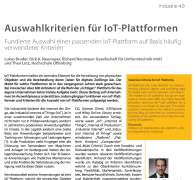
Selection Criteria for IoT Platforms

Selection Criteria for IoT Platforms

Fundierte Auswahl einer passenden IoT-Plattform auf Basis häufig verwendeter Kriterien
Lukas Bruder, Dirk A. Neumayer, Richard Neumayer, Theo Lutz ORCID Icon
IoT-Platforms are a key element for interconnecting physical objects and providing data for digital twins which represent such objects. The market for IoT platforms has grown massively in recent years. With now more than 600 providers, selecting the “right” platform for a company is no longer an easy task. This article supports companies in the selection process by providing an overview on common functionalities of IoT platforms and criteria for evaluating IoT platforms.
Industrie 4.0 Management | Volume 37 | 2021 | Edition 4 | Pages 55-58
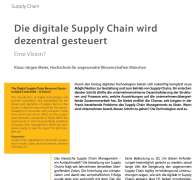
The Digital Supply Chain Becomes Decentralized Controlled

The Digital Supply Chain Becomes Decentralized Controlled

A Vision?
Klaus-Jürgen Meier
The introduction of digital technologies will provide completely new possibilities for the design and operation of supply chains in the future. A decisive step should be the decentralization of structures and processes inside firms which also shows effect on the cooperation between companies. It finally offers the opportunity to solve long-standing problems of supply chain management. When are companies ready to take this step? The technologies are.
Industrie 4.0 Management | Volume 37 | 2021 | Edition 2 | Pages 30-34
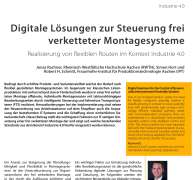
Digital Solutions for the Control of Dynamically interconnected Assembly Systems

Digital Solutions for the Control of Dynamically interconnected Assembly Systems

Realisierung von flexiblen Routen im Kontext Industrie 4.0
Jonas Rachner, Simon Hort, Robert Schmitt ORCID Icon
Due to an increased product variety, the need for flexibly configured assembly systems is steadily growing. In contrast to classic assembly lines with predominantly rigid conveyor technology, efficient, individual assembly routes with cycle-independent processing times are implemented in a dynamically interconnected assembly system using intelligent control and AGVs. This article presents the most important factors for the IT-related implementation of a dynamically interconnected assembly system and shows which existing standards from the field of Industry 4.0 can be used for this purpose.
Industrie 4.0 Management | Volume 36 | 2020 | Edition 6 | Pages 43-47
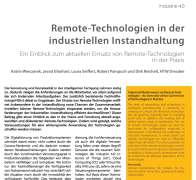
Industrial Maintenance via Remote Technologies

Industrial Maintenance via Remote Technologies

An Overview of the Current Use of Technologies in Practice
Katrin Wieczorek, Javad Ghofrani, Laura Seiffert, Robert Pampuch, Dirk Reichelt
The level of networking and complexity in intelligent manufacturing is constantly increasing. As a result, the demands on employees are growing, especially due to changing work tasks. In addition, the existing lack of skilled workers leads to bottlenecks. The use of remote technologies opens up new opportunities for collaboration, especially in maintenance. Considering the challenges of industrial maintenance, to what extent can remote technologies be used to efficiently meet these demands? This article provides an overview of the remote technologies currently used and discussed in practice and research. In addition, it shows which prerequisites must be created for an effective application of the technologies.
Industrie 4.0 Management | Volume 36 | 2020 | Edition 6 | Pages 59-64
1 2