artificial intelligence

Assistance for Simulation in Production and Logistics

Assistance for Simulation in Production and Logistics

A literature-based classification
Sigrid Wenzel ORCID Icon, Felix Özkul, Robin Sutherland ORCID Icon
Despite the commercial availability of simulation tools, using of discrete-event simulation for complex production and logistics systems is becoming increasingly challenging. It requires extensive expertise, high data quality, and considerable time and financial resources. For many years, therefore, there has been high demand for methodological and organizational support for the conduction of simulation studies. This article is based on an analysis of relevant publications and aims to classify previous research on improving the use of simulation. It also raises the question of the need for assistance in applying discrete event simulation and identifies areas for action.
Industry 4.0 Science | Volume 41 | 2025 | Edition 5 | Pages 66-76 | DOI 10.30844/I4SE.25.5.64
Human-Centered AI-Paired Work Systems

Human-Centered AI-Paired Work Systems

Integrating GenAI and the human factor in work system theory
Katharina Hölzle ORCID Icon, Udo-Ernst Haner
The work system is the key unit of analysis within the discipline of human factors/ergonomics (HFE); it is also considered a fundamental element for value creation within other domains. Its concept is based on sociotechnical systems theory and, within HFE, it conveys a distinctly human-centered perspective. So far, work system models have focused on one or several people working within a defined setting as the only (intelligent) actors within the system. The introduction of generative artificial intelligence (genAI) into work systems, particularly as an intelligent and autonomous actor (agent) with potentially specific social abilities and personality traits, calls for reconceptualization. This article elaborates on the new requirements related to the introduction of genAI and develops a human-centered AI-paired work system model that recognizes the significantly expanded capabilities of AI-enabled collaborative social robots.
Industry 4.0 Science | Volume 41 | 2025 | Edition 5 | Pages 38-48 | DOI 10.30844/I4SE.25.5.38
Data-Driven Assistance Systems in the Working Environment

Data-Driven Assistance Systems in the Working Environment

Efficient development of target group-specific BI dashboards in companies
Martin Schmauder ORCID Icon, Gritt Ott ORCID Icon, Martin Hahmann
Dashboards play a key role in informed business decisions. Based on findings from an action research process, this article shows how company-specific solutions can be systematically developed and bad investments avoided. The provision of IT capacities, securing data access, formulating requirements, and developing the data model prove to be particularly critical.
Industry 4.0 Science | Volume 41 | 2025 | Edition 5 | Pages 136-143 | DOI 10.30844/I4SE.25.5.130
AI-Supported Personnel Planning in Industrial Maintenance

AI-Supported Personnel Planning in Industrial Maintenance

User-centered development and implementation in a pilot project
Philipp Hein ORCID Icon, Katharina Simon ORCID Icon, Alexander Kögel, Angelika C. Bullinger-Hoffmann, Thomas Löffler
Personnel deployment planning in industrial maintenance is a complex challenge, as dispatchers often have to match incomplete customer requests with the appropriate employee skills. An AI-based assistance system can help by automatically analyzing relevant data and providing well-founded suggestions for employee selection. This article describes the user-centered development and introduction of such a system as part of a pilot project at a medium-sized service provider. The user-centered design ensures that dispatchers retain their autonomy. Involving employees from the outset creates acceptance and promotes a deeper understanding of the system’s advantages.
Industry 4.0 Science | Volume 41 | 2025 | Edition 5 | Pages 14-20 | DOI 10.30844/I4SE.25.5.14
Automation of Production Planning and Control

Automation of Production Planning and Control

A deep dive into production control with intelligent agents
Jonas Schneider, Peter Nyhuis ORCID Icon, Matthias Schmidt
How can artificial intelligence (AI) automate production planning and control? This study examines its potential to enhance efficiency in modern production environments. The focus is on establishing a robust data infrastructure that integrates real-time, historical, and contextual data to create a solid basis for AI models. Reinforcement learning (RL) is applied to aid automation. A roadmap for implementation, focusing on practical application, is presented. This roadmap incorporates simulation-based training methods and outlines strategies for continuous improvement and adaptation of production processes.
Industry 4.0 Science | Volume 41 | 2025 | Edition 5 | Pages 86-93 | DOI 10.30844/I4SE.25.5.84
I4S 4/2025: Smart Logistics

I4S 4/2025: Smart Logistics

Sustainable, resilient processes along the entire value chain
Logistics is entering a new era. Climate change and geopolitical uncertainties are shifting the focus to resilience and sustainability. The concept of smart logistics is gaining importance. But what exactly makes logistics smart, and how can it help us organize our societies and the economy? Approaches such as predictive analytics, demand analysis, and machine learning show why smart logistics is more than just a technological trend.
Field Meets Code

Field Meets Code

Artificial intelligence for better collaboration in software development
Andreas Groche, Dominik Augenstein
Software development is fundamental to digital transformation. A good foundation of data is required for developers to tailor software to the needs of the commissioning department. Unfortunately, the data models required for this are incomplete, often created unilaterally by the development department and not embedded in the business context. This makes it difficult for both developers and AI to find the right algorithms. The present approach increases understanding and exchange between the specialist and development departments and offers digital assistance with data modeling as a basis for software development. Furthermore, AI approaches can help to increase the quality and completeness of the data.
Industry 4.0 Science | Volume 41 | Edition 4 | Pages 104-110
Digital Twins Using Semantic Modeling and AI

Digital Twins Using Semantic Modeling and AI

Self-learning development and simulation of industrial production facilities
Wolfram Höpken ORCID Icon, Ralf Stetter ORCID Icon, Markus Pfeil ORCID Icon, Thomas Bayer ORCID Icon, Bernd Michelberger, Markus Till, Timo Schuchter, Alexander Lohr
The AI-driven, self-learning digital twin continuously adapts to real system behavior, ensuring an optimal representation of the production process. A comprehensive semantic model serves as the foundation for advanced artificial intelligence (AI) approaches. Insights derived from AI methods are integrated into this model, enhancing the interpretability and explainability of AI systems. Techniques from the field of eXplainable AI (XAI) facilitate the automated description of AI models and their findings, as well as the development of self-explanatory models.
Industry 4.0 Science | Volume 41 | Edition 2 | Pages 30-36
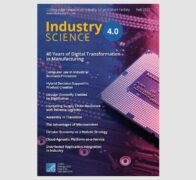
I4S 1/2025: 40 Years of Digital Transformation in Manufacturing

I4S 1/2025: 40 Years of Digital Transformation in Manufacturing

Key research questions for tomorrow's production and logistics
Digital transformation has been a central focus of scientific discussions for years. Questions relating to data-driven decisions, artificial intelligence and resilient supply chains are at the heart of current research. The articles in this issue explain key trends and present scientific findings and practical solutions - from automation and the circular economy to cloud computing.
Hybrid Decision Support in Product Creation

Hybrid Decision Support in Product Creation

Improving performance with data science and artificial intelligence
Iris Gräßler ORCID Icon, Jens Pottebaum ORCID Icon, Peter Nyhuis ORCID Icon, Rainer Stark ORCID Icon, Klaus-Dieter Thoben ORCID Icon, Petra Wiederkehr ORCID Icon
Technical systems are characterized by increasing interdisciplinarity, complexity and networking. A product and its corresponding production systems require interdisciplinary multi-objective optimization. Sustainability and recyclability demands increase said complexity. The efficiency of previously established engineering methods is reaching its limits, which can only be overcome by systematic integration of extreme data. The aim of "hybrid decision support" is as follows: Data science and artificial intelligence should be used to supplement human capabilities in conjunction with existing heuristics, methods, modeling and simulation to increase the efficiency of product creation.
Industry 4.0 Science | Volume 41 | Edition 1 | Pages 18-25 | DOI 10.30844/I4SE.25.1.18
1 2 3 5