Artificial intelligence

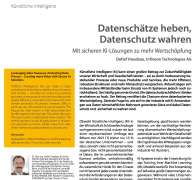
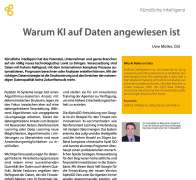
Leveraging Data Treasures, Protecting Data Privacy

Leveraging Data Treasures, Protecting Data Privacy

Adding value with secure AI solutions
Detlef Houdeau
Artificial Intelligence (AI) can make a major contribution to the future viability of our economy and society—whether by improving existing processes or new products and services that promise greater efficiency, more robust structures and more climate protection. At present, however, SMEs in particular are still reluctant to use AI systems. The frequently cited reason is that data protection hurdles appear to be too high. This article discusses the opportunities of data-based value creation. The central question is how AI applications in industry can generate economic added value from data while maintaining data protection and security.
Industrie 4.0 Management | Volume 39 | 2023 | Edition 3 | Pages 24-27
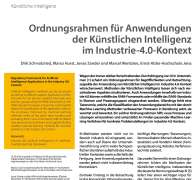
Regulatory Framework for Artificial Intelligence Applications in the Industry 4.0 Context

Regulatory Framework for Artificial Intelligence Applications in the Industry 4.0 Context

Dirk Schmalzried, Marco Hurst, Jonas Zander, Marcel Wentzien
Artificial Intelligence methods can be structured according to different aspects. Applications within Industrie 4.0 can also be classified into levels and process groups using the RAMI framework or the ISA95 standard. However, a taxonomy is lacking that relates the classification of the application areas to the processes improved by machine learning methods while at the same time locating and evaluating them. Such a framework helps to classify new processes and solutions and supports finding suitable machine learning methods for concrete problems in the Industry 4.0 context.
Industrie 4.0 Management | Volume 39 | 2023 | Edition 3 | Pages 28-33 | DOI 10.30844/IM_23-3_28-33
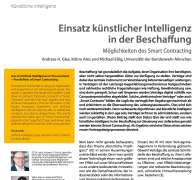
Use of Artificial Intelligence in Procurement

Use of Artificial Intelligence in Procurement

Possibilities of smart contracting
Andreas H. Glas, Kübra Ates, Michael Eßig
Procurement has the task to supply an organization with required but not self-produced goods. The goods vs. payment exchange with suppliers is laid down in contracts. “Electronic contracts" or “Smart Contracts” represent the logic digitally and thus enhance transparency. This can still evolve. In the future, improved algorithms and artificial intelligence will not only be able to administer contracts, but also to design them. This article presents the status quo of "Smart Contracting", places it in the "Legal Tech" topic and shows how artificial intelligence could be used in procurement.
Industrie 4.0 Management | Volume 39 | 2023 | Edition 1 | Pages 14-18
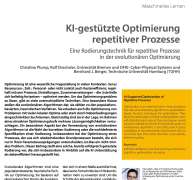
AI-Supported Optimization of Repetitive Processes

AI-Supported Optimization of Repetitive Processes

A coding technique for repetitive processes in evolutionary optimization
Christina Plump, Rolf Drechsler, Bernhard J. Berger
Optimisation is an essential task in many situations. The class of evolutionary algorithms is a population-based, heuristic technique for optimisation. They allow the optimisation of multi-modal problems even with distorted search spaces. They can propose several solutions instead of just one. An important aspect of evolutionary algorithms is encoding search space candidates. In the optimisation of processes, this is a non-trivial task. This article describes a successfully tested encoding.
Industrie 4.0 Management | Volume 39 | 2023 | Edition 1 | Pages 19-22
Methods for Designing Enterprise Architecture in Manufacturing Companies

Methods for Designing Enterprise Architecture in Manufacturing Companies

EAM as enabler for the design of transferable AI solutions
Arno Kühn, Arthur Wegel ORCID Icon, Jonas Cieply ORCID Icon
A study by the German Academy of Science and Engineering (acatech) indicates that artificial intelligence (AI) is of growing importance for the success of manufacturing companies [1]. The emerging, data-driven solutions in the manufacturing field are highly diverse, both in terms of the processes and the locations (different factories, factory sub-areas, etc.) where these solutions are implemented. Often the solutions are also hardly scaled beyond the limits defined in the pilot project. When such an AI project ends, the goals of a use case are fulfilled, but this often results in another isolated solution being added to the company’s established IT system landscape. The data this solution delivers is not further used, and complex maintenance requirements negate any gains in efficiency.
Industrie 4.0 Management | Volume 39 | 2023 | Edition 1 | Pages 37-42 | DOI 10.30844/I4SE.23.1.106
Why AI Relies on Data

Why AI Relies on Data

Uwe Müller
Artificial intelligence has the potential to bring companies and entire industries to a completely new technological level. The prerequisite is data with a high degree of maturity, with which companies can automate complex processes, calculate forecasts or create analyses. With the right data strategy, structuring and achieving the necessary data quality are no longer dreams of the future.
Industrie 4.0 Management | Volume 39 | 2023 | Edition 1 | Pages 63-66
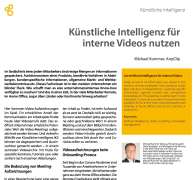
Use Artificial Intelligence for Internal Videos

Use Artificial Intelligence for Internal Videos

Michael Kummer
Huge amounts of information are stored in the memory of every employee. How a product works, best practices in departments, customer-specific information, general market and competitive knowledge, etc. This expertise is a blind spot in most companies. So how do you make in-house know-how available? And in a time when many employees work remotely, in home offices, even across countries or continents?
Industrie 4.0 Management | Volume 38 | 2022 | Edition 5 | Pages 61-63
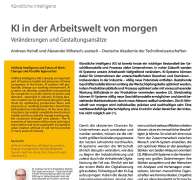
Artificial Intelligence and Future of Work

Artificial Intelligence and Future of Work

Changes and Possible Approaches
Andreas Heindl, Alexander Mihatsch
Artificial intelligence (AI) is already an important part of business models and processes of many companies. In the future, AI systems will pro- foundly change our working environment. AI systems can develop completely new potential for companies in a wide variety of sectors and domains - especially in industry. Existing busi- ness models can be optimized along the value chain by optimizing production flows and processes or avoiding production downtimes with predictive maintenance. At the same time, AI systems can enable completely new business models and thus radically change existing mar- ket structures through new players. The AI economy of tomorrow will be more individual, more precise and more sustainable: Competitive value creation without AI will not be possible in many areas of industry.
Industrie 4.0 Management | Volume 38 | 2022 | Edition 4 | Pages 10-14
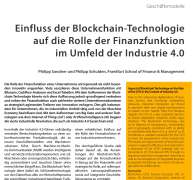
Impact of Blockchain Technology on the Role of the CFO in the Context of Industry 4.0

Impact of Blockchain Technology on the Role of the CFO in the Context of Industry 4.0

Philipp Sandner, Philipp Schulden
Due to the advancing digitalization of business sectors and increasing competitive pressures, industrial companies are forced to promote their own digital transformation to sustain on the market. Here, the literature regards the CFO as a key corporate function to induct digitization initiatives within organizations. The blockchain technology, due to its features of transparency, immutability and cryptography combined with its ability to coordinate data flows of e. g. the IoT or AI, constitutes a suitable instrument for the CFO to meet the requirements of the Industry 4.0. The results are improvements of business processes in regard to efficiency and automation, a relocation of the CFO’s strategic role, improvements of CFO-relevant KPIs through integrating machines into payment networks as well as the emergence of integrated business ecosystems facilitating new forms of inter-organizational collaboration.
Industrie 4.0 Management | Volume 36 | 2020 | Edition 1 | Pages 61-64
Edge Computing from the Perspective of Artificial Intelligence

Edge Computing from the Perspective of Artificial Intelligence

Dirk Hecker, Michael Mock, Joachim Sicking, Angi Voss, Tim Wirtz
Machine learning is the key technology of almost every instance of modern Artificial Intelligence. Enormous datasets are produced in digitized industrial processes and in the Internet of Things, which can well be exploited by learning in deep artificial neural networks. Standard machine learning algorithms require these datasets to be centralized before learning a model. Several good reasons - ranging from data privacy over latency to economic efficiency - favor learning at the edge so that reasoning is fast and no local data is transferred. The article shows how decentralized learning works and how to evaluate it. Moreover, we point to special resource-efficient learning algorithms and discuss small remaining risks of data reconstruction.
Industrie 4.0 Management | Volume 34 | 2018 | Edition 6 | Pages 13-16
1 2