AI

Hybrid Decision Support in Product Creation

Hybrid Decision Support in Product Creation

Improving performance with data science and artificial intelligence
Iris Gräßler ORCID Icon, Jens Pottebaum ORCID Icon, Peter Nyhuis ORCID Icon, Rainer Stark ORCID Icon, Klaus-Dieter Thoben ORCID Icon, Petra Wiederkehr ORCID Icon
Technical systems are characterized by increasing interdisciplinarity, complexity and networking. A product and its corresponding production systems require interdisciplinary multi-objective optimization. Sustainability and recyclability demands increase said complexity. The efficiency of previously established engineering methods is reaching its limits, which can only be overcome by systematic integration of extreme data. The aim of "hybrid decision support" is as follows: Data science and artificial intelligence should be used to supplement human capabilities in conjunction with existing heuristics, methods, modeling and simulation to increase the efficiency of product creation.
Industry 4.0 Science | Volume 41 | Edition 1 | Pages 18-25 | DOI 10.30844/I4SE.25.1.18
Can Artificial Intelligence (AI) Act as an Enabler for Industry 4.0 (4IR)?

Can Artificial Intelligence (AI) Act as an Enabler for Industry 4.0 (4IR)?

Impacts on the maturity level of Industry 4.0 technologies
Dennis Richter, Mildred Doe, Steffen Kinkel ORCID Icon
Artificial intelligence is often mentioned often mentioned in the same context as Industry 4.0, but the exact role of AI is unclear. Is AI just another 4IR technology or an essential "enabler" for other 4IR technologies? Six experts assess the impact of AI on 41 4IR technologies. AI could indeed be a decisive factor in unleashing the full potential of Industry 4.0.
Industry 4.0 Science | Volume 40 | 2024 | Edition 6 | Pages 80-87 | DOI 10.30844/I4SE.24.6.80
Intelligent Shopfloor Assistants

Intelligent Shopfloor Assistants

Increasing productivity through the use of generative AI
Eckart Uhlmann ORCID Icon, Julian Polte ORCID Icon, Christopher Mühlich ORCID Icon, Yassin Elsir
In modern production companies, a heterogeneous IT landscape often complicates day-to-day work. A promising antidote is the use of intelligent agents, which use generative AI for routine tasks and can therefore increase efficiency. Whether these intelligent systems can be successfully integrated into existing networks determines whether the flow of information can be improved and manual effort reduced.
Industry 4.0 Science | Volume 40 | 2024 | Edition 6 | Pages 64-71
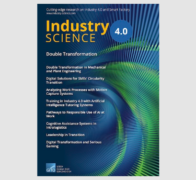
I4S 5/2024: Double Transformation

I4S 5/2024: Double Transformation

Integrating digital and ecological change in the world of work
Change is necessary for companies to maintain their competitive edge—both digital and ecological change. But while external support is at hand, the drive for change must come from companies themselves. In this issue of Industry 4.0 Science, experts of the Academic Society for Work and Industrial Organization discuss how the real-world application of innovative technologies lead to resource-efficient manufacturing.
ReThink! Smart Manufacturing 2024
Start 23.06.2024 - End 25.06.2024

ReThink! Smart Manufacturing 2024

Rethink! Smart Manufacturing helps leaders in the manufacturing industry to optimize, strengthen and redesign their businesses. At ReThink! Smart Manufacturing 2024, which will take place from June 23-25 in Berlin, visitors can discuss with up to 150 executives how the latest trends and technologies in smart manufacturing, such as factory automation, AI and robotics, are impacting every aspect of business. Take part in the event and secure your ticket today!
Warehouse Inventory Detection with Airship Drones

Warehouse Inventory Detection with Airship Drones

(Semi-)autonomous aircraft for inventory and quality inspection of pallets in block storage facilities
Dmitrij Boger, Michael Freitag ORCID Icon, Britta Hilt, Michael Lütjen ORCID Icon, Benjamin Staar ORCID Icon
The complex dynamics of block warehouses pose major challenges to the manual stocktaking process. Frequent relocation of pallets, crates or pallet cages without fixed storage locations leads to a time-consuming and error-prone inventory process, wherein goods often have to be searched for and damages due to improper storage can occur. The use of (semi-)autonomous drones offers a promising solution to enable automated stocktaking, especially if these are appropriately equipped for optical goods detection.
Industry 4.0 Science | Volume 40 | 2024 | Edition 2 | Pages 56-63
Sustainable Food Supply Chains through Artificial Intelligence

Sustainable Food Supply Chains through Artificial Intelligence

A conceptual visualization to promote animal welfare and food quality
Corinna Köters ORCID Icon, Maik Schürmeyer, Alexander Prange ORCID Icon
For the transition to a sustainable economy to succeed in its entirety, logistics must be considered in addition to raw materials and manufactu­ring. Artificial intelligence will play a central role in improving the exchan­ge of data between the individual links in the supply chain and in regula­ting processes and costs at the various stages of production. The meat industry, with its hygienic and increasing ethical requirements for animal welfare, is set to greatly benefit from the digital revolution.
Industry 4.0 Science | Volume 40 | 2024 | Edition 1 | Pages 70-75 | DOI 10.30844/I4SE.24.1.70
Cost-efficient Digitization of Refrigerating Appliances Recycling

Cost-efficient Digitization of Refrigerating Appliances Recycling

Digital twins and the path to a sustainable future
Christian Thiehoff, Georgii Emelianov ORCID Icon, Jochen Deuse ORCID Icon, Jochen Schiemann, Mikhail Polikarpov ORCID Icon
Correctly recycling obsolete refrigeration devices plays an important role in environmental and climate protection efforts. Recycling plants are subject to regular audits to ensure their compliance with strict environmental regulations. However, the collection of audit-related data is a challenging and time-consuming task, as it is usually done manually and is prone to errors. One solution for more sustainable and efficient monitoring is to automate digital data collection using sensors and artificial intelligence. This enables a direct estimate of the expected level of pollutants. This paves the way for continuous performance monitoring and efficient management of refrigeration appliance recycling plants.
Industry 4.0 Science | Volume 40 | 2024 | Edition 1 | Pages 76-82
Determining Sustainable Application System Architectures

Determining Sustainable Application System Architectures

EAM as enabler for the design of transferable AI solutions
André Ullrich ORCID Icon, Norbert Gronau ORCID Icon
The need to sometimes respond very quickly to changes requires companies to have a high degree of flexibility and speed of reaction. Application system architectures, which usually consist of old and self-developed systems, often do not allow companies to meet these requirements. However, investment funds for new software are limited, so priorities must be set when it comes to replacing legacy systems. An adaptability analysis is an efficient analysis method for planning the renewal of the application system landscape. This article describes the procedure and results of an adaptability analysis, using the example of an internationally active automotive supplier.
Industry 4.0 Science | Volume 39 | 2023 | Edition 1 | Pages 46-52 | DOI 10.30844/I4SE.23.1.46
Integration of Artificial Intelligence into Factory Control

Integration of Artificial Intelligence into Factory Control

Norbert Gronau ORCID Icon
With the increasing availability of IoT devices and significantly greater incorporation of Internet-enabled technologies into manufacturing processes, the idea of improving factory control through the use of artificial intelligence (AI) is also coming to the fore. Using the example of high-variation series manufacturing, this article describes which steps need to be taken to improve factory control with AI.
Industry 4.0 Science | Volume 39 | 2023 | Edition 1 | Pages 95-99 | DOI 10.30844/I4SE.23.1.95
1 2 3