Product Piracy

Anti-Counterfeiting as a Process

Anti-Counterfeiting as a Process

Hans Joachim Fuchs, Zhuomin Wu
It is not possible to eliminate counterfeiting sustainably only by single and short-term measures. Particularly isolated legal measures fail because they have only late and short-term effects. An effective and sustainable anti-counterfeiting requires a process-oriented approach as well as an integrated protection system that combines legal, organizational, technological and political processes. To manage such an integrated system, a company has to implement a process oriented organization as well as a monitoring system.
Industrie Management | Volume 24 | 2008 | Edition 6 | Pages 19-22
Leveraging Anti-Counterfeiting

Leveraging Anti-Counterfeiting

Optimized counter-measures to protect machine tools, components and spare parts
Eberhard Abele, Philipp Kuske, Sven Kuhn
Product piracy has risen to a serious problem for almost every OEM in the capital goods industry. Identifying the right counter-measures for creating and optimizing a holistic anti-counterfeiting-strategy helps to cope with these challenges. One of the most critical factors in developing such a strategy is establishing a cost/benefit ratio. A three-level selection concept helps choosing the right measures.
Industrie Management | Volume 24 | 2008 | Edition 6 | Pages 47-50
An Integrated Active Approach against Product Piracy

An Integrated Active Approach against Product Piracy

Horst Meier, Oliver Völker, Sebastian M. Binner
The German mechanical Engineering and plant construction industry has high potential risk for product piracy. The growing globalization leads to very complex and often non existing possibilities of law enforcements. Thus corporate demands are emerging for new strategies and methods against product piracy. This paper describes a concept for copy protection out of a systematic combination from an early technological implementation of controlled inter- and intraorganizational Know-how and sig-nal flows. Therefore operational and organizational aspects are reducing the risk of being copied. The described approach is not limited to the own company instead it will reconsider the whole value chain for a complete copy protection.
Industrie Management | Volume 24 | 2008 | Edition 6 | Pages 11-14
Counterfeiting protection of spare parts

Counterfeiting protection of spare parts

Ein ganzheitlicher Ansatz für die Investitionsgüterindustrie
Jan C. Aurich, Christian Bohr, Jan-Niko Kranz
Nowadays, product piracy is a challenge which should not be neglected by the capital goods industry. Especially, the high margin turnovers in the spare part business are threatened by the increasing number of counterfeited products. First of all, this article gives a definition of product piracy and points out some spare part specific examples affecting different juridical disciplines. After that the framework for a concept against product piracy, including the whole supply chain and product life cycle, is introduced. Within this concept the four modules Piracy-Information-System, Piracy-Evaluation-Model, Protective-Measures-Pool and Organisational-Network are implemented.
Industrie Management | Volume 24 | 2008 | Edition 6 | Pages 39-42
Procedure for Designing a Concept for Protection against Product Piracy

Procedure for Designing a Concept for Protection against Product Piracy

Thomas Meiwald, Markus Petermann, Udo Lindemann
The increasing number of copied products of increasing complexity as well as their increasing quality is presenting a challenging task to German industry. It is important to protect the own company of unwanted loss of know-how with appropriate input of resources. To solve this task, a number of possible measures exist. Their origin reaches from juridical measures like patents and brands and technological measures like labelling through holograms or similar items to organizational and strategic counter measures. The following paper presents a scientific approach to designing individual and comprehensive concepts for protection against unwanted loss of know-how and product piracy. The approach is evaluated in industry and includes necessary methods.
Industrie Management | Volume 24 | 2008 | Edition 6 | Pages 43-46
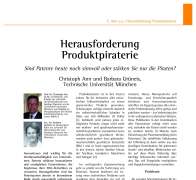
Product Piracy – Does it still make sense to file a patent application?

Product Piracy - Does it still make sense to file a patent application?

Sind Patente heute noch sinnvoll oder stärken Sie nur die Piraten?
Christoph Ann, Barbara Grüneis
Innovation is important for the competitiveness of an enterprise. Patents protect innovations and enable companies to exploit the fruits of their R&D. This article focuses on the effects of product piracy upon our Western patent system. It shows that in the future there will be only two alternatives for the strategic IP-management in sectors exposed to piracy threats: to patent the inventions in all relevant markets or to maintain them as trade secrets. This paper highlights the parameters as well as results.
Industrie Management | Volume 24 | 2008 | Edition 6 | Pages 59-62
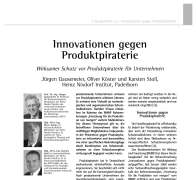
Innovations against counterfeiting

Innovations against counterfeiting

Effective protection against counterfeiting for producing companies
Jürgen Gausemeier, Oliver Köster, Karsten Stoll
Capital goods industry is imperilled by counterfeiting more than ever. Legal services are the preferred measure of companies facing this challenge. This article shows further possibilities how producing companies can protect themselves effectively against counterfeiting. There are many technological and organisational measures already available. Furthermore, innovative measures are being developed at the very moment. Considering this background it is necessary to inform affected companies about the manifold possibilities of preventing counterfeiting. Moreover it is essential to depict how a specific threat can be faced by combining stand alone measures to customised safety concepts.
Industrie Management | Volume 24 | 2008 | Edition 6 | Pages 51-54
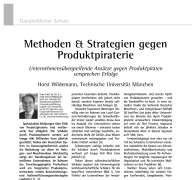
Methods & Strategies to Fight Counterfeiting

Methods & Strategies to Fight Counterfeiting

Unternehmensübergreifende Ansätze gegen Produktpiraten versprechen Erfolge
Horst Wildemann
Globalization of world trade leads to an increased scope and scale of product counterfeiting. More companies and industries are affected. Counterfeiters get more and more professional. German companies have to protect themselves better. Legal measures are not enough - comprehensive strategies that combine legal, management and technical measures are necessary to fight counterfeiting. The research project ProAuthent is focused on authentication and labelling technologies as one important step towards a integrated protection against counterfeiting.
Industrie Management | Volume 24 | 2008 | Edition 6 | Pages 28-30
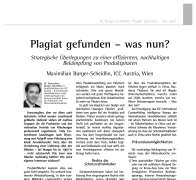
Counterfeit found – what now?

Counterfeit found - what now?

Strategische Überlegungen zu einer effizienten, nachhaltigen Bekämpfung von Produktpiraten
Maximilian Burger-Scheidlin
Consumergoods but also technical products, pharmaceuticals etc. are increasingly counterfeid. Production and global sales are often controlled by organised crime. The local confiscation of counterfeits does not impress the fraudsters. Effective countermeasures must include the closure of their production facilities.
Industrie Management | Volume 24 | 2008 | Edition 6 | Pages 63-65
Intention Recognition in Depots with Automated Guided Vehicles

Intention Recognition in Depots with Automated Guided Vehicles

Tjorben Bogon, Andreas D. Lattner, René Schumann, Ingo J. Timm
Whenever automated guided vehicles (AGVs) and humans work in a common environment, dangerous situations can emerge, especially if the human workers do not know or do not pay attention to the current activities of the automated vehicles. A complete emergency stop in all situations where a worker could interfere with a vehicles plan would not be a good solution due to the associated costs. In this article, we propose an approach which is based on a qualitative scene representation created from sensory input. By detecting actions in the scene, hypotheses about possible plans are generated. Taking into account possible future actions of workers, a risk assessment is performed. The behavior of an automated vehicle has to be changed only in those situations that exceed a certain risk threshold.
Industrie Management | Volume 24 | 2008 | Edition 4 | Pages 49-52
1 2 3