Energy Efficiency

Predictive Energy Flow Control of Supply Systems

Predictive Energy Flow Control of Supply Systems

An Optimization Approach for Connected, Industrial Supply Systems Considering Dynamic Energy Markets
Niklas Panten, Eberhard Abele
Considering the background of the Energiewende challenges like energy efficiency and flexibility become more important for the industrial production. A smart building automation system is able to decrease energy costs and improve the performance of supply systems. Model-based predictive control (MPC) is a suitable approach to optimize complex energetic systems as presented in the ETA model factory at Technical University of Darmstadt.
Industrie 4.0 Management | Volume 33 | 2017 | Edition 1 | Pages 19-23
Resource Efficiency within Production

Resource Efficiency within Production

Verbesserung der Ressourceneffizienz durch transparenten Verbrauch von Material und Energie
Sarah Majid Ansari, Serjosha Wulf
Ecological sustainability in production does not only cause a positive contribution to environmentalism, but also leads to a longterm improvement of the companies’ competitiveness. Due to a lack of transparency, many companies face difficulties rating their own resource efficiency. This article deals with the introduction of a ratio system, which allows companies to evaluate the efficiency concerning their usage of resources. This enables companies to enhance their consumption transparency. Besides, this article discusses the challenges of using ratio systems and the comparison of ratios in general.
Industrie Management | Volume 31 | 2015 | Edition 4 | Pages 12-16
Energy Costs and Energy Management

Energy Costs and Energy Management

A Study on the Importance of Energy in Manufacturing Companies
Tobias Rackow, Tallal Javied, Jörg Franke, Sebastian Schießl, Peter Schuderer
Energy management systems provide a framework for the transparent display of energy consumptions, aiming for an increase of energy efficiency. At the same time, a certified energy management system is condition for the reimbursement of electricity taxes and the exemption of the EEG (Renewables Energy ACT) apportionment. Even though energy management systems lead evidently to a reduction of energy consumptions, only little companies have implemented such a system. The study presented in this paper gives an insight into the status of the cost factor energy and respective management systems in German SMEs (manufacturing industry). Moreover, the main pillars of energy management systems and their benefits are outlined.
Industrie Management | Volume 31 | 2015 | Edition 3 | Pages 49-52
Material and Energy Efficient Production

Material and Energy Efficient Production

Requirements for a modern work organization
Serjosha Wulf, Sarah Majid Ansari
The potentials of a resource efficient production become the focal point of interest of production companies. Necessary for a permanent change are qualified and motivated employees. This article describes the requirements for the change such as a fundamental shift in values and a position specific qualification. Furthermore, relevant steps for establishing an efficient working organisation are presented.
Industrie Management | Volume 31 | 2015 | Edition 3 | Pages 61-64
Intelligent Investments with View on Total Operating Costs

Intelligent Investments with View on Total Operating Costs

Kai-Otto Landwehr
When investing into new technological equipment, decision-makers have to take into account a lot more than just the purchasing price. Forward-looking enterprises consider all the costs that are generated over the course of the life span of machines. Two factors play an increasingly important role in this context: Firstly, energy efficiency, as it can help reduce the total cost of ownership (TCO). Liquidity on the other hand is essential for a firm’s further growth and competitiveness. With the right financing methods, these two preconditions for budget-friendly investments can be ensured.
Industrie Management | Volume 30 | 2014 | Edition 2 | Pages 49-52
Energy-Oriented Management with Energy Management Systems?

Energy-Oriented Management with Energy Management Systems?

Welche Handlungsfelder eines ganzheitlichen Managements decken EMS ab?
Alexander Sauer
Energy management systems (EMS) experience an increase in popularity since their introduction. Especially as their introduction allows for tax capping. However, an integrated approach on energy-orintation requires more than the realisation of an EMS. The article illustrates spheres of activity that can be taken to enhance the approach of energy management systems towards a holistic energy-orientation.
Industrie Management | Volume 29 | 2013 | Edition 5 | Pages 53-57
Energy Value Stream Mapping as a Tool of the Digital Factory

Energy Value Stream Mapping as a Tool of the Digital Factory

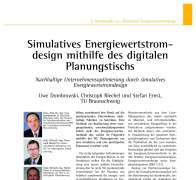
Sustainable Optimization with Simulative Energy Value Stream Mapping
Uwe Dombrowski, Christoph Riechel, Stefan Ernst
Rising energy costs, the changing political context as well as growing customer requirements are increasing the pressure on manufacturing companies to run sustainable factories. A method to realize an energy efficient factory is the Energy Value Stream Mapping. This paper shows an approach which adds a simulative and participative dimension to the method by using the IFU planning table.
Industrie Management | Volume 28 | 2012 | Edition 6 | Pages 55-58
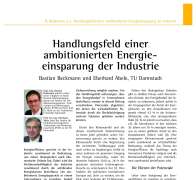
Fields of Action of an Ambitious Energy Saving in Industry

Fields of Action of an Ambitious Energy Saving in Industry

Bastian Beckmann, Eberhard Abele
Energy efficiency is becoming increasingly important in industry, which has not only ecological but also economic reasons. Thereby, the competitiveness of the industry is increasingly influenced by the incurred energy costs. In order to achieve ambitious targets of energy saving in a company, existing potentials must be consistently exploited. Furthermore it is not enough to focus solely on technical measures. Instead, more factors must be considered which make it possible to achieve these ambitious goals. To identify areas where energy demand is affected in the economy in this article various potentials are derived in order to achieve the economic potential by taking other factors into account.
Industrie Management | Volume 28 | 2012 | Edition 5 | Pages 53-56
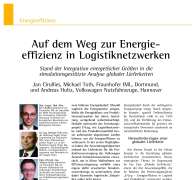
On the Way to Energy Efficiency in Logistics Networks

On the Way to Energy Efficiency in Logistics Networks

State of the Integration of Energy-Related Objectives into the Simulation-Based Analysis
Jan Cirullies, Michael Toth, Andreas Holtz
Globalization and the growing number of supply chain participants lead to increasing cargo transport service and, thus, to higher energy demand. Although energy prices increase at the same time, the energy balance of production networks remains unconsidered during in the network design phase. Hence, the research project E²Log analyzes how logistics networks and production environment can be coordinated in order to improve energy efficiency. In the first project phase, based on the supply chain for the production of the Volkswagen Amarok, the use case partners have derived simulation scenarios and enhanced a simulation tool to evaluate measures for the efficiency increase without ignoring classic logistic objectives soon.
Industrie Management | Volume 28 | 2012 | Edition 5 | Pages 20-24
Energy Efficiency as Decision Criterion for the Purchase of Machine Tools

Energy Efficiency as Decision Criterion for the Purchase of Machine Tools

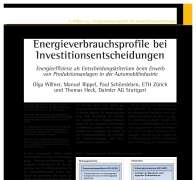
Energieeffizienz als Entscheidungskriterium beim Erwerb von Produktionsanlagen in der Automobilindustrie
Olga Willner, Manuel Rippel, Paul Schönsleben, Thomas Heck
Over the last two decades, themes such as resource scarcity, environmental pollution and rising commodity prices have gained increasing importance in the design of automotive industry production processes. As a result, the pressure on car manufacturers to plan their production facilities according to energy efficiency criteria is constantly rising. At present, machine tool suppliers still provide insufficient data to support purchasing decisions based on energy efficiency aspects. A case study conducted with Daimler AG explores a car manufacturer’s specific information requirements with respect to energy efficiency. Furthermore, an approach for the integration of energy data in the product data sheets of machine tool suppliers is presented.
Industrie Management | Volume 28 | 2012 | Edition 5 | Pages 33-36
1 2 3 4