Manufacturing Systems

The Hard Disk of the Day After Tomorrow

The Hard Disk of the Day After Tomorrow

Heiko Fuchs, Roland Wiesendanger
The development of faster and more powerful computers has led to virtual flood of digital data. Over the decades capacity of data storage devices has continued to multiply. At the same time the dimensions of these digital silos have even become smaller. Year after year better devices and finer write-read-heads are developed. The magnetic bit domains became smaller and smaller. Until one day - they are no bigger than an atom. By using spin-polarized scanning tunnelling microscopy - a method of nanotechnology - it is possible today to determine the individual magnetic orientation of single atoms on surfaces, which means to read magnetic information atom by atom. If the same instrument could be used to write magnetic information in adjacent atoms, it would be possible to store the entire world literature on a space of a postage stamp. This is in the focus of research at the University of Hamburg.
Industrie Management | Volume 21 | 2005 | Edition 6 | Pages 17-20
Development of a High-Dynamic Double Axis Micro Forming Press

Development of a High-Dynamic Double Axis Micro Forming Press

Hendrik Schulze Niehoff, Frank Vollertsen
Micro-forming presses are barely to find at the market, especially if it comes apart from high precision and high dynamic to free stroke and force control. The Bremer Institut für angewandte Strahltechnik has developed and built such a press, which is additionally featured with double axis, high stroke and air bearings for high precision force measurement and control.
Industrie Management | Volume 21 | 2005 | Edition 6 | Pages 45-48
Functional Micro Parts via Micro Metal Injection Molding

Functional Micro Parts via Micro Metal Injection Molding

Astrid Rota
By Micro Metal Injection Molding (Micro MIM) the manufacturing of miniature parts and parts with microstructured surfaces out of nearly all metallic materials is possible. Single injected parts with dimensions of 300 µm and microsturctured surfaces with details in the range of 20 µm could be achieved. Targeted material selection and process control allow the production of parts consisting of different materials without additional joining techniques. Functionality of parts can be increased by structural properties as micro channels for fluidic applications. On the other hand special material properties as the use of magnetic, bio-active or corrosion resistant materials contribute to further functionalisation. Regarding the trend to smaller components and devices micro MIM offers a cost-effective production technology for the necessary parts.
Industrie Management | Volume 21 | 2005 | Edition 6 | Pages 53-56
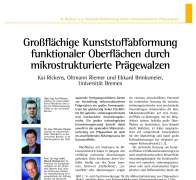
Molding of Large-Area Plastic Films

Molding of Large-Area Plastic Films

Improving functional surfaces with microstructured embossing rollers
Kai Rickens, Oltmann Riemer, Ekkard Brinksmeier
The microstructuring of embossing rollers offers an economic and productive production tool for molding of large-area plastic films with functional and optical properties. Due to ultraprecision diamond machining processes a wide spectrum of microstructures in combination with a high manufacturing flexibility can be produced for optical, fluidic and mechanical applications. Both, the microstructuring of embossing rollers by ultraprecision diamond machining as well as the following molding process of plastic films exhibit a high potential for innovative applications in industrial and consumer products.
Industrie Management | Volume 21 | 2005 | Edition 6 | Pages 37-40
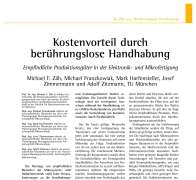
Cost Reduction by Contactless Handling

Cost Reduction by Contactless Handling

Empfindliche Produktionsgüter in der Elektronik- und Mikrofertigung
Michael F. Zäh, Michael Franzkowiak, Mark Harfensteller, Josef Zimmermann, Adolf Zitzmann
The assembly of fragile microsystem or semiconductor components poses a challenge on handling technologies as damage by gripping forces must be avoided. Non-contact handling solutions are being developed at the Institute for Machine Tools and Industrial Management that facilitate a gentle gripping of sensitive dies and highly thinned wafers using fluid dynamic effects. The advantages of this technology are reduced damages during handling, a higher yield per wafer as well as a reduction of particle contamination.
Industrie Management | Volume 21 | 2005 | Edition 6 | Pages 29.32
Augmented Reality in the Field of Automobile Advance Development

Augmented Reality in the Field of Automobile Advance Development

Horst Oehlschlaeger, Jens Krebs, Michael Grafe, Rafael Radkowski
In many applications Virtual Prototyping allows for an analysis based on computer models reducing time and cost. The Augmented Reality technology offers new potentials for virtual prototyping by augmenting a user’s view on real objects with additional computer generated information. In analogy to hardware in the loop techniques it is possible, e.g., to jointly analyse already existing and virtual components of a system currently under development. In this paper we describe the application and potential benefits of AR-technologies. As an example we present a mobile test platform for the analysis and evaluation of automotive ergonomics under real driving condi-tions in the field of automobile advance development.
Industrie Management | Volume 21 | 2005 | Edition 2 | Pages 31-34
Holistic Production Systems for Learning Enterprises

Holistic Production Systems for Learning Enterprises

An organizational-methodical knowledge pool
Stephan Keßler, Giourai Housein
The ideas of lean production for rationalization of the value-added processes, which were intensely discussed during the nineties of the last century, presently undergo a revival. In the course of this development the concept of Holistic Production Systems is praised by industry and science as an effective instrument for realizing a production focussing on added value and eliminating wastefulness. Because of this fact this article deals in-depth with the basics of setup and introduction of Holistic Production Systems. Furthermore the benefit of this concept for learning enterprises will be assessed.
Industrie Management | Volume 21 | 2005 | Edition 1 | Pages 37-40
Advanced Pore Morphology (APM)

Advanced Pore Morphology (APM)

einfach anwendbar, reproduzierbar, flexibel, kostengünstig
Matthias Busse, Karsten Stöbener
The material “metal foam” shows a unique combination of properties such as low density, excellent energy absorption, improved attenuation of sound and vibration etc., which provides an ideal basis for light-weight construction. Metal foams are mainly employed as a light-weight component of hybrid structures with other materials. Metal foam parts can directly be produced in the desired near net shape. But for their production individual process management as well as specific equipment and tools are required. The Advanced Pore Morphology (APM) Technology has been developed for reduced effort and complexity production of metal foam containing hybrid structures. The foam expansions process has been separated from foam part shaping. The APM-process can be completely automated and provides a high flexibility, reproducibility, and robustness. As a result the material costs are significantly reduced.
Industrie Management | Volume 20 | 2004 | Edition 6 | Pages 39-42
Machining of Ultra-Precise Micro Structures for Optical Molds

Machining of Ultra-Precise Micro Structures for Optical Molds

Oltmann Riemer, Ralf Gläbe, Ekkard Brinksmeier
In modern industry optical technologies stand for a leading innovative power influencing all sectors of economy and, thus, representing important factors within economic competition of coming markets. Regarding the manufacture of complex consumer optics the development of reasonable and flexible mass production processes is one of the dominant priority actions and ultra-precision machining technologies play a key role within this challenging task.
Industrie Management | Volume 20 | 2004 | Edition 6 | Pages 36-38
Incremental Sheet Forming with CNC-Machines

Incremental Sheet Forming with CNC-Machines

Eine wirtschaftliche Alternative für die flexible Herstellung von Prototypen und Kleinserien
Gerhard Hirt, Jochen Ames
Incremental sheet forming is a new approach, which offers high flexibility and economic advantages for low number manufacturing of complex sheet metal parts. The forming of the sheet metal is effected by the CNC-controlled movement of a universal, ball-headed punch in combination with a simplified die as a support under the sheet. This enables quick and cost effective adaptation to changes of the product geometry. The process itself can be carried out on any conventional 3-axis milling machine which is refitted with a clamping device for the metal sheet.
Industrie Management | Volume 20 | 2004 | Edition 6 | Pages 15-18
1 20 21 22 23