Manufacturing Systems

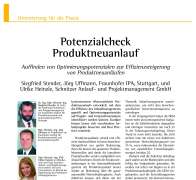
Potential Analysis of Product Ramp-Up

Potential Analysis of Product Ramp-Up

Siegfried Stender, Jörg Uffmann, Ulrike Heinzle
Today, an efficient product ramp-up is a precondition of the success of a company. The ramp-up management provides the coordination and management of the ramp-up process. The Fraunhofer Institute for Manufacturing Engineering and Automation and the company Schnitzer Anlauf- und Projektmanagement GmbH has developed a tool for analysing the product ramp-up process in order to achieve potentials for optimization. Ramp-up projects can be evaluated and best practices can be identified.
Industrie Management | Volume 20 | 2004 | Edition 4 | Pages 38-40
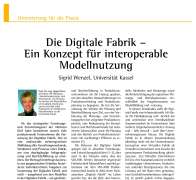
The Digital Factory – An Approach for Interoperable Model Utilization

The Digital Factory - An Approach for Interoperable Model Utilization

Sigrid Wenzel ORCID Icon
Currently the realisation of the Digital Factory as the strategic goal for the next five years has been identified by many manufacturing enterprises. To achieve an integrated system planning and operation, the work is aimed at a comprehensive computer-based modelling of all design characteristics, structures and processes of a factory. This article scrutinises the technique-centred process for the realisation of the Digital Factory, which is currently favoured due to pragmatic reasons, and presents - based on the models in the Digital Factory - a comprehensive integration concept. To ensure the users’ acceptance, a user-oriented process considering enterprise-organisational requirements is preferred.
Industrie Management | Volume 20 | 2004 | Edition 3 | Pages 54-58
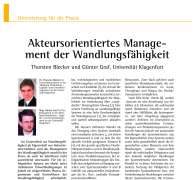
Management of Changeability from an Actor-oriented Perspective

Management of Changeability from an Actor-oriented Perspective

Thorsten Blecker, Günter Graf
Changeability has become a buzzword for operations management, especially in German literature. Management of changeability, in contrast, has not yet been considered in practice or in literature sufficiently. The article presents an actors oriented approach for the management of changeability that enables a better composition and maintenance of change potentials in operation sys-tems. Change potentials are the unused abilities and relationships of actors and build up the changeability of an operation system. The management of changeability has to take care of these potentials for using i hemin the change process.
Industrie Management | Volume 20 | 2004 | Edition 2 | Pages 70-73
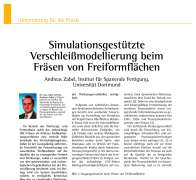
Simulation-Based Tool Wear Modelling for the Milling of Sculptured Surfaces

Simulation-Based Tool Wear Modelling for the Milling of Sculptured Surfaces

Andreas Zabel
For the area of die-and-mould-making industry multi-axis HSC-milling plays an important role for the applied process chains. Tool wear, which cannot be avoided, influences the quality of the produced dies and moulds and it is determined mainly by the geometrical and technological properties of a concrete process. The following paper describes a system, which allows to predict the tool wear state during a future process on the machine tool. This is achieved by incorporating a process simulation system combined with technological wear models.
Industrie Management | Volume 20 | 2004 | Edition 1 | Pages 60-63
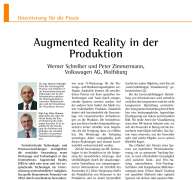
Augmented Reality in Production

Augmented Reality in Production

Werner Schreiber, Peter Zimmermann
Modern factories are heavily influenced by product technologies, processes, IT tools and by the behaviour of the markets. Therefore these factories have to change accordingly using new tools and technologies. As such, Augmented Reality (AR) is a new and promising technology to support different tasks within the factories. The large economic potential of the AR technology is verified through different applications and justifies the efforts for further hardware and software development.
Industrie Management | Volume 19 | 2003 | Edition 6 | Pages 32-34
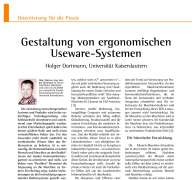
Development of Ergonomic Useware Systems

Development of Ergonomic Useware Systems

Holger Oortmann
The development of ergonomic sys-tems and products will become a key role in the future of technical engineering and although a marketing objective. The relevance of “ease of learning” and “ease of use” will grow and will have an influence on the economic factor. It is necessary to orientate the communication between man and machine to the needs of both communicationpartners, and not to force the Operator to adapt to the machine. The article shows the requirements of the development of ergonomic user-interfaces and how a service provider can properly support a manufacturer.
Industrie Management | Volume 19 | 2003 | Edition 5 | Pages 70-73
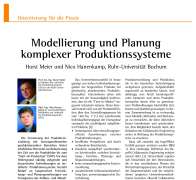
Modelling and Planning of Complex Production Systems

Modelling and Planning of Complex Production Systems

Horst Meier, Nico Hanenkamp
production management is crucial to reduce time-to-market. Regarding ever-changing dynamic requirements that production systems have to meet there is a need of cooperative development and planning models, methods and tools. By that transparency in process organizations can be achieved as well as the availability of resources and competencies can be verified. The article de-scribes a resource-oriented collaborative engineering model to allow short and long term (re-)planning of production systems.
Industrie Management | Volume 19 | 2003 | Edition 5 | Pages 50-53
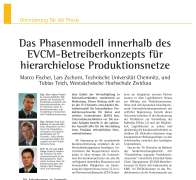
Phase-Model within the EVCM Operating Concept for Nonhierarchical Production Networks

Phase-Model within the EVCM Operating Concept for Nonhierarchical Production Networks

Marco Fischer, Lars Zschorn, Tobias Teich
The requirements to enterprises in-creased and became more complex over the last years. This is caused by changing market demands - chief the change to customer orientation - and the resulting necessary changes. For these reasons the research on the area of value adding in networks grew in their significance. This paper presents an operating model for non-hierarchical production networks between small and medium enterprises and -units developed by the Chemnitz University of Technology. The selection of the necessary network participants is the central task of this model.
Industrie Management | Volume 19 | 2003 | Edition 4 | Pages 60-63
Scheduling and Resource Optimising MES for the Semiconductor and MEMS Industry

Scheduling and Resource Optimising MES for the Semiconductor and MEMS Industry

Ricco Walter, Jürgen Sieberg
While the number of custom specific products is increasing the order size often diminishes. This problem leads to difficulties in managing demand changes, promising accurate dates and ensuring optimal equipment utilisation. A real-time information gap exists in the heart of most manufacturing enterprises, since there is a lack of visibility & predictability. Based on modern MES with maximum equipment integration, the use of automatic process control and optimization enables SME to be more competitive, efficient and customer-friendly.
Industrie Management | Volume 19 | 2003 | Edition 2 | Pages 52-55
1 … 22 23