Automation

Autonomous Systems in Production

Autonomous Systems in Production

Toward a planning and development methodology
Roman Dumitrescu ORCID Icon, Thorsten Westermann, Tommy Falkowski
The performance of assistance systems, especially in the automotive sector, has become an unique selling point. The trend toward Autonomous driving represents the expected impact of innovation resulting from the exploitation of the latest technologies. Besides autonomous driving, other areas of application for autonomous systems could trigger social change - the prime example being industrial production. The following article presents a planning approach tailored to the complex engineering task of planning and designing autonomous systems for industrial applications.
Industrie 4.0 Management | Volume 34 | 2018 | Edition 6 | Pages 17-20 | DOI 10.30844/I40M_18-6_17-20
Using Mobile IIoT-Technologies in Hybrid Learning Factories

Using Mobile IIoT-Technologies in Hybrid Learning Factories

a Scenario-Based Development of Acting Capability in the Application Center Industry 4.0
Malte Teichmann, André Ullrich ORCID Icon, Benedict Bender, Norbert Gronau ORCID Icon
Recently, implementation procedures of automatic production, digitalization and Industrial Internet of Things technologies (IIoT) play an increasing role in industrial manufacturing processes. Subsequently, the competence requirements for employees change. These changes cannot be anticipated by traditional learning approaches. The following contribution faces this challenge and will show a new integrated learning factory approach which combines the application of new technologies with a flexible production environment. Thus establishing production surroundings that are familiar to the learner. The contribution demonstrates this approach using a quality control process in the context of logistics.
Industrie 4.0 Management | Volume 34 | 2018 | Edition 3 | Pages 21-24 | DOI 10.30844/I40M_18-3_S21-24
Securing IT-Risks in a Production Environment

Securing IT-Risks in a Production Environment

an Integrated Approach for Information and Operational Technology
Christof Thim
The IT-risks which factory infrastructures are exposed to, require a common view of IT-security and operational technology (OT) protection. In this context, the measures from office IT can only be transferred to the production area and production control to a limited extent. The requirements and protection goals for the equipment used and the networking between these components are too different. An integrated approach and continuous management of IT security helps to identify and implement targeted measures in a concerted manner.
Industrie 4.0 Management | Volume 34 | 2018 | Edition 1 | Pages 11-14
Modular and Adaptable Robot Systems

Modular and Adaptable Robot Systems

Model Based Software Development Based on AutomationML and Ontological Semantics
Yingbing Hua, Michael Mende, Björn Hein
Software development of industrial robots requires interdisciplinary knowledge and technical experience. Due to the heterogeneity of the manufacturer-dependent programming languages and tools, robot programming remains highly complex, although robots themselves are flexible and can be used for a wide range of applications. To support different roles during the development, including component provider, application developer, system integrator and end user, a model based approach was developed in the research project ReApp. The data exchange format AutomationML was used for the modelling of robot components and systems. Based on domain ontologies, the AutomationML models were processed semantically and converted to a machine-interpretable information model, from which source code was generated.
Industrie 4.0 Management | Volume 33 | 2017 | Edition 6 | Pages 33-37
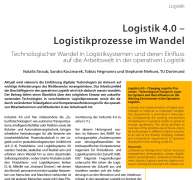
Logistics 4.0 – Changing Logistics Processes – Technological Changes in Logistics Systems and their Influence on the Working Environment in the Operative Logistics

Logistics 4.0 - Changing Logistics Processes - Technological Changes in Logistics Systems and their Influence on the Working Environment in the Operative Logistics

Natalia Straub, Sandra Kaczmarek, Tobias Hegmanns, Stephanie Niehues
Currently the implementation of digital technologies in response to important competition requirements is promoted in many places. Consequently, the working environment of employees in operative logistics is going to change significantly. This article provides an overview of the possible uses of future-oriented technologies in different logistics processes as well as the thereby changing subtasks and competence requirements of operative employees in the working world 4.0.
Industrie 4.0 Management | Volume 33 | 2017 | Edition 2 | Pages 47-51
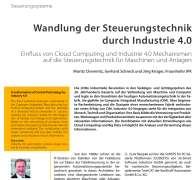
Transformation of Control Technology by Industry 4.0

Transformation of Control Technology by Industry 4.0

Einfluss von Cloud Computing und Industrie 4.0 Mechanismen auf die Steuerungstechnik für Maschinen und Anlagen
Moritz Chemnitz, Gerhard Schreck, Jörg Krüger
The third industrial revolution culminated in the Computer Integrated Manufacturing but limited computing power and the dystopia of a deserted factory prevented its success. Industry 4.0, however, stands for the integration of people, technology and organization. Based on the networking of products, tools and means of production become all relevant information available. The combination with cloud computing and big data enables the analysis and utilization of such information.
Industrie Management | Volume 31 | 2015 | Edition 6 | Pages 16-19
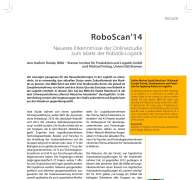
Applying Robots to Logistics

Applying Robots to Logistics

Online market study Roboscan’14 reveals current trends, developments and potentials
Ann-Kathrin Rohde, Michael Freitag ORCID Icon
To develop solutions tailored to the challenges of logistics, it is necessary to realize the current state of the market as well as market trends. For this reason, BIBA has been conducting the RoboScan study series since 2007. It determines the status quo of applying robotics to logistics and instantly works out one specific area in greater detail. RoboScan’14 is now concerned with “man-machine interaction”. Some results of the study are presented in this article.
Industrie Management | Volume 31 | 2015 | Edition 1 | Pages 57-60
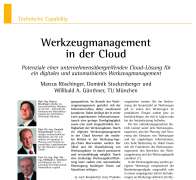
Cloud-based Tool Management

Cloud-based Tool Management

Potenziale einer unternehmensübergreifenden Cloud-Lösung für ein digitales und automatisiertes Werkzeugmanagement
Marcus Röschinger, Dominik Stockenberger, Willibald A. Günthner
The networking between companies in a supply chain becomes tighter. This applies for manufacturing plants and the supply with manufacturing equipment as well. Hence, the complexity of the flow of information, in particular for tool management, increases. Currently the exchange of information is mostly paper-based and tool data is not available continuously along the supply chain. By using a digital and cloud-based tool management system, breaks in the flow of information along the supply chain for machining tools can be overcome. Herewith tool data can be called and updated ongoing and location-independent. Furthermore, after clearly identifying a tool, required tool data can automatically be transferred into the control system of the machine.
Industrie Management | Volume 30 | 2014 | Edition 3 | Pages 52-56
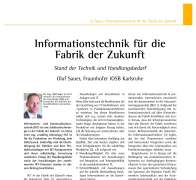
Information Technology for the Factory of the Future

Information Technology for the Factory of the Future

Stand der Technik und Handlungsbedarf
Olaf Sauer
Information technology is one of the key enabling technologies of future manufacturing. In the two basic business processes manufacturing is located at the intersection point. However, for manufacturing and its value adding purpose, information technology has to be considered as a tool. In this paper the author describes an approach to the components of a new information model inside the future factory.
Industrie Management | Volume 29 | 2013 | Edition 1 | Pages 11-14
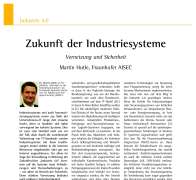
The Future of Industry – Interconnectedness and Security

The Future of Industry - Interconnectedness and Security

Martin Hutle
Industrial and automation systems from the corporate IT perspective for a long time have been deserted islands because, these were mainly isolated systems. While this is largely still the case, through the increasing use of IT standards industry systems with its stand-alone solutions are more and more involved in the internal office networks, or even connected to the Internet. Especially the transition to the so called “Industry 4.0” vision bears new requirements and challenges for industry systems - particularly in the area of security. For more interconnectedness also means greater security needs. Industry 4.0 (smart factory, factory of the future) means that machinery and equipment gain the ability to adapt their behavior through self-tuning and reconfiguration to changing conditions. The goal is highly optimized processes that produce high quality products tailored to individual customer needs. In such manufacturing processes of the future, for example, a large number of ...
Industrie Management | Volume 29 | 2013 | Edition 1 | Pages 62-64
1 5 6 7