Adaptability

Information Technology for the Factory of the Future

Information Technology for the Factory of the Future

Stand der Technik und Handlungsbedarf
Olaf Sauer
Information technology is one of the key enabling technologies of future manufacturing. In the two basic business processes manufacturing is located at the intersection point. However, for manufacturing and its value adding purpose, information technology has to be considered as a tool. In this paper the author describes an approach to the components of a new information model inside the future factory.
Industrie Management | Volume 29 | 2013 | Edition 1 | Pages 11-14
Self-organization in Manufacturing

Self-organization in Manufacturing

Eckart Uhlmann ORCID Icon, Eckhard Hohwieler, Manfred Kraft
In the future, objects with embedded intelligence will be able to coordinate and steer the production sequence in a self-organizing production environment. Instead of existing central planning and control the new product-controlled manufacturing uses a multi-agent system with the possibilities of auctions and negotiation. The project “Self-organizing Production  SOPRO” implements autonomous micro systems and software agents to provide embedded intelligence on objects in production field.
Industrie Management | Volume 29 | 2013 | Edition 1 | Pages 57-61
Software Platforms for the Upcoming Industry 4.0

Software Platforms for the Upcoming Industry 4.0

Requirements and Challenges
Arne Schuldt, Jan Gehrke
The fourth industrial revolution promises a further automation of process control by cyber-physical systems. The individual products gain the ability for controlling their production and logistics themselves. By coordinating themselves they can jointly achieve business objectives. This logical decomposition reduces the complexity of cross-company process control significantly. Thus, even exceptions on short notice can be dealt with in real-time. In operation, the required artificial intelligence will usually not be implemented on the active objects. Instead, adequate software platforms for the so-called Industry 4.0 are required. This article investigates the requirements for such platforms and describes how they can be implemented.
Industrie Management | Volume 29 | 2013 | Edition 1 | Pages 29-32
Development of a Cyber-Physical Logistics System

Development of a Cyber-Physical Logistics System

Marius Veigt, Dennis Lappe, Karl Hribernik, Bernd Scholz-Reiter ORCID Icon
Along with increasing complexity and dynamics the importance of cyber-physical systems in production and logistics also increases. Hence, the BIBA - Bremer Institut für Produktion und Logistik GmbH at the University of Bremen considers the application of cyber-physical systems in logistics. This paper presents the approach for the development of a cyber-physical logistics system. To start we describe the fundamental terms cyber-physical system and cyber-physical production system. Following these definitions we explain the term cyber-physical logistics system. Afterwards we describe the course of action; in particular necessary steps within the development of a cyber-physical logistics system are explained. In detail we present the procedure consisting of requirements analysis, conception and simulation-based evaluation.
Industrie Management | Volume 29 | 2013 | Edition 1 | Pages 15-18
Change-specific Taxonomy in the Communication Process

Change-specific Taxonomy in the Communication Process

Tobias Mersmann, Tim Klemke, Peter Nyhuis ORCID Icon
Nowadays, companies deal with a hugh amount of challenges which are the reason to change the production system more and more often. To be able to do this a production system needs a sufficient degree of changeability. Caused on a change, a communication process between the user and supplier will be initialized. In an optimal communication process there will be no losses due to communication lacks. This article deals with a change-specific taxonomy which adds some items to a communication process to decrease losses during communication.
Industrie Management | Volume 28 | 2012 | Edition 6 | Pages 41-44
Procedure for the Identification of Change Drivers

Procedure for the Identification of Change Drivers

Potenzielle Wandlungstreiber am Beispiel eines Unternehmens der Bekleidungsindustrie
Bernd Scholz-Reiter ORCID Icon, Susanne Schukraft, Mehmet-Emin Özsahin, Luling Lo
Today, companies operating in the textile industry are integrated within value chain networks. Due to the global distribution and the cooperation with external partners, these companies underlie several influencing factors. In the case that the reaction to these influencing factors is not possible with the use of the existing flexibility, a basic adaption of the company structure is required. The potential to undergo these necessary changes is also named as changeability. To create changeable network structures it is firstly necessary to know about potential influencing factors and their impacts onto the company. The paper on hand therefore describes a procedure for the identification and evaluation of potential change drivers and introduces identified, potential change drivers using the example of a company that is active in the field of the apparel industry.
Industrie Management | Volume 28 | 2012 | Edition 6 | Pages 19-22
Approximation and Robustness of Dynamic Production networks

Approximation and Robustness of Dynamic Production networks

Bernd Scholz-Reiter ORCID Icon, Michael Kosmykov, Thomas Makuschewitz, Fabian Wirth, Michael Schönlein, Sergey Dashkovskiy
Global production networks connect partners with outstanding expertise, and make use of regional cost advantages for purchasing and production operations. This development leads to an increasing structural complexity of the networks, which is accompanied by a closer collaboration of dynamic logistics processes. Hence, the resulting dynamics of a large-scale production network is characterized by the dynamics of the individual logistics processes, the dynamics of the network structure and dynamics of the external processes that affect the production network. However, in practice a lack of adequate procedures for the analysis and design of these networks can be observed. The presented article addresses this need by introducing tools and methods for the approximation of large-scale production networks, analysis of their dynamics and the robust design of the network resources.
Industrie Management | Volume 28 | 2012 | Edition 4 | Pages 51-56
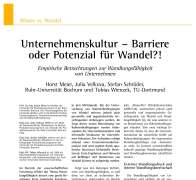
Corporate Culture—Barrier or Potential for Transformability?

Corporate Culture—Barrier or Potential for Transformability?

An empirical view on the mutability of enterprises
Horst Meier, Julia Velkova, Stefan Schröder, Tobias Wienzek
Challenges of transformability have recently experienced great consideration within the field of scientific research. First empirical research has shown that the German term for transformability „Wandlungsfähigkeit” in many cases is used as a synonym for the term “flexibility”. Today’s scientific considerations on this topic mostly focus the technical aspects. However, further aspects such as human resources and organizational factors have to be implied in the present research on conditions that enable change processes. In the course of considerations about conditions the aspects of corporate culture and informal structures attain more attention. The evaluation is conducted as a business analysis and is complimented with qualitative interviews (informal structures). Through this first results and indicators for empowerers and constraints for change are identified.
Industrie Management | Volume 28 | 2012 | Edition 3 | Pages 56-60
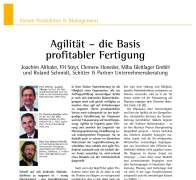
Agility – The Key to Profitable Manufacturing

Agility - The Key to Profitable Manufacturing

Joachim Althaler, Clemens Honeder, Roland Schmidt
Reacting quickly to rapidly changing market needs is, unsurprisingly, a basic requirement for profitable manufacturing. Why turn what is common sense into a science? Agility is the new buzzword. But is it merely „old wine in new bottles“ like so many things in the field of logistics or is it an interesting or even the decisive approach towards ensuring profitable production? Agility in its final perception is an organizations’ ability to swiftly and specifically utilize all available forces in order to fulfill an order. That is to meet requirements with agility. Agility and the excessive focus on detail and planning are oxymorons which are frequently found in both individuals and scientific literature. Agility is the manifestation of good leadership and is pretty much the opposite of planning optimization, high detailing and comprehensive forecasts which is why it is so difficult to describe it within the classic mainstream of logistics research. What really makes production ...
Industrie Management | Volume 28 | 2012 | Edition 2 | Pages 34-37
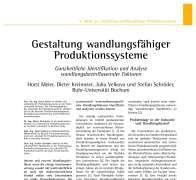
Designing Changeable Production Systems

Designing Changeable Production Systems

Holistic Identification and Analysis of Change Factors
Horst Meier, Dieter Kreimeier, Julia Velkova, Stefan Schröder
Internal and external influences of change plus the steady examination with continuous as well as discontinuous change constitute a great challenge for industrial companies to be mastered. The improvement of production systems towards variable and unpredictable requirements caused by a variety of company-specific impacts will be increasingly focused. In this article a concept will be introduced which helps to identify and analyze company-specific change factors systematically.
Industrie Management | Volume 28 | 2012 | Edition 2 | Pages 55-58
1 11 12 13 21