Branche: Small and Medium-Sized Enterprises

Modeling Picking Processes

Modeling Picking Processes

A basis for executable processes in small and medium-sized companies
Daniel Hilpoltsteiner, Stephanie Bäuml, Christian Seel, Sebastian Meißner
Process modeling represents a challenge for small and medium-sized enterprises. In most cases, the added value is not recognized and is therefore rarely used. This article shows the potential of process modeling in order picking processes. The focus is on the documentation of the processes as well as their execution. Deficits in companies are pointed out and clarified, how the process modeling can solve these. Above all in the management of different process variants adaptive process modeling can show advantages. The resulting adaptive process models form the basis for making processes executable.
Industrie 4.0 Management | Volume 35 | 2019 | Edition 3 | Pages 39-42
Status Quo on Digitalization

Status Quo on Digitalization

Survey on influencing factors and obstacles in practice
Wilhelm Bauer, Jessica Klapper, Florian Strieg, Ozan Yesilyurt
The topic Internet of Things (IoT) is omnipresent and has already found its way into many living rooms under the term Smart Home [1]. Be it lamps, heaters or the television set - everything is interconnected and easy to control from anywhere. The corresponding counterpart in manufacturing is Industry 4.0, sometimes named the Industrial Internet of Things. Companies and research institutions are working intensively on the possibilities offered by the so-called fourth industrial revolution. The forward-looking positioning of the German economy in international competition requires that the development and distribution of concepts and solutions in the context of Industry 4.0 be actively shaped by the industry itself and thereby to play a pioneering role in innovation [2]. Due to the rapid pace of development, it is essential for German companies to identify, develop and adapt new methods and technologies at an early stage and to transform them into marketable solutions.
Industrie 4.0 Management | Volume 34 | 2018 | Edition 3 | Pages 33-37
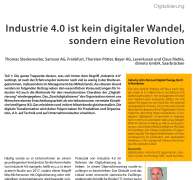
Industry 4.0 Is Not Just Digital Change, But It Is Revolution

Industry 4.0 Is Not Just Digital Change, But It Is Revolution

Thomas Steckenreiter, Thorsten Pötter, Claus Riehle
The story behind “Industry 4.0” has a much bigger scope as it is talked about, according to the authors particularly in the management of small and medium-sized enterprises (SMEs). For this reason the paper on one hand lists the essential prerequisites for Industry 4.0, on the other hand it describes the features of the “Digitalisation” which make the upcoming move revolutionary. A consequent digitalisation of processes in organisations in terms of automation takes away people’s effort for decision-making as well as semi-autonomous, networked artificial intelligence (AI) does. This facilitates and irritates participants of organisation equally. The digital transformation will have consequences for production and organisation therefore, i.e. this change will influence technology and corporate culture.
Industrie 4.0 Management | Volume 34 | 2018 | Edition 2 | Pages 43-47 | DOI 10.30844/I40M18-2_43-47
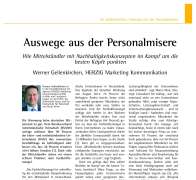
Ways Out of the Human Resources Dilemma

Ways Out of the Human Resources Dilemma

SMEs Use Sustainable Strategies for Recruiting Highly Talented Employees
Werner Geilenkirchen
Small and medium enterprises (SME) in Germany are in a good mood. More than 90 % of the SMEs are in an appropriate economic situation reports the Bundesverband mittelständische Wirtschaft (BVMW). About 38 % of these companies expect a higher turnover in 2014 [1]. But there is one real problem the companies are faced with: the lack of skilled labour.
Industrie Management | Volume 30 | 2014 | Edition 3 | Pages 35-38
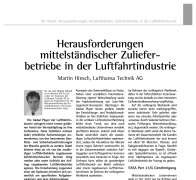
Challenges for Midsized Subcontractors in the Aviation Industry

Challenges for Midsized Subcontractors in the Aviation Industry

Martin Hinsch
The global players of the aviation industry are shifting a growing shares of their value added to their subcontracters. New subcontractors must do considerable expenses to get accustomed to the special quality and security requirements of the aviation industry. This can be done as an EASA approved production organisation or as an extended workbench. The decision orientates itself at the specific activities required.
Industrie Management | Volume 25 | 2009 | Edition 4 | Pages 57-60
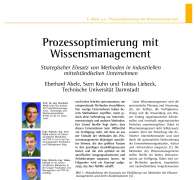
Process Optimization Using Knowledge Management

Process Optimization Using Knowledge Management

Strategic Employment of Methods for Medium-Sized Enterprises
Eberhard Abele, Sven Kuhn, Tobias Liebeck
Although medium sized enterprises ascribe high importance to knowledge management and its impact on company’s success, they have rarely undertaken steps to introduce respective methods. Only a small share of companies applies selected methods, usually rather sporadic and without connection to corporate strategy or other management techniques. The reason lies in the lack of a tool for choosing the most suitable methods. Out of the multitude of instruments available for knowledge management, it is difficult to decide about a method mix fitting best to respective business processes, initial situation and specific demands of the company. This paper presents a concept to manage these shortcomings.
Industrie Management | Volume 21 | 2005 | Edition 1 | Pages 13-16
1 2 3