Autor: Bernd Scholz-Reiter

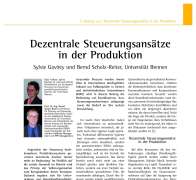
Decentralised Control Systems in Production

Decentralised Control Systems in Production

Sylvie Gavirey, Bernd Scholz-Reiter ORCID Icon
Incentives for self control in enterprises can only be successful when integrated by coordination. For this, harmonious concepts and “new” mechanisms of cooperation have to be developed. That topic is discussed in this article.
Industrie Management | Volume 22 | 2006 | Edition 1 | Pages 11-14
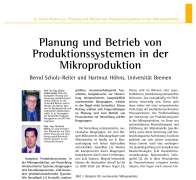
Planning and Operations of Production Systems in Micro Production

Planning and Operations of Production Systems in Micro Production

Bernd Scholz-Reiter ORCID Icon, Hartmut Höhns
Complex production systems in micro production, concerning the manufacturing of miniaturised systems, assemblies and components, are very special. For example Hesselbach [1] stated, that micro production technology (sometimes to be found as (ultra) precision engineering) spans basically all, partly highly specialised production techniques. Kiesewetter [2] points out, that micro production is not just a kind of “shrinked machine building or mechanical engineering”. Mostly the whole manufacturing process chain or at least larger, interrelated section or subsystems and -processes, for example mainly for the manufacturing of miniaturised mechanical modules or assemblies respectively, are basically not examined. The paper discusses and presents topics concerning the planning and operations of micro production manufacturing process chains, against the background of the manufacturing of miniaturised mechanical modules and components.
Industrie Management | Volume 21 | 2005 | Edition 6 | Pages 9-12
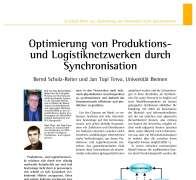
Optimisation of Production and Logistics Networks Using Synchronisation

Optimisation of Production and Logistics Networks Using Synchronisation

Bernd Scholz-Reiter ORCID Icon, Jan Topi Tervo
Production and logistics networks are distinguished by a permanently growing complexity and are nowadays more than ever forced to adapt fast to dynamically changing markets. These and other factors make an enterprise-spreading production planning and control more difficult. A new, promising approach is to take advantage of synchronisation phenomena in such dynamical systems. The production of individual enterprises in the network has to be synchronised on the basis of technical and physical aspects in order to render the whole network more efficient and more productive.
Industrie Management | Volume 21 | 2005 | Edition 5 | Pages 13-16
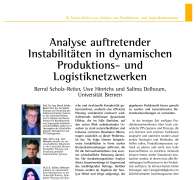
Instabilities in Dynamic Production and Logistic Networks

Instabilities in Dynamic Production and Logistic Networks

Simulation-based analysis
Bernd Scholz-Reiter ORCID Icon, Uwe Hinrichs, Salima Delhoum
Production and logistics networks are characterized by an increasing dynamic and structural complexity, which makes an efficient planning more difficult. Observed non-linear dynamic effects, which in case of similar causes can lead to different results, contribute additionally to this problem. As a consequence strong inventory fluctuations can appear among others, which represent a strong economically load for network participants. The simulation-supported analysis of these connections is the main focus of this article. Moreover as a result of the analysis ways and means are pointed out, which will help to react more adequately to the given problems.
Industrie Management | Volume 21 | 2005 | Edition 5 | Pages 25-28
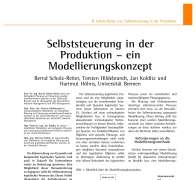
Autonomous Control of Production Processes

Autonomous Control of Production Processes

A Modelling Concept
Bernd Scholz-Reiter ORCID Icon, Torsten Hildebrandt, Jan Kolditz, Hartmut Höhns
Control of dynamics and complexity of logistic systems will continue to gain in importance in the future. One possibility to cope with this challenge is the concept of autonomous logistic processes. This article addresses the issue of requirements to a method for modelling autonomous logistic processes as well as the development of the method. It gives an overview of the created modelling and view concepts.
Industrie Management | Volume 21 | 2005 | Edition 4 | Pages 33-36
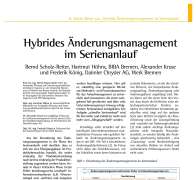
Hybrid Product Change Management in the Ramp-up Phase of the Automotive Industry

Hybrid Product Change Management in the Ramp-up Phase of the Automotive Industry

Bernd Scholz-Reiter ORCID Icon, Hartmut Höhns, Alexander Kruse, Frederik König
The fact that the ramp-up phase is a highly critical and economically important stadium within the product lifecycle for both suppliers and OEMs implies that an efficient product change management is applied to meet the goals of cost, quality, and time. This article introduces a combined management concept called hybrid product change management. By recombining existing management solutions, such as the standard processes matching certain product change types and the product change processes based on process elements, enterprise networks are enabled to coordinate all product change projects. This aspect is described further by giving an idea of how this hybrid product change management can be supported in terms of information and communication technology and knowledge management.
Industrie Management | Volume 20 | 2004 | Edition 4 | Pages 21-24
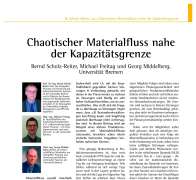
Chaotic Material Flow Close to the Capacity Limit

Chaotic Material Flow Close to the Capacity Limit

Bernd Scholz-Reiter ORCID Icon, Michael Freitag ORCID Icon, Georg Middelberg
Very often material flows within or between companies seem to behave in an irregular manner, which can cause inventory levels to become unpredictable and poorly manageable. This behaviour can especially be observed at high utilisation ratios of means of production or logistics. Commonly, it is assumed to be caused by small disturbances, which can never be completely excluded in practice. For that reason often large efforts are made to minimise disturbances, but the question arises, if it always has to be disturbances that make predictions of e.g. inventory levels difficult for the near future and practically impossible in the long run. Using a small, but re-entrant manufacturing system, this article presents in-vestigations on how even relatively simple networks can develop irregular dynamics.
Industrie Management | Volume 20 | 2004 | Edition 3 | Pages 25-28
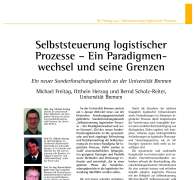
Autonomous Cooperating Logistic Processes: A Paradigm Shift and its Limitations

Autonomous Cooperating Logistic Processes: A Paradigm Shift and its Limitations

Ein Paradigmenwechsel und seine Grenzen Ein neuer Sonderforschungsbereich an der Universität Bremen
Michael Freitag ORCID Icon, Otthein Herzog, Bernd Scholz-Reiter ORCID Icon
The new Collaborative Research Centre “Autonomous Cooperating Logistic Processes: A Paradigm Shift and its Limitations”, funded by the German Research Foundation, started on January 1st, 2004 at the University of Bremen. The objective of the new Collaborative Research Centre is systematic and broad investigation and application of “autonomy” as a new paradigm for logistic processes. For this, appropriate concepts and models as well as methods and tools are being researched and developed in twelve scientific sub-projects. In a later phase of the Collaborative Research Centre, the results of this research will be transferred into real logistic applications.
Industrie Management | Volume 20 | 2004 | Edition 1 | Pages 23-27
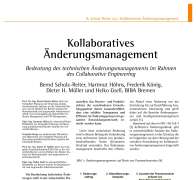
Collaborative Product Change Management

Collaborative Product Change Management

The management of technical product changes within the scope of collaborative engineering
Bernd Scholz-Reiter ORCID Icon, Hartmut Höhns, Frederik König, Dieter H. Müller, Heiko Gsell
The handling of complex technical changes still is a highly critical process within the industrial practice. Hence, it very often comes to critical scenarios concerning key operating figures like time, product quality or expenses, which troubles the coordinated start of operations or the running of serial production. The aim of the article is to introduce a bundle of methods, which helps to integrate the process- and product views of the different engineering partners, in order to increase transparency and efficiency for the collaborative processing of product changes within engineering networks.
Industrie Management | Volume 19 | 2003 | Edition 5 | Pages 45-49
Application-oriented E-Learning by Using Virtual Classrooms

Application-oriented E-Learning by Using Virtual Classrooms

Wolfgang Echelmeyer, Bernd Scholz-Reiter ORCID Icon, Christian Gorldt, David Henkensiefken, Dirk Nagels
Professional on the job training, the continuous lifelong learning in the companies, requires as prerequisite, an ever increasing orientation toward more applications. Activities and situations pertaining to the organisation and to work processes are gaining in importance. The research project “PALME” offers a new approach to enterprise specific training. PALME follows up on an enterprise integrated education concept consisting of studying in a decentra- lized system and using computer support.
Industrie Management | Volume 19 | 2003 | Edition 3 | Pages 45-48
1 7 8 9